Why Researchers Are Switching to Novix for Scientific Workflows
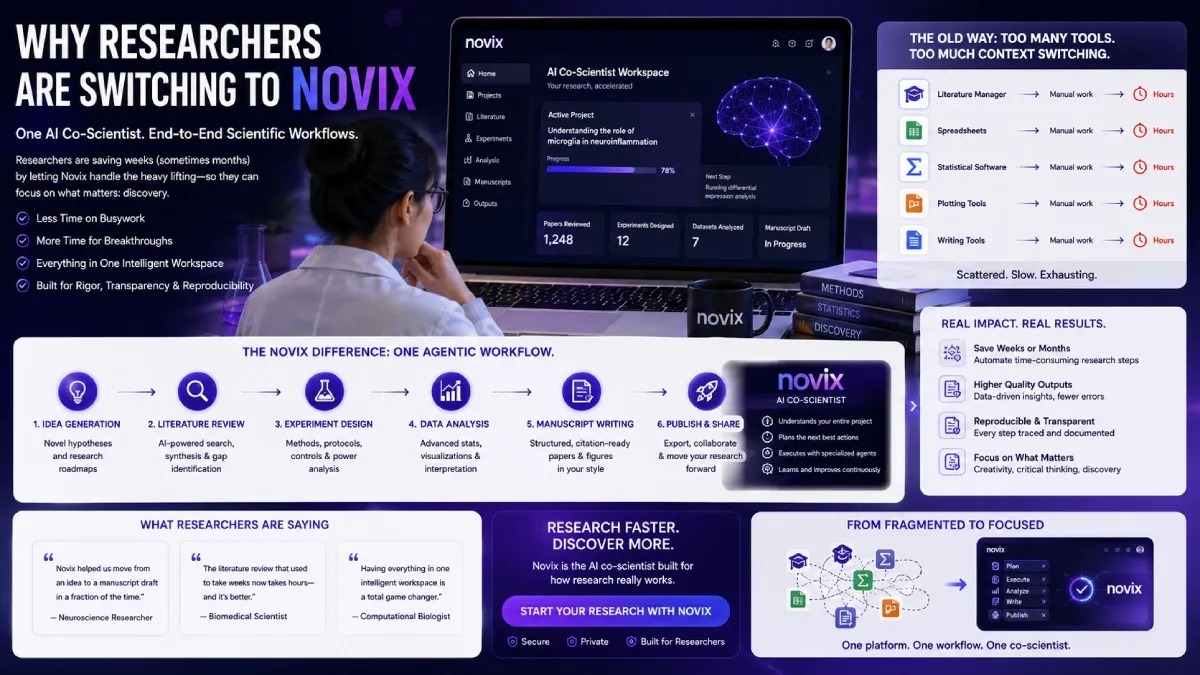
Most researchers don't quit their existing tools because those tools are broken. They switch because the workflow around them is broken — a literature manager here, a stats package there, a writing tool somewhere else, and a human stitching it all together late into the night.
That's the gap Novix is built to close. Instead of one more point tool, Novix is an AI agentic co-scientist that runs the entire research lifecycle in one place — idea generation, literature review, experiment design, analysis, and manuscript writing. This post breaks down why researchers are making the switch, what it changes day to day, and how to evaluate it for yourself.
The real problem: your workflow is fragmented, not your tools
A typical research project today is spread across a dozen disconnected steps. You search and triage papers in one app, take notes in another, design experiments in your head or a doc, code analysis in a notebook, build figures in yet another tool, and finally write everything up by hand.
Each handoff costs time and context. The result is a workflow where the thinking — the part only a scientist can do — gets squeezed between hours of manual coordination. Researchers switching to Novix are usually trying to solve three recurring frustrations:
- Literature overload. Keeping up with the volume of new papers is effectively impossible by hand.
- Slow iteration. Going from "interesting idea" to "tested hypothesis" takes weeks, not hours.
- The writing bottleneck. Even finished research stalls for ages at the manuscript stage.
If those sound familiar, the rest of this post is for you.
Why researchers are switching to Novix
1. One platform replaces a stack of disconnected tools
The biggest reason for switching is consolidation. Novix orchestrates the full research lifecycle — from initial concept through algorithm design, validation, and manuscript creation — instead of solving one isolated step. That means fewer handoffs, less lost context, and a single workflow instead of a patchwork.
2. It's an agent, not just an assistant
Most AI tools wait for the next prompt. Novix runs on autonomous multi-agent orchestration: you set the research goal and its agents manage the process, from concept development to experimental validation, with minimal manual intervention. Researchers switch because they want to delegate a workflow, not babysit a chatbot.
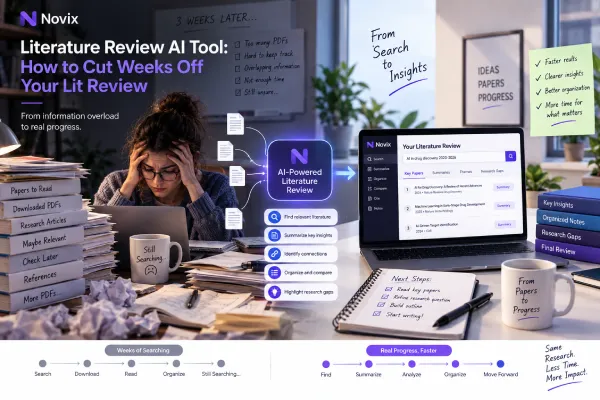
3. Weeks of literature review collapse into a starting point
Novix scans, synthesizes, and summarizes large bodies of literature to surface knowledge gaps and emerging trends, then proposes novel, data-driven hypotheses. Work that used to consume the first month of a project becomes a structured launchpad.
4. Experiment design and implementation are built in
Novix doesn't stop at ideas. It designs comprehensive experimental protocols — with statistical methods and validation frameworks — and can build, train, and tune machine learning models for scientific applications. The gap between hypothesis and tested result narrows dramatically.
5. The manuscript writes its first draft itself
The writing bottleneck is often where projects die. Novix integrates your research ideas, methods, algorithm frameworks, and validation results into a polished, full-length, publication-ready draft — so you're editing instead of starting from a blank page.
6. You can start with almost nothing
A common adoption blocker for AI tools is setup. Novix is engineered for easy kickoff: it supports multiple LLM providers, offers out-of-the-box functionality, and can begin a project from as little as a list of reference papers — no deep domain configuration required.
What the switch actually looks like
Switching to Novix doesn't mean rebuilding your process from scratch. In practice, it tends to show up as three quick wins:
- Faster hypotheses. Drop in a domain or a few papers and get novel, data-driven hypotheses back — saving the weeks normally spent on manual exploration.
- Ready-to-run experiments. Hand Novix an idea and objectives, and get detailed protocols, statistical methods, and validation frameworks ready for execution.
- Drafts in a fraction of the time. Once the research is done, Novix assembles your findings, methods, and results into a structured manuscript, cutting writing time significantly.
Each of these is a place where a research project usually stalls. Removing even one of them changes your throughput; removing all three changes your output.
Novix vs. the status quo
| Piecemeal tool stack | Novix AI co-scientist | |
|---|---|---|
| Workflow | Fragmented across many apps | Unified, end to end |
| Mode | Manual operation + prompt-and-respond | Autonomous multi-agent orchestration |
| Literature review | Hours of manual reading | Automated synthesis and gap-finding |
| Experiment design | Built by hand | Generated protocols + model implementation |
| Manuscript | Written from scratch | Auto-drafted, publication-ready |
| Getting started | Heavy setup per tool | Start from a list of papers |
| Cost to try | Multiple subscriptions | Free during public beta |
"But what about…" — honest answers to the real objections
Will it replace my judgment? No — and that's the point. Novix automates the time-consuming mechanics of research, but the scientific judgment, interpretation, and accountability stay with you. Treat its outputs as a fast, rigorous first pass to review and refine, not as final truth. Always validate results before relying on them.
Can I trust the quality of its output? Novix is built on a comprehensive, open-source benchmark suite that uses human expert-written papers as ground truth and evaluates outputs across dimensions like novelty, experimental comprehensiveness, and theoretical foundation. That transparency is a deliberate contrast to opaque "trust us" tools — but, as with any research, peer review and your own verification remain essential.
Is there a steep learning curve? Novix is designed for accessibility, with out-of-the-box functionality and the ability to start from just a few reference papers. Most researchers can run a first project without specialized onboarding.
What does it cost to find out? Novix is in public beta with a freemium model, so you can evaluate it on real work before spending anything.
Frequently Asked Questions
Do I have to abandon my current tools to use Novix?
No. Many researchers start by running one project through Novix alongside their existing setup, then expand as it proves out.
Is Novix free to try?
Yes. Novix is in public beta with a freemium model, so you can test it on real research at no cost before upgrading.
Who is Novix best for?
Academic researchers, PhD students, research labs, and data scientists who want to automate the repetitive parts of the workflow and reclaim time for high-judgment thinking.
How is Novix different from a regular AI research assistant?
Assistants handle isolated tasks and wait for prompts. Novix autonomously orchestrates the full research lifecycle — idea to manuscript — as a multi-agent system.
Will using Novix compromise scientific rigor?
Used as intended — as an accelerator whose outputs you review and validate — Novix is built to support rigor, with transparent, benchmark-based evaluation. Final responsibility for accuracy stays with the researcher.
Researchers aren't switching to Novix for novelty. They're switching because a fragmented, manual workflow has a real cost — in weeks lost, in projects stalled at the writing stage, in time taken away from actual science. Novix consolidates that workflow into a single autonomous co-scientist, so the machine handles the grind and you keep the thinking.
The lowest-risk way to decide is to try it on one project. Start free at novix.science and measure the difference yourself.