Research Paper AI Tools That Spot Methodological Flaws: Study Design, Sample Size and Statistics
A paper can have a strong idea, clear writing, and a well-organized literature review, and still be rejected because of its methods. Reviewers are trained to look past the narrative and ask a harder question: can this study actually support its conclusions? Is the design appropriate, the sample large enough, and the statistics suited to the data?
Methodological flaws are also the hardest problems to see in your own work. You designed the study, so its logic feels obvious to you. You know why a control was skipped, why a test was chosen, and why a subgroup was small, so you read your methods section with all of that context silently filled in. A reviewer has none of it.
That gap is where research paper AI tools can help. They read your methods the way a skeptical outsider would, without the assumptions that make your own weak points invisible to you. This guide covers what these tools can realistically catch in study design, sample size, and statistics, where they fall short, and how to tell a capable tool from one that only sounds confident.
Why methodological flaws sink papers
Weak methods are among the most common reasons for major revisions and outright rejection, and they are expensive to fix late. A flaw spotted before data collection is a design tweak. A flaw spotted by a reviewer after submission can mean new experiments, a full reanalysis, or a rewritten claim that makes your paper less exciting than the one you set out to write.
An AI tool to review research papers is most valuable at exactly this stage: before submission, while you still have room to respond. The goal is not to outsource judgment. It is to get a structured, critical first read that points you toward the places a human reviewer is most likely to push.
Study design: does the design fit the question?
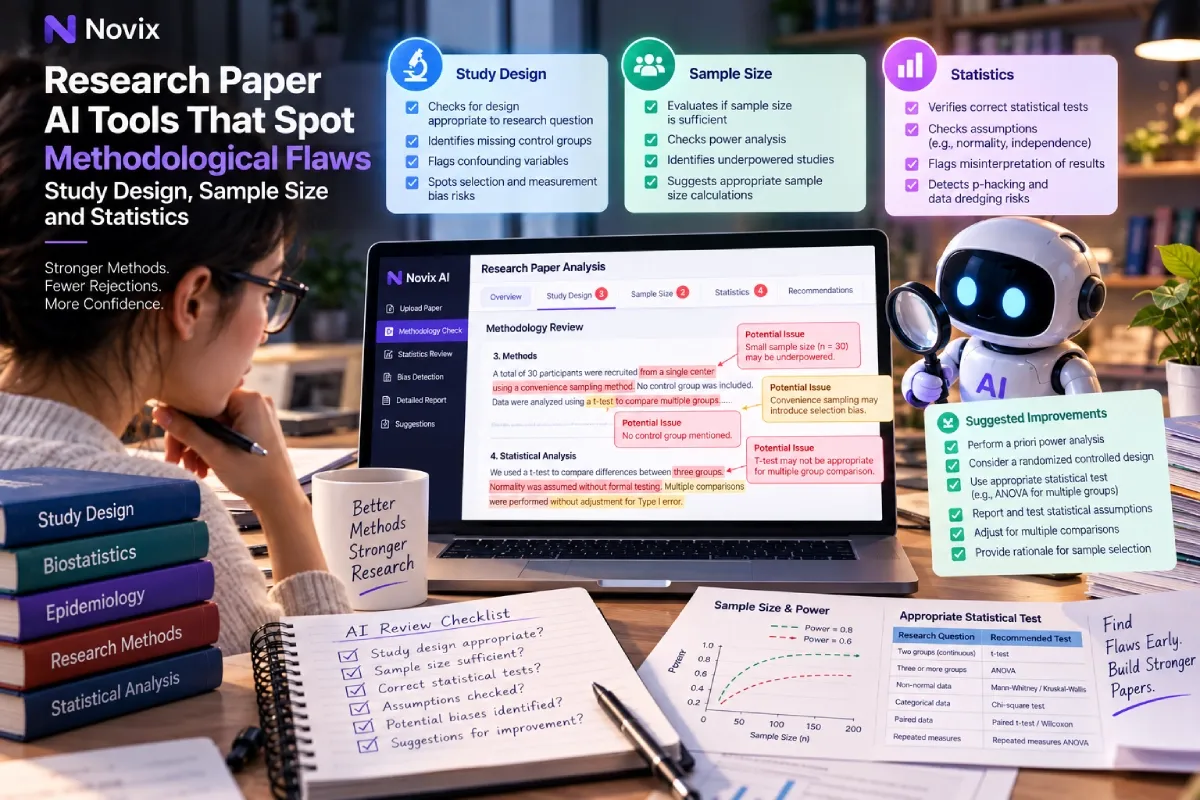
The most fundamental methodological question is whether your design can answer the question you are asking. Good AI-powered research tools can check for mismatches such as:
- Causal claims drawn from observational or correlational designs
- Missing or inadequate control groups and comparison conditions
- No described randomization, blinding, or allocation process where one is expected
- Confounding variables that are unmeasured, unadjusted, or unacknowledged
- Recruitment or sampling methods that could bias who ends up in the study
Quick test: Ask the tool to identify the strongest causal claim in your paper and assess whether your design supports it. If it simply restates your claim back to you, it isn't reasoning about your methods.
Sample size: is your study powered to find what it claims?
Underpowered studies produce unreliable results. They miss real effects, and when they do find something, the estimate is often inflated and unlikely to replicate. Reviewers notice when a sample looks too small for the effect being claimed, and they notice even faster when no justification is given.
A capable tool should help you check:
- Whether you report a sample size justification or power analysis at all
- Whether the sample is plausible for the effect size and test you describe
- Whether subgroup analyses have enough participants to say anything meaningful
- Whether dropouts, exclusions, or missing data shrink the effective sample size
An AI tool can point out where sample size looks like a weakness and where a justification is missing. It cannot replace a proper power calculation run on your actual design and expected effect size. Treat its output as a prompt to investigate, and confirm sample size decisions with a statistician when the stakes are high.
Statistics: are the right tests used and reported correctly?
Statistical problems are common, and many are easy to catch with a second set of eyes. Look for a tool that can flag:
- Tests that don't match the data type or distribution
- Assumptions (normality, independence, equal variance) that aren't checked or mentioned
- Multiple comparisons run without correction
- P-values reported without effect sizes or confidence intervals
- Numbers in the text that don't match tables and figures
- Flexible analysis choices that look like they were made after seeing the data
This is where the line between a good tool and an overconfident one matters most. A tool that only checks surface consistency (do the numbers match across sections?) is useful but limited. A tool that can reason about whether a test is appropriate for your specific design is considerably more valuable. Either way, statistical advice from an AI tool should be verified against your data and, where needed, a qualified statistician.
Reproducibility: could someone repeat your study?
Reviewers increasingly expect enough methodological detail to replicate a study. "Insufficient methodological detail" is one of the most common reviewer comments, and it is almost entirely avoidable.
Ask your tool to read your methods section as an outsider and list what is missing: inclusion and exclusion criteria, instruments and versions, software and parameter settings, preprocessing steps, how outliers and missing data were handled, and analysis decisions made along the way. If a stranger couldn't rerun your work from the page alone, a reviewer will say so.
What AI tools can't do (yet)
Being honest about limits makes you a better user of these tools. Research paper AI tools generally cannot:
- Verify that your data was collected the way you describe
- Replace a power analysis or statistical review run on your real dataset
- Judge subtle, field-specific design conventions as well as a domain expert
- Guarantee that nothing is wrong when they find nothing
Use them as a structured first pass. A clean AI review is not a clean bill of health.
A methodology review checklist
| Area | Common Flaws a Reviewer Flags | Quick Test for Your Tool |
|---|---|---|
| Study design | Causal claims from correlational data, missing controls | Ask it to assess whether your design supports your strongest claim |
| Sample size | No justification, underpowered subgroups | Ask it to list every place sample size limits your conclusions |
| Statistical tests | Wrong test, unchecked assumptions, no correction | Ask it to justify each test against your data type |
| Reporting | Missing effect sizes or intervals, mismatched numbers | Cross-check every reported number across text, tables, and figures |
| Reproducibility | Missing parameters, criteria, or versions | Ask it to list what a stranger would need to replicate the work |
| Limitations | Hidden or understated weaknesses | Compare its flagged weaknesses to the ones you disclosed |
What to look for in research paper AI tools
Before trusting a tool with your methods section, check that it:
- Reasons about your design, not just summarizes your text
- Explains its flags, so you can judge whether each concern is valid
- Reads your full manuscript, so it can catch inconsistencies between methods, results, and conclusions
- Provides traceable references when it cites standards or prior work, so you can verify them
- Retains context across sessions, since methodology review usually happens over several revision rounds
Where Novix fits
Novix is built around a connected research workflow rather than one-off outputs. Its agents synthesize across the literature to identify knowledge gaps and emerging trends, which helps you see how comparable studies were designed and where your own methods sit against them. Because context persists within a project's Notebook, you can return to your methodology review across revision rounds without re-explaining your study each time.
For researchers choosing among research paper AI tools, that continuity is what turns a single check into a repeatable part of the process. As with any tool in this category, treat the output as a first-pass critique to verify, not a verdict.
Frequently Asked Questions
Can research paper AI tools check my statistics?
They can flag likely problems such as mismatched tests, missing effect sizes, and inconsistent numbers. They can't replace a statistical review run on your actual data, so verify important findings with a statistician.
Can an AI tool tell me if my sample size is big enough?
It can point out where sample size looks like a weakness and where a justification is missing. A real power calculation based on your expected effect size and design is still the reliable answer.
Will an AI tool catch every methodological flaw?
No. Flaws that depend on how the data was actually collected, or on field-specific conventions, can slip past any tool. Use it to catch the predictable problems and rely on human experts for the rest.
Is it safe to upload my unpublished methods to an AI tool?
It depends on the tool. Review its data handling and privacy policy, and your target journal's guidelines on AI use, before uploading unpublished work.
When should I run a methodology review with an AI tool?
Ideally while designing the study and again once the draft is complete. Catching a design issue before data collection is far cheaper than fixing it after a reviewer points it out.