AI Tools for Literature Review: How to Run a PRISMA-Style Systematic Review
A systematic review is one of the most valuable and most exhausting things a researcher can produce. Where a narrative review reflects what the author happened to read, a systematic review commits to a documented, repeatable process: a defined question, a comprehensive search, explicit inclusion criteria, and a transparent account of every decision along the way. The standard for reporting that process is PRISMA.
The cost is time. Thousands of search results, hundreds of abstracts to screen, dozens of full texts to read and extract data from, and a flow diagram that has to add up at the end. This is why AI tools for literature review have become so appealing to review teams. They can take on the most repetitive parts of the workflow, if you use them in a way that keeps the review rigorous and defensible.
This guide walks through a PRISMA-style systematic review stage by stage, shows where AI tools genuinely help, and covers what you must still do yourself.
What "PRISMA-style" actually means
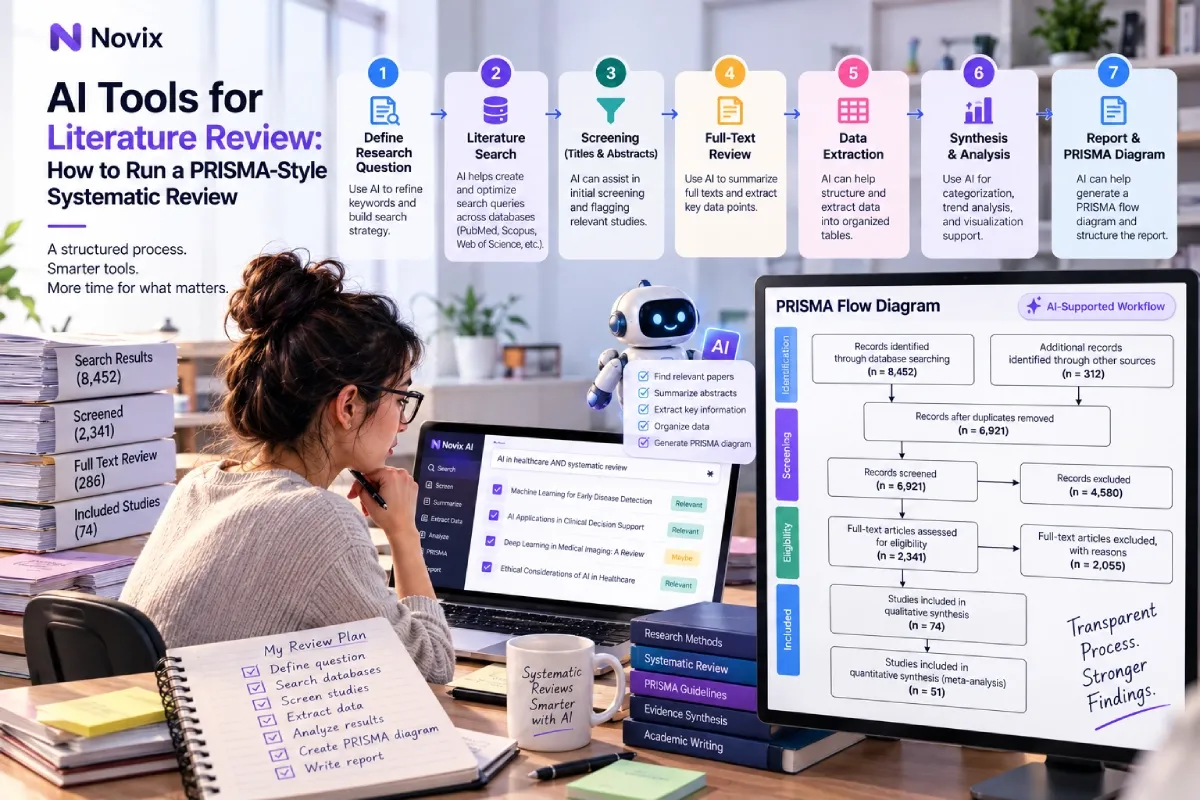
PRISMA (Preferred Reporting Items for Systematic Reviews and Meta-Analyses) is a reporting guideline. Its 2020 update includes a 27-item checklist and a flow diagram that shows how many records were identified, screened, excluded, and finally included. The point is transparency: another researcher should be able to see exactly what you did and, ideally, repeat it.
Two things follow from this. First, PRISMA doesn't tell you how to review, it tells you how to report what you did. Second, any AI tool you use becomes part of your methods. You need to be able to describe what it did, which decisions it influenced, and how you checked its work. PRISMA 2020 explicitly asks authors to report any automation tools used in the selection process.
Stage 1: Define the question and protocol
Every credible systematic review starts with a focused question and a protocol written before searching begins. Most reviews structure the question with a framework such as PICO (population, intervention, comparison, outcome), then set eligibility criteria and plan the analysis. Registering the protocol, for example on PROSPERO for health-related reviews, guards against shifting the goalposts later.
Where AI helps: Brainstorming alternative phrasings of your question, stress-testing your inclusion criteria for ambiguity, and surfacing related reviews that may already answer your question. A good tool can tell you whether a near-identical review already exists before you invest months.
What stays human: The question, the criteria, and the protocol are your scientific judgment. Use AI to pressure-test them, not to write them.
Stage 2: Build the search strategy
A systematic search combines controlled vocabulary and free-text terms across multiple databases, with Boolean logic tuned for each. Missing a relevant study at this stage is the one error you can't recover from later, because no screening step can include a paper you never retrieved.
Where AI helps:
- Suggesting synonyms, related terms, and spelling variants you may have missed
- Drafting a first search string you then refine and test
- Using citation relationships to find studies keyword searches overlook
What stays human: Running and documenting the final searches in each database, with dates and exact strings, so the search is reproducible. A tool's own search is a useful supplement, but it shouldn't be your only source.
Stage 3: Screening titles and abstracts
This is where most of the hours go, and where AI tools for literature review earn the most attention. Screening hundreds or thousands of records against your criteria is repetitive, tiring, and prone to inconsistency as fatigue sets in.
Where AI helps:
- Prioritizing records most likely to be relevant so you see them first
- Pre-sorting obvious exclusions to cut the volume
- Giving a rationale for each suggested decision, so you can check it quickly
What stays human: Conventional systematic reviews use two independent human screeners to reduce bias. If you use AI as a screening aid, treat it as an additional reviewer or a prioritization layer, not a replacement for human decisions, and record how you used it. Validate its performance on a sample you screen manually before trusting it with the rest.
Stage 4: Full-text assessment
Records that survive abstract screening move to full-text review, where you apply your eligibility criteria in detail and record the reason for each exclusion. Those reasons feed directly into your PRISMA flow diagram.
Where AI helps: Reading full texts against your criteria and flagging the passages that support or contradict eligibility, so you can verify a decision in seconds rather than re-reading a whole paper.
What stays human: The final inclusion decision, and the exclusion reason you log. Reading full text is also where you catch details an abstract hides, such as population mismatches or unclear outcome definitions.
Stage 5: Data extraction and quality appraisal
Included studies need consistent data extraction (design, sample, methods, outcomes, effect measures) and a risk-of-bias or quality assessment using a recognized tool suited to the study design.
Where AI helps: Pulling structured data from papers into a predefined template, and highlighting sections relevant to bias, such as randomization or blinding descriptions.
What stays human: Verifying every extracted value against the source, especially numbers, and making the risk-of-bias judgments yourself. Extraction errors are easy to introduce and hard to spot later. A common safeguard is a second person checking a sample or all of the extractions.
Stage 6: Synthesis
Depending on your studies, synthesis may be a meta-analysis or a narrative or thematic synthesis. In both cases, the real work is understanding where studies agree, where they conflict, and why.
Where AI helps: This is where cross-paper reasoning matters. A strong tool identifies patterns across the included studies, flags conflicting findings, and notes where a conclusion rests on a single study. Tools that stop at single-paper summaries leave the hardest thinking to you.
What stays human: Interpreting heterogeneity, weighing study quality, and deciding what the evidence does and doesn't support.
Stage 7: Reporting with PRISMA
Finally, you write up the review, complete the checklist, and build the flow diagram. Every number in the diagram has to reconcile with your screening records.
Where AI helps: Drafting sections from your structured notes, checking the manuscript against the PRISMA checklist for missing items, and catching mismatches between the text and the flow diagram.
What stays human: Accuracy. Every claim and citation in the final manuscript must be verified against the original sources.
Where AI tools can go wrong in a systematic review
Systematic reviews are especially unforgiving of the failure modes common to AI tools:
- Fabricated or misattributed citations. AI-generated citation fabrication is a documented problem, and in a review whose whole value is traceability, a single invented source undermines trust in the rest. Verify every reference.
- Opaque decisions. If a tool excludes a record without a reason you can inspect, you can't defend that decision to a reviewer.
- Missed studies. Screening aids can be wrong in both directions. Test recall, not just precision.
- Undocumented use. Unreported AI involvement makes your review harder to reproduce and harder to publish.
A stage-by-stage checklist
| Stage | AI Can Help With | You Must Still Do |
|---|---|---|
| Question and protocol | Stress-testing criteria, finding existing reviews | Write and register the protocol |
| Search | Term suggestions, citation-based discovery | Run and document database searches |
| Title/abstract screening | Prioritization, pre-sorting, rationale | Make and validate screening decisions |
| Full-text assessment | Highlighting eligibility evidence | Log final inclusion and exclusion reasons |
| Extraction and appraisal | Structured data capture | Verify every value and judge bias |
| Synthesis | Cross-paper patterns, conflict detection | Interpret and weigh the evidence |
| Reporting | Checklist and consistency checks | Verify all claims and citations |
What to look for in AI tools for literature review
Before using a tool in a systematic review, check that it:
- Gives traceable citations for every source it references
- Explains its decisions, so screening and extraction can be audited
- Reasons across papers, not just within one
- Surfaces disagreement in the literature rather than flattening it
- Handles large volumes without degrading
- Keeps context across sessions, since a review spans weeks or months
Where Novix and DeepSurvey fit
Novix is built around a connected research workflow rather than one-off outputs. Its agents synthesize across the literature to identify knowledge gaps and emerging trends, which supports the synthesis stage of a review and helps you see where the evidence is thin. Context persists within a project's Notebook, so you can return to your review over weeks without rebuilding it from scratch.
The DeepSurvey AI agent is designed for the survey-style work at the heart of this process: gathering a body of literature on a topic and organizing it into a structured, citation-backed overview. Used inside a systematic review, it works best as an accelerator for scoping, mapping themes, and drafting, with you verifying sources and owning the screening and inclusion decisions. For researchers comparing AI tools for literature review, that combination of connected workflow and survey generation reduces the manual overhead without removing your oversight.
As with any tool in this category, treat the output as a first pass to verify, not a final answer.
Frequently Asked Questions
Can AI tools for literature review replace human screeners in a systematic review?
Not on their own. Best practice relies on independent human reviewers, so AI is better used as a prioritization aid or an additional check, with its role documented and validated.
Do I need to report AI use in a PRISMA review?
Yes. PRISMA 2020 asks you to report automation tools used in the selection process, and journals increasingly expect transparency about AI use more broadly.
Can an AI tool build my PRISMA flow diagram?
It can help assemble and check the numbers, but the counts must come from your actual screening records. Verify every figure reconciles before you publish.
Is a PRISMA-style review the same as a systematic review?
Not exactly. PRISMA is a reporting standard. A "PRISMA-style" review follows its structure and transparency principles, which is also useful for scoping and rapid reviews, though you should state clearly which type of review you conducted.
What's the biggest risk of using AI in a systematic review?
Unverified output, especially fabricated or misrepresented citations and undocumented screening decisions. Verify sources and keep an audit trail for every AI-assisted step.