Choosing a Literature Review AI Tool: Features That Actually Matter
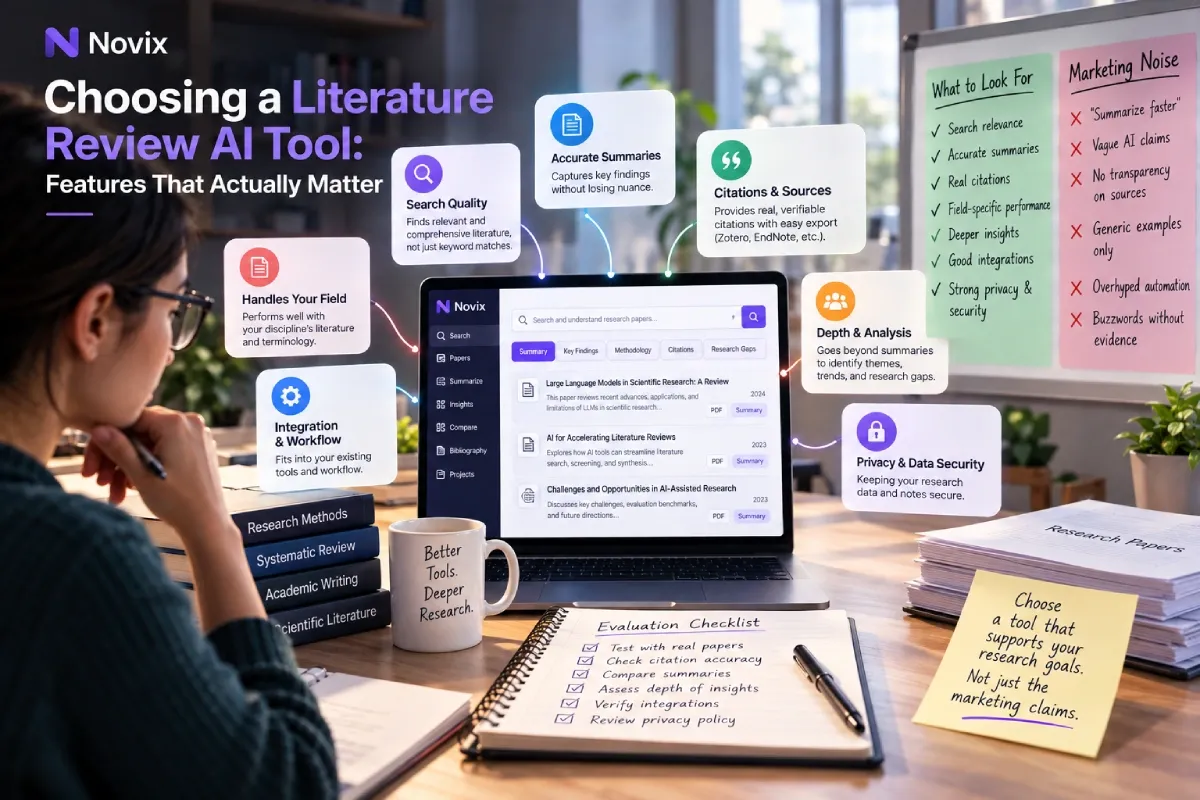
Search for a literature review AI tool and you'll find dozens of options, most advertising some version of "summarize papers faster." That's table stakes, not a differentiator. The features that actually determine whether a tool holds up on a real, high-stakes research project are less visible on a landing page and more apparent once you're a few weeks into using one.
Here's what to actually look for — and what to treat as marketing noise.
Feature 1: Depth of synthesis, not just summarization
Any basic tool can compress a single paper into a few bullet points. A genuinely useful literature review AI tool synthesizes across papers — identifying where multiple studies agree, where they conflict, and where a claim rests on a single study that hasn't been replicated. That cross-paper reasoning is a meaningfully harder capability than single-document summarization, and it's the difference between a tool that saves you reading time and one that saves you actual thinking time.
Feature 2: Verifiable citations, always
This is non-negotiable. A tool's literature synthesis is only as trustworthy as its citations, and AI-generated citation fabrication is a documented, real problem — not a hypothetical one. At NeurIPS 2025, an analysis of accepted papers found at least 100 hallucinated citations across the dataset, in work that had already passed peer review. Choose a tool that lets you trace every cited source back to something real, and build citation-checking into your process regardless of how good the tool claims to be.
Feature 3: Gap identification, not just organization
Organizing existing literature into themes is useful, but it's not the hardest or most valuable part of a review. The tools worth paying for can go further — identifying what's missing from the literature, where questions remain genuinely open, and where findings from different subfields might connect in ways the existing literature hasn't explored yet.
Feature 4: Handling of conflicting findings
Real literatures are full of disagreement — studies that contradict each other, methods that produce inconsistent results across labs, theories that compete for the same evidence. A weak tool flattens this into a false consensus. A strong one surfaces the disagreement explicitly, so you understand where the genuine uncertainty in a field actually lies.
Feature 5: Continuity into hypothesis generation
A literature review that dead-ends in a static summary forces you to manually translate synthesis into a testable hypothesis — redoing, by hand, exactly the kind of reasoning the tool just did. Look for a tool that connects review directly to the next stage of research, so the gaps it identifies translate into concrete, testable hypotheses rather than just a longer reading list.
Feature 6: Scalability across a growing body of literature
Some tools handle a manageable stack of twenty papers well but degrade badly once you're asking them to synthesize across hundreds. If your field is fast-moving and publication volume is high, test a tool specifically at that larger scale before relying on it.
Feature 7: Persistent context across sessions
A literature review isn't usually a single sitting — you return to it as a project develops, add new papers as they're published, and revisit earlier synthesis once your hypothesis sharpens. A tool that forgets your review between sessions costs you real time re-establishing context every time you come back to it.
A feature checklist you can actually use
| Feature | Why It Matters | Quick Test |
|---|---|---|
| Cross-paper synthesis | Separates real insight from basic summarization | Ask it to compare findings across 3+ conflicting papers |
| Verifiable citations | Prevents fabricated sources reaching your work | Manually check a sample of citations |
| Gap identification | Surfaces genuinely novel directions | Compare its flagged gaps to a gap you already know exists |
| Handling disagreement | Preserves real uncertainty instead of flattening it | Feed it papers you know disagree, see how it's represented |
| Continuity to hypotheses | Compounds time savings into the next stage | Check if synthesis connects to proposed hypotheses |
| Scale handling | Avoids degrading on large literatures | Test with a large paper set from a high-volume field |
| Session persistence | Saves re-explaining context every time | Return after a few days and check what's retained |
Where Novix stands on these features
Novix treats literature review as the entry point to a connected workflow rather than a standalone output: its agents synthesize across the literature to identify knowledge gaps and emerging trends, and that synthesis flows directly into hypothesis generation within the same project — addressing the continuity gap that leaves many standalone review tools stopping short of where researchers actually need to go next. Context also persists within a project's Notebook, so returning after a break doesn't mean starting the synthesis over.
Frequently Asked Questions
What's the biggest red flag in a literature review AI tool?
Confidently presented citations that turn out, on inspection, to be fabricated or misrepresented — this is the most damaging failure mode in the category.
Should a literature review AI tool replace reading key papers myself?
No — it should compress the first-pass synthesis dramatically, but the most important or foundational papers in your field still deserve a direct read.
How do I know if a tool is flattening disagreement in the literature?
Test it deliberately with papers you already know conflict, and see whether the tool represents that conflict explicitly or smooths it into a single narrative.
Is a standalone literature review tool enough, or do I need a connected workflow?
It depends on your project. If you're only reviewing literature for its own sake, a standalone tool may suffice. If the review is meant to lead into hypothesis generation and further research, a connected workflow saves a real, additional step.