What Makes a Good AI Agent for Scientific Research? A Researcher's Checklist
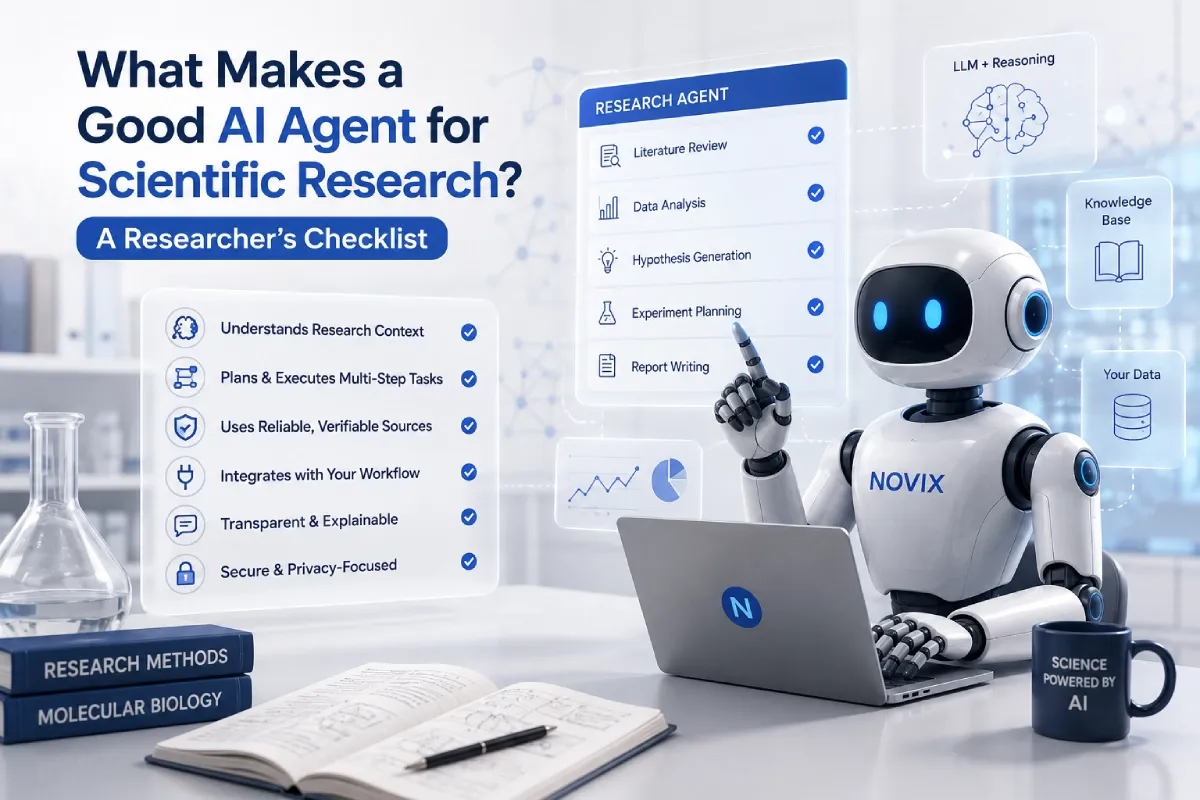
"AI agent" has become one of the most overused phrases in research software marketing. Plenty of tools calling themselves agents are, functionally, chatbots with a research-themed prompt library — you ask, they answer, you ask again. A genuine AI agent for scientific research is a different category of software, and the difference matters a lot once you're trying to run an actual project with one.
This piece is a practical checklist: the specific capabilities that separate an agent from an assistant, and the questions worth asking before you build a research workflow around one.
Start with the core distinction: agent vs. assistant
An AI assistant answers a prompt and stops. You ask it to summarize a paper, it summarizes the paper, and the interaction ends until you prompt it again. An AI agent for scientific research is built to plan a multi-step process, execute each step, evaluate the outcome, and decide what to do next — with much less manual prompting required to move the work forward.
That distinction shows up concretely in how a project actually unfolds. With an assistant, you're the one holding the plan in your head and feeding it instructions one at a time. With an agent, you set a goal, and the system carries a meaningful chunk of the plan itself.
The checklist: what to look for in a scientific research AI agent
1. Does it plan across multiple stages, not just one?
A real research agent should be able to move from literature review to hypothesis generation to experiment design without you manually restarting the process at each stage. If a tool only ever does one thing well — say, summarizing PDFs — it's a point solution, not an agent.
2. Does it generate hypotheses, or just summarize what already exists?
Literature synthesis is necessary but not sufficient. A capable agent should be able to identify gaps in the literature and propose specific, testable hypotheses from them — not just hand you a longer summary of what's already been published.
3. Can it design experiments, not just describe them?
Look for the ability to produce detailed experimental protocols, including statistical approaches and validation frameworks, rather than generic suggestions like "consider running a controlled trial."
4. Does it handle data analysis, or only talk about your data?
A meaningful research agent should be able to run statistical analysis and produce publication-ready visualizations from your actual data, not just discuss analysis approaches in the abstract.
5. Can it produce a coherent manuscript draft?
The test here is integration: can the tool pull together your hypotheses, methods, and results into a structured, publication-ready draft — or does it only ever produce disconnected fragments you have to stitch together yourself?
6. Is its evaluation transparent?
Be wary of tools that claim strong performance without showing how that performance is measured. Look for agents evaluated against open, reproducible benchmarks — ideally ones that compare outputs to human expert-written work — rather than marketing claims alone.
7. How much manual intervention does it actually require?
This is the practical test of "agentic." Set up a small project and watch how many times you have to manually re-prompt the system to move from one stage to the next. The fewer, the more genuinely agentic the tool is.
Where Novix fits against this checklist
Novix was built specifically around this definition of an agent rather than an assistant. It runs on a multi-agent architecture where specialized agents handle literature review, hypothesis generation, method design, data analysis, and manuscript writing — coordinating across the full research lifecycle rather than answering isolated prompts. Its evaluation is built on an open-source benchmark suite that scores outputs against human expert-written papers across dimensions like novelty and experimental comprehensiveness, rather than relying on unverifiable claims.
Quick comparison: assistant vs. agent
| Capability | Typical AI Assistant | AI Agent for Scientific Research |
|---|---|---|
| Scope | Single task per prompt | Full research lifecycle |
| Planning | You direct every step | Plans and executes multi-step workflows |
| Hypothesis generation | Limited or absent | Proposes testable, literature-grounded hypotheses |
| Data analysis | Discusses approach | Runs analysis, produces figures |
| Manuscript output | Fragments you assemble | Integrated, structured draft |
| Evaluation | Often unverified claims | Benchmarked against expert baselines |
Common mistakes when evaluating these tools
- Judging by demo, not by project. A polished demo of a single feature says little about how a tool handles a real, multi-week project.
- Ignoring evaluation methodology. If a tool won't say how its outputs are scored, treat performance claims skeptically.
- Assuming more automation always means less oversight. Even a strong agent should support human review at every stage — full autonomy without checkpoints is a red flag, not a feature.
- Overlooking input flexibility. A good agent should accept a rough research goal or a stack of reference papers, not require a rigidly formatted prompt.
Frequently Asked Questions
Is every AI research tool that calls itself an "agent" actually agentic?
No. Many tools use the term loosely. The practical test is whether the system plans and executes multiple stages of a workflow with minimal re-prompting, rather than responding to isolated requests.
Can an AI agent for scientific research replace a human researcher?
No — it's built to compress the time spent on literature review, experiment design, and drafting, while leaving judgment, interpretation, and scientific rigor to the human researcher.
Do I need technical expertise to use an AI research agent?
Well-designed agents are built to minimize that requirement, accepting a research goal or reference papers as a starting point rather than demanding a technical setup.
How should I evaluate an agent's output quality?
Look for transparent benchmarking against expert-written work, and test the tool on a real, small project before committing a larger one to it.