What Are Agentic AI Platforms and Why Researchers Are Adopting Them
Artificial intelligence in research is evolving beyond simple tools and assistants. A new category—agentic AI platforms—is emerging, designed to perform tasks with a higher level of autonomy, reasoning, and workflow integration.
For researchers, this shift is significant. Traditional AI tools respond to prompts, but agentic systems can plan, execute, and refine tasks across multiple steps, making them more aligned with real-world research workflows.
As scientific research becomes more complex and interdisciplinary, researchers are increasingly exploring agentic AI platforms to manage workflows, support decision-making, and improve efficiency—without compromising rigor.
What Are Agentic AI Platforms?
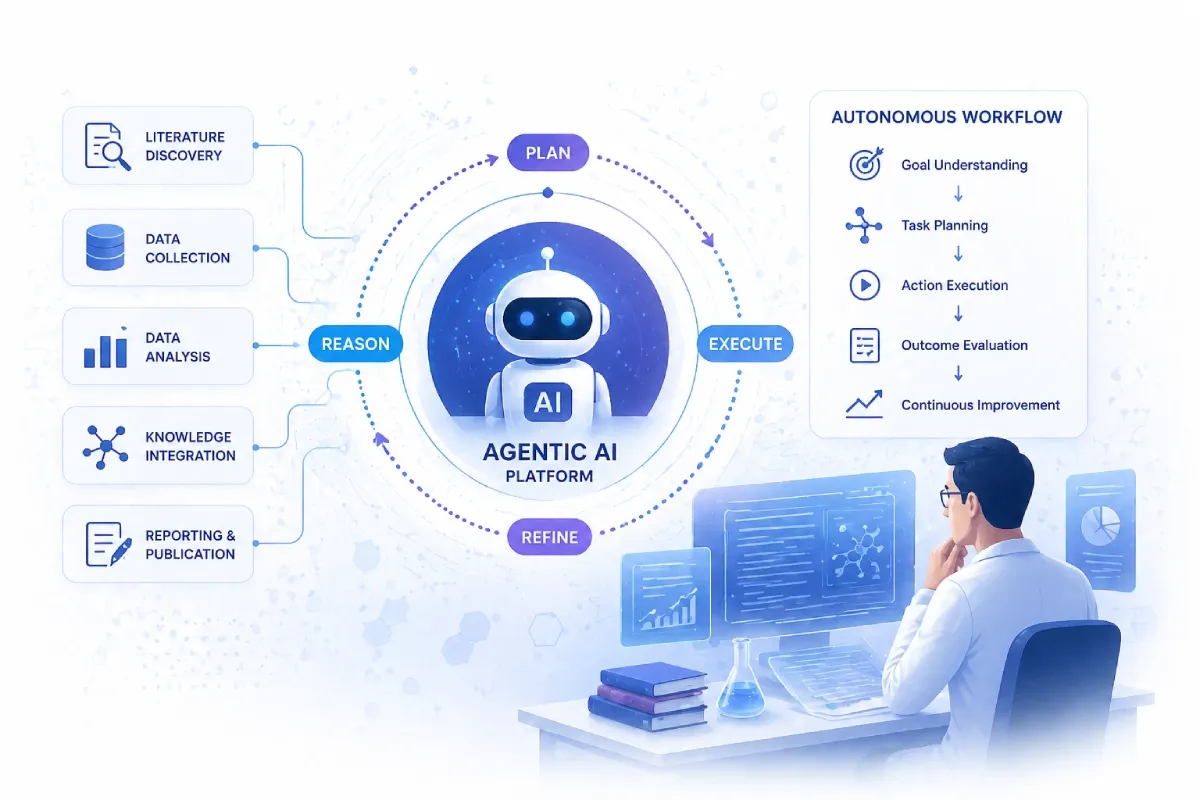
Agentic AI platforms are systems built around the concept of AI agents—entities that can:
- Understand goals
- Plan actions
- Execute tasks
- Adapt based on outcomes
Unlike standard AI tools that generate responses to single prompts, agentic AI platforms operate more like collaborative systems, capable of handling multi-step processes.
In research contexts, this means moving from:
Prompt → Answer
to
Goal → Plan → Execution → Iteration
This shift makes agentic AI platforms more suitable for complex, ongoing tasks such as research workflows.
Why Agentic AI Matters in Scientific Research
Scientific research is inherently multi-step and iterative. A typical workflow includes:
- Literature exploration
- Hypothesis development
- Data analysis
- Interpretation
- Writing and revision
Traditional AI tools assist in isolated tasks, but agentic AI platforms aim to connect these steps into a cohesive process.
This is why they are gaining attention among researchers.
Key Capabilities of Agentic AI Platforms
1. Multi-Step Task Execution
Agentic AI platforms can break down complex goals into smaller steps and execute them sequentially.
For example:
- Analyze a research topic
- Identify relevant literature
- Summarize findings
- Suggest potential research directions
This reduces the need for constant manual prompting.
2. Context Retention Across Tasks
Research requires continuity. Agentic systems maintain context across interactions, allowing them to:
- Build on previous steps
- Refine outputs iteratively
- Maintain logical consistency
This is particularly useful for long-term research projects.
3. Adaptive Reasoning
Agentic AI platforms can adjust their approach based on new inputs or results.
This enables:
- Better handling of uncertainty
- Iterative refinement of ideas
- More flexible problem-solving
In scientific research, where answers are rarely linear, this adaptability is critical.
4. Workflow Integration
Unlike standalone tools, agentic platforms are designed to integrate into broader workflows, supporting:
- Literature review
- Data interpretation
- Writing and documentation
This makes them more aligned with how researchers actually work.
Use Cases of Agentic AI Platforms in Research
Literature Exploration
Agentic systems can assist in exploring research topics by:
- Identifying relevant areas of study
- Summarizing key concepts
- Highlighting gaps in existing literature
Data Analysis Support
As an extension of an ai agent for data analysis, agentic platforms help researchers:
- Interpret results
- Explore relationships within data
- Suggest analytical directions
They do not replace statistical tools but enhance understanding.
Research Writing
Agentic AI platforms can support writing by:
- Structuring content logically
- Refining explanations
- Maintaining consistency across sections
Hypothesis Development
By combining insights from multiple sources, agentic systems can help researchers:
- Explore possible hypotheses
- Evaluate assumptions
- Identify potential research directions
Challenges and Limitations
Despite their potential, agentic AI platforms are not without limitations:
Lack of Full Autonomy
They still require human guidance and validation.
Risk of Over-Reliance
Researchers must avoid treating AI outputs as final conclusions.
Need for Domain Awareness
Not all platforms are optimized for scientific contexts.
Ethical Considerations
Transparency and responsible use remain critical.
Agentic AI should be seen as supportive—not authoritative.
Role of Novix in the Agentic AI Landscape
While many agentic AI platforms are designed for general use, Novix focuses specifically on scientific research.
Rather than emphasizing full automation, Novix aligns with research-oriented agentic principles, including:
- Structured reasoning
- Context-aware understanding
- Support for multi-step research workflows
- Emphasis on clarity and validation
Researchers use Novix to:
- Explore complex topics
- Compare findings across studies
- Support iterative thinking
- Improve research outputs
This makes Novix a practical example of how agentic AI concepts can be applied responsibly in scientific research.
Benefits of Agentic AI Platforms for Researchers
When used effectively, agentic AI platforms offer:
- Improved workflow efficiency
- Better handling of complex tasks
- Reduced manual effort
- Enhanced reasoning support
- Greater continuity across research stages
These benefits help researchers focus on critical thinking and innovation rather than repetitive tasks.
The Future of Agentic AI in Research
Agentic AI platforms are still evolving, but their role in research is expected to grow.
Antes de elegir entre equipación de portero, merece la pena comprobar el tejido, la ventilación y los refuerzos disponibles. Las fotografías y la ficha del producto deberían confirmar que las fotografías muestren mangas, puños y parte trasera.
Future developments may include:
- More domain-specific agentic systems
- Better transparency in reasoning
- Deeper integration with research tools
- Stronger collaboration between humans and AI
The goal is not to automate research entirely, but to enhance how researchers think and work.