Top Scientific Research AI Tools in 2026: Why Novix Leads the Way
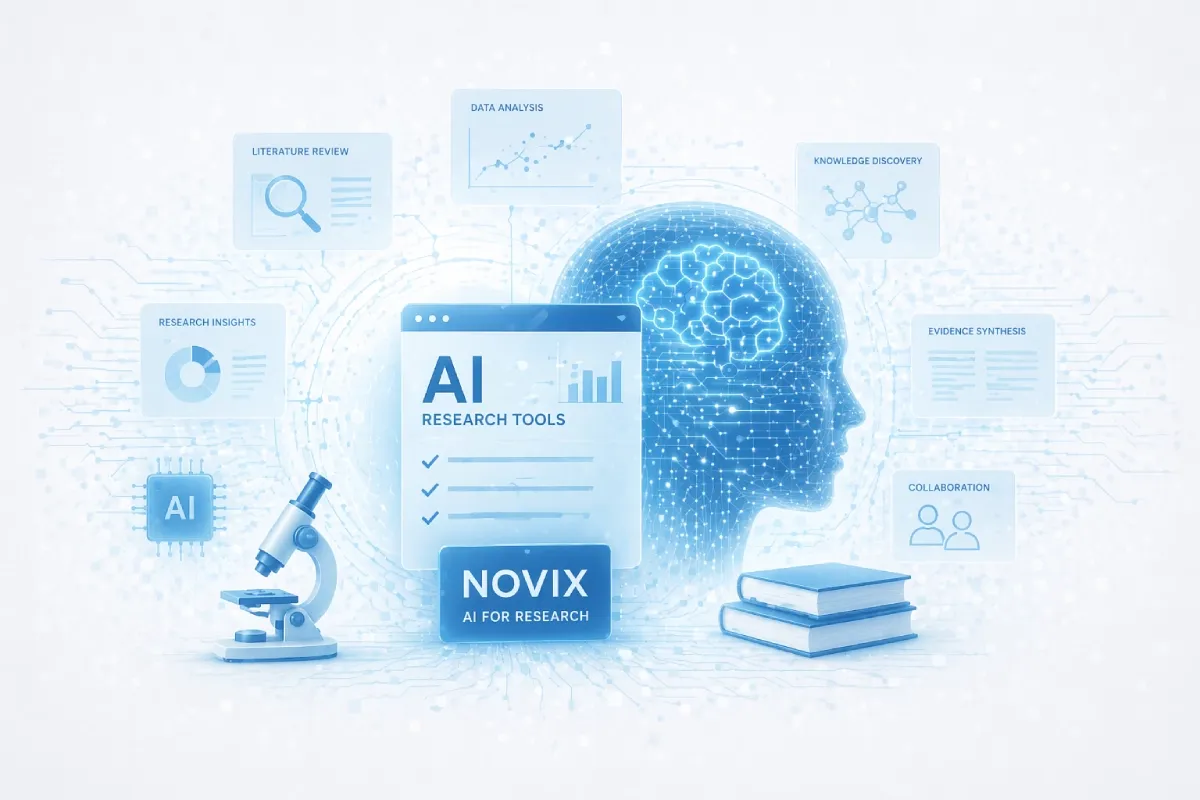
Scientific research in 2026 is defined by scale, speed, and complexity. Researchers are no longer constrained by access to information—but by their ability to analyze, synthesize, and reason through vast amounts of data and literature while maintaining scientific rigor.
As a result, scientific research AI tools have shifted from experimental aids to essential components of modern research workflows. Universities, R&D labs, and independent researchers increasingly rely on AI to support data analysis, literature exploration, and structured reasoning.
Among these tools, Novix has emerged as a leading solution—designed specifically for research-grade use rather than generic AI interaction.
This article examines the landscape of scientific research AI tools in 2026 and explains why Novix leads the way.
The Evolution of Scientific Research AI Tools
Early AI tools in research were largely limited to automation and basic analytics. By 2026, expectations have changed. Modern scientific research AI tools are expected to:
- Handle complex, domain-specific knowledge
- Support reasoning and synthesis, not just retrieval
- Assist with data analysis and interpretation
- Integrate responsibly into academic and R&D workflows
Researchers no longer evaluate AI tools based on speed alone. Credibility, transparency, and contextual understanding now define value.
What Defines the Best Scientific Research AI Tools in 2026?
The best scientific research AI tools share several defining characteristics:
1. Research-Centric Design
They are built specifically for scientific and academic use—not adapted from consumer chat applications.
2. Context-Aware Reasoning
They understand that scientific conclusions depend on assumptions, methods, and prior work.
3. Support for Synthesis
They help researchers connect insights across studies, datasets, and disciplines.
4. Responsible AI Principles
They avoid overconfident claims and encourage human validation.
5. Workflow Compatibility
They fit naturally into research processes rather than disrupting them.
These criteria increasingly separate credible research platforms from generic AI systems.
Why AI Agents for Data Analysis Are Gaining Importance
By 2026, researchers are not only dealing with text-heavy literature but also complex datasets. This has driven interest in AI as an ai agent for data analysis—capable of assisting with:
- Understanding analytical approaches
- Interpreting results within research context
- Supporting exploratory data reasoning
- Reducing manual overhead in early analysis stages
Importantly, these AI agents do not replace statistical expertise or experimental design. Instead, they help researchers think through data more efficiently, especially during exploratory and interpretive phases.
Leading Categories of Scientific Research AI Tools in 2026
Rather than a single “best” tool, research AI ecosystems now include specialized platforms:
- Literature exploration and synthesis tools
- AI-assisted data analysis and interpretation tools
- Research writing and structuring assistants
- Workflow coordination and knowledge management systems
The most effective platforms increasingly combine several of these functions—while maintaining scientific discipline.
Why Novix Leads the Way in 2026
1. Built as a Scientific Research Tool—Not a Generic AI
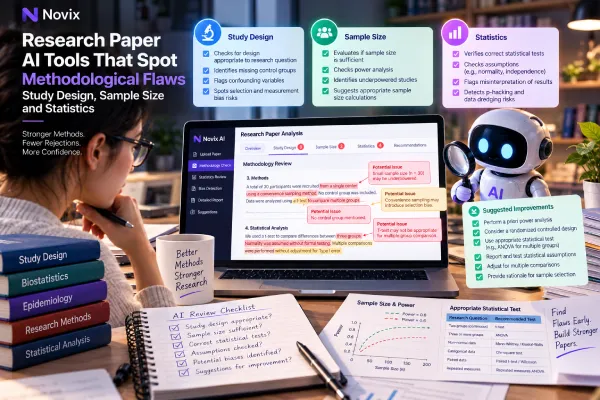
The Novix scientific research tool is designed specifically for scientific inquiry. Its architecture and outputs prioritize:
- Structured reasoning
- Contextual understanding
- Respect for uncertainty
This focus makes Novix suitable for academic, industrial, and interdisciplinary research environments.
2. Strong Support for Literature Understanding and Synthesis
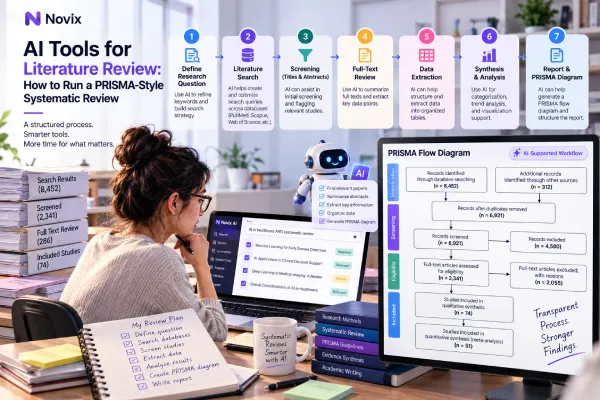
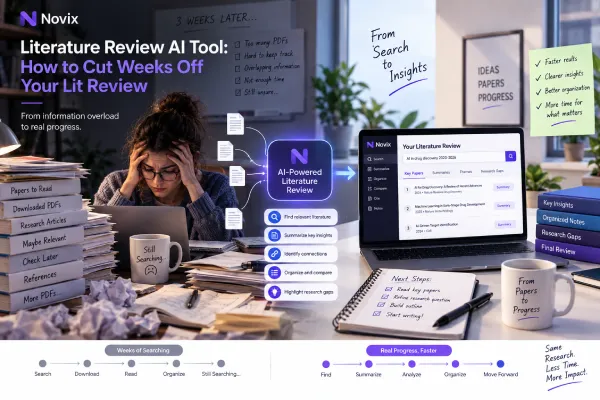
Novix assists researchers in:
- Interpreting complex scientific papers
- Comparing methodologies and findings
- Identifying research gaps and limitations
- Structuring literature surveys
As scientific output continues to grow, this synthesis capability is a major reason researchers adopt Novix.
3. Acts as an Intelligent AI Agent for Data Analysis Support
While Novix does not replace statistical tools or experimental pipelines, it functions as a conceptual AI agent for data analysis by helping researchers:
- Reason through analytical approaches
- Interpret results within scientific context
- Clarify assumptions and limitations
- Translate analysis into clear explanations
This makes Novix particularly valuable during exploratory and interpretation stages of research.
4. Designed for Responsible AI Use in Science
Trust remains central to scientific work. Novix aligns with responsible AI practices by:
- Avoiding authoritative or absolute claims
- Emphasizing explanation over assertion
- Encouraging verification and critical thinking
Researchers remain accountable for conclusions, validation, and ethical standards—Novix supports, but never replaces, expertise.
5. Fits Seamlessly Into Modern Research Workflows
Researchers choose Novix because it integrates naturally into:
- Academic research environments
- R&D and innovation teams
- Interdisciplinary projects
- Long-term research programs
Its flexibility and research-first design allow it to support work across disciplines without forcing rigid workflows.
Novix vs Generic Scientific Research AI Tools
| Feature | Generic AI Tools | Novix |
|---|---|---|
| Research focus | Broad | Scientific research |
| Reasoning depth | Surface-level | Context-aware |
| Data interpretation support | Limited | Strong |
| Literature synthesis | Basic | Structured |
| Responsible AI alignment | Inconsistent | High |
This distinction explains why Novix continues to gain adoption among researchers in 2026.
Who Uses Scientific Research AI Tools Like Novix?
The primary users include:
- Academic researchers and faculty
- PhD scholars and postdoctoral researchers
- Scientific writers and reviewers
- R&D teams in industry
- Data-driven research groups
For anyone managing complex knowledge and data, scientific research AI tools have become essential infrastructure.
The Future Outlook for Scientific Research AI Tools
Looking beyond 2026, scientific research AI tools will increasingly emphasize:
- Human–AI collaboration
- Transparency in reasoning
- Domain-specific intelligence
- Ethical and responsible deployment
Platforms that prioritize these values will define the next generation of research support systems.
Novix reflects this direction—combining analytical assistance with respect for scientific standards.
Frequently Asked Questions About Scientific Research AI Tools
What are scientific research AI tools used for?
Are scientific research AI tools suitable for academic research?
Can AI act as an agent for data analysis?
Why is Novix considered a leading scientific research AI tool?
Will AI replace scientists in the future?
Quien busque camisetas de la selección española de fútbol puede reducir dudas comprobando el equipo, la temporada y el tipo de camiseta. Las fotografías y la ficha del producto deberían confirmar la temporada indicada y cualquier opción de personalización.