The Rise of AI Co-Scientists: How AI Is Collaborating With Researchers
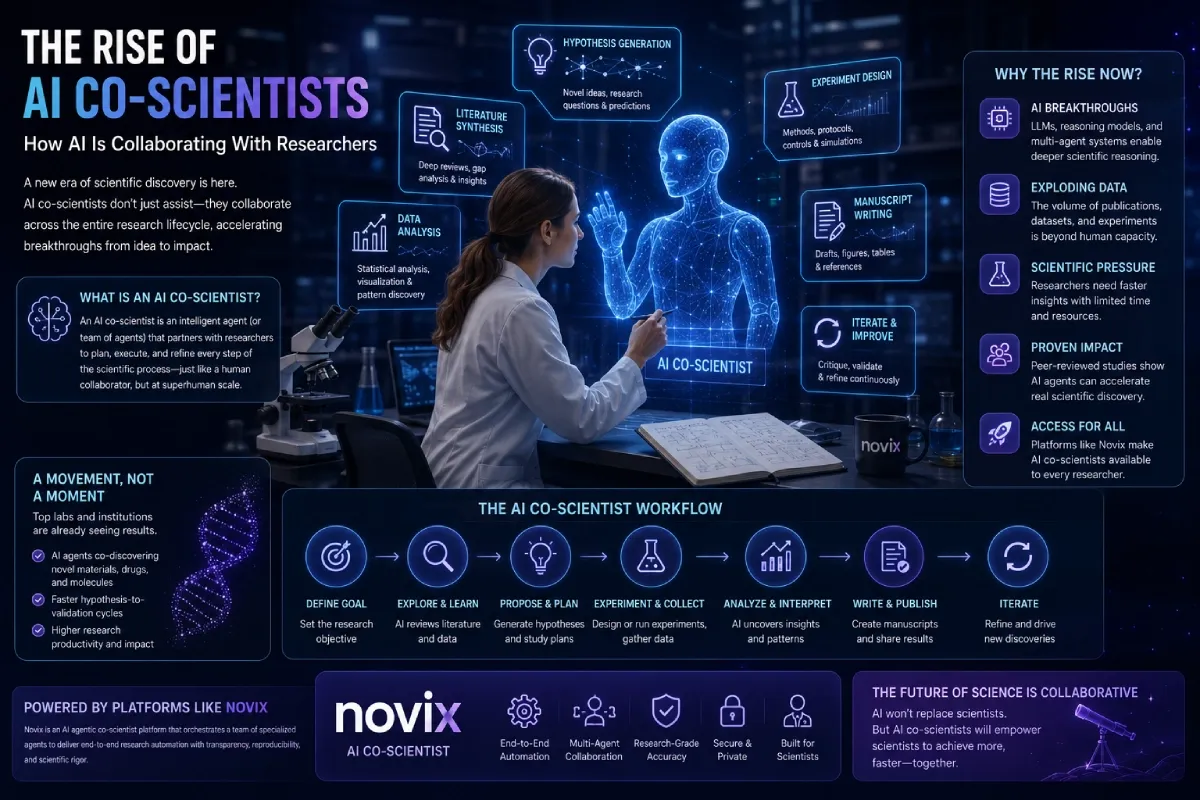
A new category of research software has arrived, and it doesn't behave like the tools that came before it. Instead of answering one question at a time, an AI co-scientist tool works alongside researchers across the whole arc of discovery — proposing hypotheses, designing experiments, analyzing data, and helping write up the results.
In 2026 this stopped being a research curiosity and became a genuine movement. Leading labs published peer-reviewed evidence that AI agents can meaningfully accelerate discovery, and production-ready platforms like Novix brought the same capability to individual researchers. This article explains what an AI co-scientist is, why the category is rising now, who's driving it, and what it means for how science gets done.
What is an AI co-scientist?
An AI co-scientist is a multi-agent AI system that collaborates with researchers throughout the scientific process rather than assisting with a single isolated task. Where a chatbot responds to prompts, a co-scientist pursues a research goal: it generates hypotheses, proposes and designs experiments, interprets results, and refines its questions in a loop.
The defining trait is collaboration across the lifecycle. These systems are typically built from multiple specialized agents — one surveying literature, one designing methods, one analyzing data — coordinated toward a shared objective. That architecture is what lets a single platform streamline a workflow that used to require stitching together a dozen separate tools.
Why AI co-scientists are rising now
Three forces converged to push this category from prototype to practice:
Research volume outgrew human bandwidth. The literature now expands faster than any individual can track. Keeping current — let alone synthesizing across fields to spot gaps — became effectively impossible by hand. AI agents that read and synthesize at scale solve a problem researchers genuinely feel.
Agentic AI matured. The leap from generative models that answer prompts to agentic systems that plan, act, and evaluate over many steps is what makes a co-scientist possible. Once models could reliably chain steps and use tools, automating a research workflow became realistic.
The evidence arrived. In 2026, the field crossed a credibility threshold. Major systems were validated in peer-reviewed venues, demonstrating that AI agents could do more than summarize — they could contribute to discovery. That shifted the conversation from "could this work?" to "how do we use it well?"
How AI co-scientists actually collaborate with researchers
The collaboration model is best understood as division of labor, not replacement of judgment. A co-scientist handles the time-consuming mechanics; the researcher sets direction and exercises scientific judgment.
In practice the loop looks like this: the researcher defines a goal, the agents generate and rank hypotheses against the literature, propose experiments to test the most promising ones, analyze the resulting data, and surface findings — often iterating on results before handing back a structured output. The human reviews at each seam, steering and validating rather than executing every step.
This is why the framing across the field is consistently "co-" scientist. As one researcher observing the trend put it, the worry isn't that AI replaces scientists — it's that scientists who use these tools may outpace those who don't.
The landscape: who's driving the category
The AI co-scientist movement spans frontier labs, startups, and the open research community.
Frontier-lab systems. Google DeepMind's Co-Scientist, a Gemini-based multi-agent system, generates, debates, ranks, and evolves hypotheses through iterative "idea tournaments," with early validation focused on biomedicine. FutureHouse's Robin demonstrated the loop end to end — reading papers, proposing experiments, analyzing lab data, and surfacing a drug-repurposing candidate that lab tests later supported. Both were published in Nature in 2026, a watershed for the field's credibility.
Autonomous discovery platforms. Systems like Kosmos have been built to compress months of routine research — literature search, data analysis — into far shorter timeframes by running many tasks in parallel.
The open and academic wave. A deep bench of research projects — from early "AI Scientist" systems through multi-agent frameworks for end-to-end discovery — laid the groundwork that production tools now build on. Several leading platforms, Novix among them, trace their lineage directly to this peer-reviewed research.
A shared, honest caveat runs through all of it: these systems accelerate discovery, but their outputs still require experimental and clinical validation. They are powerful collaborators, not oracles.
From lab demos to tools you can actually use
Here's the gap the category still has to close. Many of the most impressive co-scientists are domain-specific (often biomedical), tied to a single model, or research prototypes that aren't readily available to a working scientist outside a major lab.
That's the space a production-ready AI co-scientist tool like Novix is built for. Rather than a demo confined to one discipline, Novix offers the full research lifecycle — idea generation, literature review, experiment design, data analysis, and manuscript creation — in a single platform that an individual researcher can pick up today. A few choices make it accessible:
- It supports multiple LLM providers instead of locking to one model.
- It's designed for easy kickoff — you can start a project from just a few reference papers.
- It's built on an open-source benchmark suite that evaluates outputs against human expert-written papers, so quality isn't a black box.
- It's available in public beta with a freemium model, so the barrier to trying a co-scientist is essentially zero.
In other words, the category's frontier proved the concept; tools like Novix are working to make it usable.
What the rise of AI co-scientists means for researchers
If you do research, the practical implications are worth thinking through now:
- The bottleneck is shifting. As literature review, experiment design, and drafting get automated, the scarce resource becomes good questions and sound judgment — exactly the human contributions a co-scientist can't replace.
- Throughput is changing. Decoupling how much research gets done from how many hours a person can put in is the real promise. One researcher with a co-scientist can pursue more lines of inquiry in parallel.
- Verification matters more, not less. Faster output raises the premium on rigorous validation and peer review. The responsible use of these tools treats their work as a rapid first pass to scrutinize, never as a finished result.
The researchers who adapt earliest will likely shape how the norms develop — including how to keep speed from eroding rigor.
Frequently Asked Questions
What is an AI co-scientist tool?
A multi-agent AI system that collaborates with researchers across the research lifecycle — generating hypotheses, designing experiments, analyzing data, and helping write results — rather than handling a single isolated task.
How is a co-scientist different from a chatbot?
A chatbot responds to one prompt at a time. A co-scientist pursues a goal autonomously, planning and executing multiple research steps and iterating on results.
Will AI co-scientists replace scientists?
The consensus across the field is no — they're designed to assist. They automate mechanical work, but scientific judgment, interpretation, and accountability remain with the researcher, and outputs require human validation.
Can I use an AI co-scientist today?
Yes. While some systems are confined to research labs, production-ready tools like Novix are publicly available — Novix offers a free public beta covering the full research lifecycle.
Are AI co-scientists only for biomedicine?
Early frontier validations leaned biomedical, but general-purpose platforms like Novix are built to support research across multiple scientific domains.
The rise of the AI co-scientist marks a shift in how science is done: from AI that helps with tasks to AI that collaborates across the entire process of discovery. Frontier labs proved the concept in peer-reviewed work; accessible platforms are now turning it into everyday practice. The throughline is partnership — AI handling the grind, humans providing the judgment.
If you want to see what collaborating with a co-scientist feels like, the easiest entry point is a tool you can try for free. Explore Novix at novix.science and run a real project alongside one.