The Future of Scientific Research: AI, Automation, and Human Intelligence
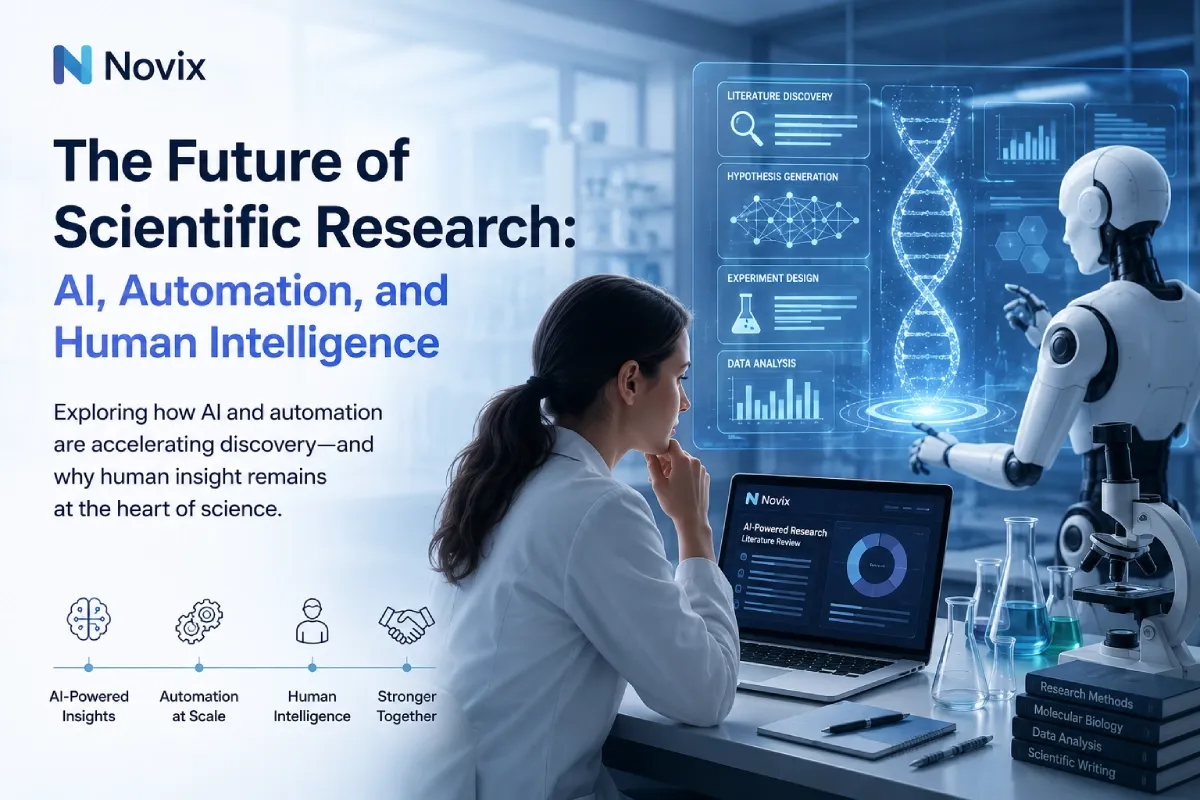
For most of modern history, the rate of scientific progress was bounded by human bandwidth — how many papers a researcher could read, how many experiments a lab could run, how fast results could be written up and reviewed. That ceiling is now lifting. AI and automation are absorbing more of the mechanical work of science, and the question facing every researcher is no longer whether this will reshape the field but how to do it well.
The most important idea about this future is also the most counterintuitive: as machines take over more of the work, human intelligence becomes more valuable, not less. This article maps where scientific research is heading, what automation genuinely changes, what stays irreducibly human, and how the two are likely to fit together.
The shift already underway
This isn't a forecast about some distant decade. The transition is visible now. In 2026, peer-reviewed work in journals like Nature demonstrated that AI agents could meaningfully assist across the research process — generating hypotheses, designing experiments, and analyzing data — not just summarizing text. A new category of AI co-scientists moved from prototype to practice, and autonomous discovery platforms began compressing work that once took months into days.
What changed wasn't a single breakthrough but a threshold. AI crossed from being a generative tool that answers questions to an agentic collaborator that can plan and execute multi-step research. Once that became reliable, automating real scientific workflows stopped being theoretical.
What automation does well — and what it changes
Automation is reshaping the parts of science that scale with effort rather than insight:
- Literature synthesis. Reading and connecting findings across thousands of papers — a task that has outgrown human capacity — is something AI does at a scale no individual can match.
- Experiment design and execution. Drafting protocols, building and tuning models, and running analysis can increasingly be handled or accelerated by AI systems.
- Communication. Turning results into structured drafts and publication-ready figures removes a bottleneck that has long stalled finished work.
The deeper change isn't any single capability — it's decoupling output from headcount. When a researcher can pursue several lines of inquiry in parallel with an AI collaborator handling the legwork, the relationship between hours worked and discoveries made starts to break in the researcher's favor. That is the real promise of automation in science.
What stays irreducibly human
It's tempting to read all this as a story about machines replacing scientists. The evidence points elsewhere. The contributions that matter most remain human:
- Asking the right question. Automation can explore a hypothesis space efficiently, but deciding which problems are worth solving — which questions are important, tractable, and meaningful — is an act of taste and vision that current AI doesn't possess.
- Judgment and interpretation. Knowing whether a result is real, surprising-because-true or surprising-because-flawed, and what it actually means for a field, requires understanding that goes beyond pattern-matching.
- Accountability. Science runs on responsibility — for claims, for ethics, for consequences. A model can produce a result; it cannot be answerable for it.
- Creativity at the edges. The conceptual leaps that redefine a field tend to come from connecting things no training distribution would predict.
This is why the consensus among the labs building these systems is "co-scientist," not "scientist." The goal is to assist human researchers, not to substitute for them.
The new division of labor
The future of scientific research looks less like AI replacing scientists and more like a renegotiated division of labor. The cleanest way to think about it:
Machines handle the work that scales. Humans handle the work that judges.
In practice, the workflow becomes a loop with the researcher at the helm: the scientist sets direction and frames the question; AI agents generate and rank hypotheses, design and run experiments, and analyze data; and the researcher reviews at each seam — steering, validating, and deciding what's worth pursuing. The human moves up the value chain, from executing steps to orchestrating and judging them.
The skill that defines a great scientist is shifting accordingly. Increasingly it's less about who can do the work fastest and more about who can direct powerful tools toward the right problems and tell good output from bad. As one observer of the field framed it, the concern isn't that AI replaces scientists — it's that scientists who use these tools may outpace those who don't.
The risks we have to manage
An honest account of this future has to take the downsides seriously, because they're real.
Eroding rigor. Faster output is only good if it's correct. The danger is that speed outpaces scrutiny — that AI-generated hypotheses and analyses get accepted without the validation they demand. The systems' own builders are clear that outputs require experimental and clinical confirmation. Treating a fast first pass as a finished result would be a serious mistake.
The reproducibility problem. Science already struggles here; a large share of researchers report being unable to reproduce experiments from their peers. Automation could either worsen this — by generating plausible-looking but unverified work at scale — or improve it, by making methods more systematic and traceable. Which way it goes depends on how the tools are built and used.
Over-reliance and skill atrophy. If researchers stop developing the judgment to evaluate AI output, the human safeguard at the center of the loop weakens exactly when it's needed most.
Bias and homogenization. Models trained on existing literature may steer toward conventional ideas and inherit its blind spots, potentially narrowing the diversity of questions science asks.
Access and equity. If the most capable tools are concentrated in a few well-resourced labs, automation could widen the gap between them and everyone else — which is part of why accessible, broadly available tools matter for the field's health.
None of these are reasons to reject the technology. They're reasons to adopt it deliberately, with human verification built into the process rather than bolted on after.
What the future scientist looks like
If the division of labor is shifting, so is the job. The researchers who thrive in this future will likely be defined less by manual technique and more by:
- Question-framing — the ability to identify problems worth an AI's effort.
- Critical evaluation — the discipline to interrogate AI output rather than accept it.
- Tool fluency — knowing how to direct agentic systems and where their limits lie.
- Methodological rigor — designing the validation that keeps speed honest.
- Domain depth — the expertise that lets a human judge what a model cannot.
Notably, none of these are about competing with machines at machine tasks. They're about doing the human parts of science better, amplified by tools that handle the rest.
Where the tools fit
The future described here depends on tools designed around partnership rather than replacement — systems that automate the lifecycle while keeping the researcher in the loop and the quality of output transparent.
That's the model behind production-ready AI co-scientists like Novix: they take on idea generation, literature review, experiment design, analysis, and drafting, but they're built to be supervised, evaluated against rigorous benchmarks, and accessible to individual researchers rather than confined to elite labs. They're a concrete instance of the broader pattern — AI doing the work that scales, humans doing the work that judges.
The point isn't any single product. It's that the future of scientific research will be shaped by how thoughtfully we combine automation with human intelligence.
Frequently Asked Questions
Will AI replace scientists?
How is AI changing scientific research?
What is the biggest risk of AI in science?
What skills will future researchers need?
How can I start working this way today?
The future of scientific research won't be written by AI or by humans alone — it will be written by the partnership between them. Automation is lifting the ceiling on how much science one researcher can do; human intelligence is what aims that capacity at problems worth solving and keeps the results honest. The labs and researchers who get the balance right — speed paired with rigor, automation paired with judgment — will define the next era of discovery.
Al revisar página de camisetas de fútbol, conviene empezar por la comodidad, el tejido y la frecuencia de uso. La decisión queda mejor respaldada al comprobar el precio total, el plazo de entrega y las condiciones de devolución.
The best way to understand a collaborative future is to start collaborating. Explore what an AI co-scientist can do at novix.science.