Novix vs Traditional AI Tools: Which Is Better for Scientific Research?
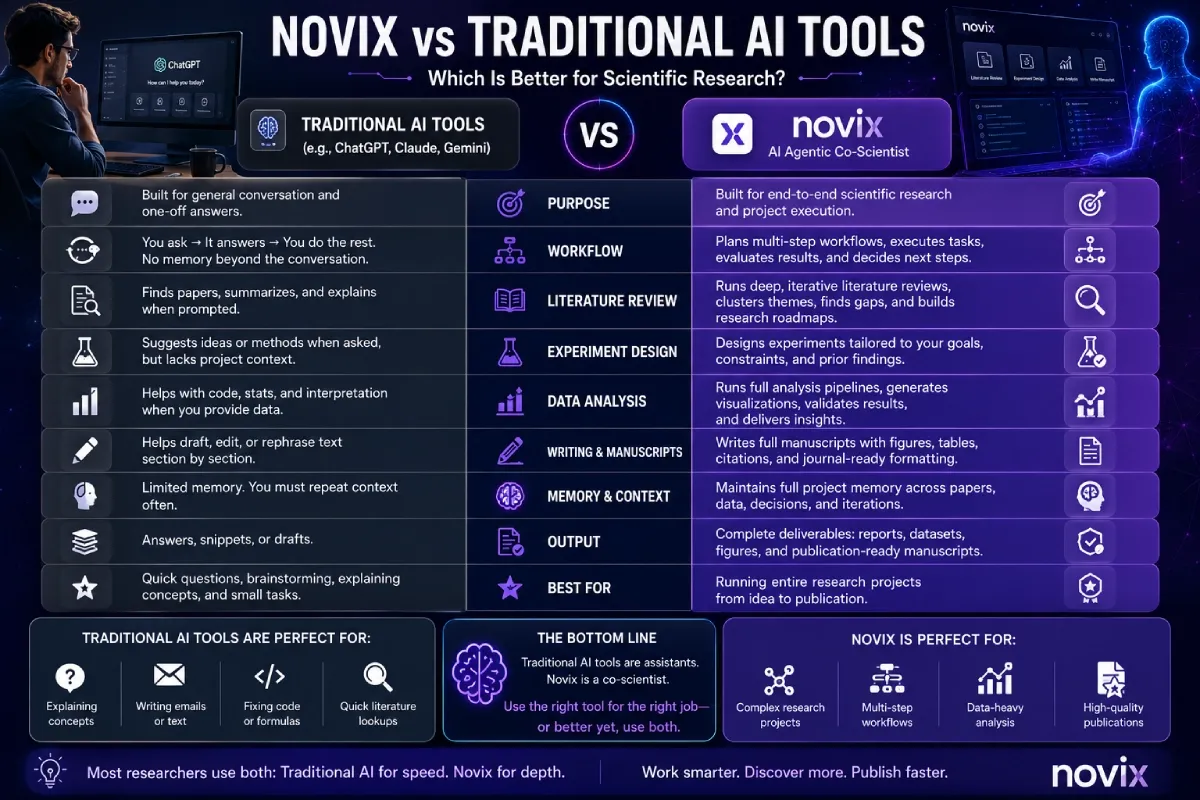
Traditional AI tools like ChatGPT are better for quick, one-off tasks, while Novix is better for running an entire research project end to end. They solve different problems — and most researchers will end up using both. The real question is which one belongs at the center of your scientific workflow.
This comparison breaks down how Novix, an AI agentic co-scientist, stacks up against traditional AI tools across the parts of research that actually matter: literature review, experiment design, analysis, and writing. By the end you'll know exactly which to reach for, and when.
First, what do we mean by "traditional AI tools"?
"Traditional AI tools" here covers the two categories most researchers already use:
- General-purpose chatbots — ChatGPT, Claude, Gemini, and similar assistants you prompt one question at a time.
- Single-purpose research apps — literature search tools, PDF summarizers, citation managers, and standalone stats or coding tools that each handle one slice of the workflow.
Both are useful. But both share a defining limitation: they operate one task at a time and wait for you to drive. You are the orchestration layer that connects them.
Novix is built on a different premise.
The core difference: assistant vs. agent
A traditional AI tool is an assistant — it responds to a prompt and stops. You decide the next step, switch tools, copy the output across, and prompt again.
Novix is an agent — or more precisely, a multi-agent system. You set a research goal, and its agents autonomously plan and execute the workflow from concept development through experimental validation, with minimal manual intervention.
In other words: with a chatbot, you run the project and the AI helps with pieces. With Novix, the platform runs the project and you supervise. That single distinction drives almost every difference below.
Head-to-head comparison
| Dimension | Traditional AI Tools | Novix AI Co-Scientist |
|---|---|---|
| Scope | One task at a time | Full research lifecycle, end to end |
| Operating mode | Prompt-and-respond | Autonomous multi-agent orchestration |
| Literature review | Summarizes what you paste in | Scans, synthesizes, and finds knowledge gaps across large bodies of work |
| Hypothesis generation | Brainstorms on request | Proposes novel, data-driven hypotheses from the literature |
| Experiment design | Suggests ideas in text | Generates protocols, statistical methods, and validation frameworks — and can implement models |
| Data analysis | Helps with code snippets | Runs statistical analysis and produces publication-ready figures |
| Manuscript writing | Drafts sections you assemble | Auto-drafts a full, structured, publication-ready paper |
| Workflow continuity | You stitch tools together | Unified in one platform |
| Best for | Fast, flexible, one-off help | Running a complete research project |
Where Novix wins
Full research lifecycle in one place
Traditional tools each own one step. Novix orchestrates the entire arc — idea conception, algorithm design, validation, and manuscript creation — so you stop losing time and context to handoffs between apps.
Autonomous execution, not just answers
Because Novix's agents manage the process themselves, you can delegate a multi-step workflow rather than manually prompting through every stage. That's the difference between getting help with a task and getting a task done.
Research-grade depth
Novix is purpose-built for science: it designs validation frameworks, builds and tunes ML models for scientific applications, and produces publication-ready figures and manuscripts. General chatbots can gesture at these, but they aren't engineered around the research lifecycle.
Transparent evaluation
Novix is built on an open-source benchmark suite that uses human expert-written papers as ground truth and scores outputs on novelty, experimental comprehensiveness, and theoretical foundation. Most general AI tools give you no comparable, research-specific quality signal.
Where traditional AI tools win
A fair comparison has to name this clearly — and it actually helps you decide:
- Quick, one-off questions. If you just need a concept explained, a paragraph polished, or a snippet of code debugged, a general chatbot is faster and lighter than spinning up a full research workflow.
- Maximum flexibility. General-purpose tools aren't tied to a research lifecycle, so they're handy for anything from emails to slide outlines to brainstorming.
- Ubiquity and familiarity. You probably already have them open, with zero new setup.
- Cost at the margins. For trivial tasks, the free tier of a general chatbot is all you need.
The honest takeaway: traditional AI tools are excellent utilities. They're just not designed to run a research project.
Which should you choose? A simple decision guide
Choose based on the job in front of you:
- Reach for a traditional AI tool when you have a single, contained task — explain this, summarize that, fix this code, reword this paragraph.
- Reach for Novix when you're running an actual research project — generating hypotheses, designing and validating experiments, analyzing data, and producing a manuscript.
For most researchers the answer isn't either/or. Use general AI tools as everyday utilities, and use Novix as the backbone of your scientific workflow. The mistake is forcing a one-prompt assistant to do a job that needs an orchestrated, multi-step agent — that's where the lost weeks come from.
FAQ: Novix vs Traditional AI Tools
Is Novix better than ChatGPT for research?
Can't I just use a chatbot for everything?
Does Novix replace my other AI tools?
Is Novix harder to use than a chatbot?
How much does it cost to compare them myself?
Comparing Novix to traditional AI tools is a bit like comparing a research team to a smart search box — both are valuable, but they're built for different jobs. Traditional AI tools win on speed and flexibility for one-off tasks. Novix wins on running the entire scientific workflow autonomously.
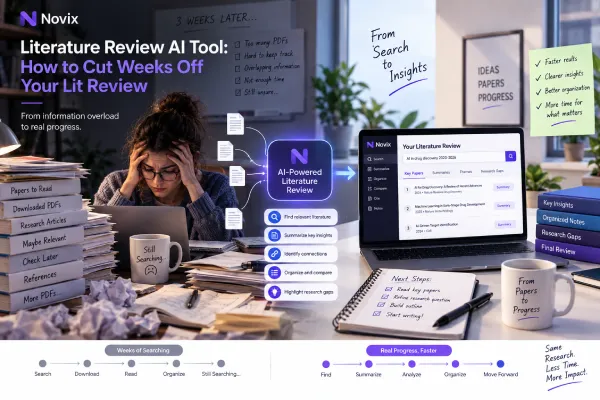
If your bottleneck is the occasional question, a chatbot is plenty. If your bottleneck is the workflow itself — the weeks lost to literature review, experiment design, and writing — that's exactly what Novix is built to fix.
The fastest way to settle the comparison is to run one real project through both. Try Novix free at novix science and see which belongs at the center of your research.
La elección de comprar camisetas de fútbol retro mejora al comparar el escudo, el cuello y la disposición de los patrocinadores. El pedido puede cerrarse después de confirmar las instrucciones de conservación para estampados y bordados.