Novix Notebook: The Research Workspace Where Your AI Co-Scientist Lives
Every researcher has lived some version of the same mess: a hypothesis scribbled in one Google Doc, PDFs scattered across a dozen browser tabs, code in a separate repo, and results buried in a folder called "final_v3_actually_final." The ideas are connected, but the tools that hold them almost never are. By the time a project is ready to write up, half the context that shaped it has already been lost.
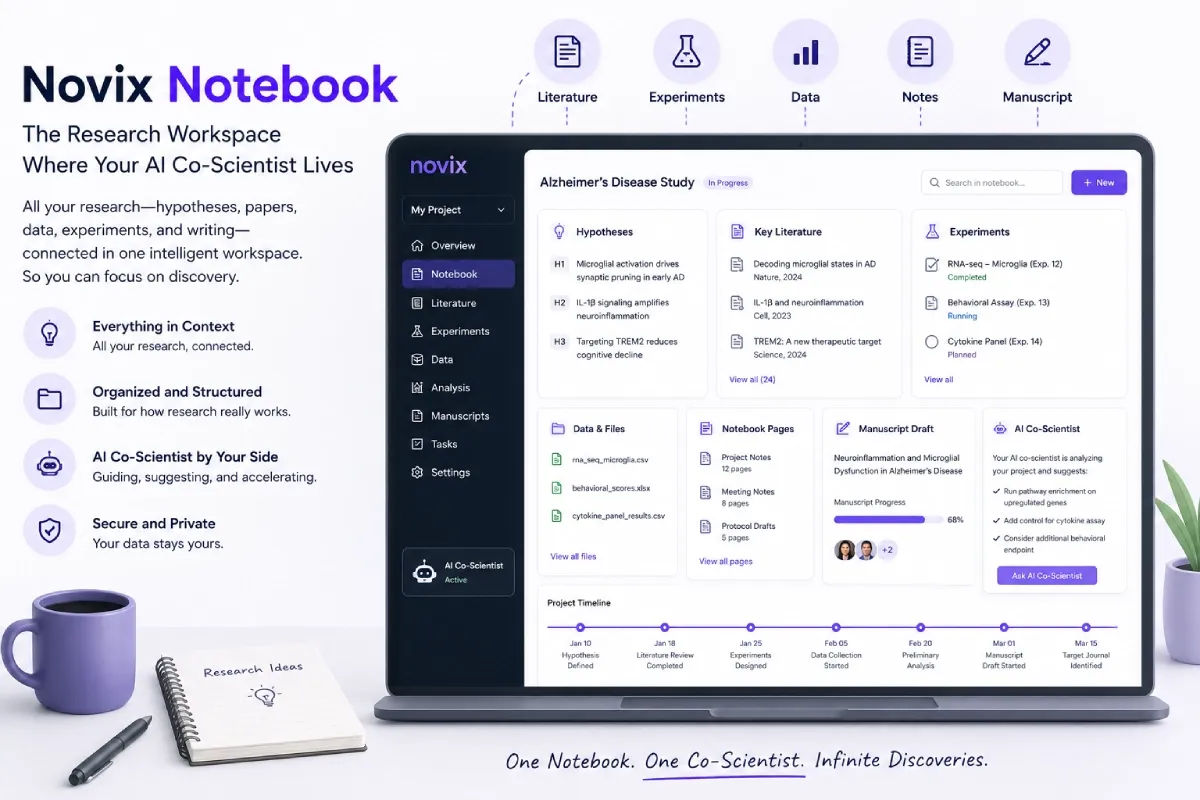
The Novix Notebook exists to close that gap. It's the working surface inside Novix where a project actually lives — the place your hypotheses, literature, experiment logs, data, and manuscript drafts sit next to each other instead of scattered across five apps. This article walks through what the Notebook is, how it's structured, and why it changes the day-to-day experience of running a research project with an AI agent.
What is the Novix Notebook?
The Notebook is the persistent workspace attached to every research project you run in Novix. Rather than treating each interaction as a one-off chat, Novix keeps a running, structured record of the project as it develops — the goal you set, the literature the agents pulled in, the hypotheses generated, the methods designed, the results produced, and the draft manuscript taking shape.
Think of it less like a chat history and more like an electronic lab notebook that an AI co-scientist keeps updated for you in real time. Every stage the Novix agents complete gets written back into the Notebook, so the project has a single source of truth instead of a trail of disconnected outputs.
Why a notebook instead of a chat log?
Chat interfaces are built for conversation, not for the shape of a research project. A conversation is linear; a project is not. You circle back to earlier hypotheses after new data comes in. You revisit the literature review once your methods change. You need to see how an early assumption connects to a later result.
A notebook structure supports that kind of nonlinear work in a few concrete ways:
- Everything stays addressable. You can jump back to the literature synthesis from week one without scrolling through unrelated messages.
- Context persists across sessions. The agents don't start from zero each time you return; they pick up from where the project actually stands.
- Different research artifacts get different treatment. A hypothesis, a dataset, and a draft paragraph aren't the same kind of object, and the Notebook doesn't force them to look alike.
What lives inside a Novix Notebook
A typical project Notebook is organized around the stages of the research lifecycle, though you're free to move between them non-sequentially:
- Goal and scope. The research question or objective you set at the start, refined as the project evolves.
- Literature synthesis. Summaries, gap analysis, and citations the agents pulled together during the review stage.
- Hypotheses. The data-driven hypotheses Novix proposed, along with the reasoning behind each one.
- Methods and experiment design. Protocols, statistical approaches, and validation frameworks tied to the hypotheses they support.
- Data and results. Analysis outputs, figures, and visualizations generated as the project runs.
- Manuscript draft. The evolving write-up that pulls the above sections into a coherent paper.
Because these sections are linked rather than siloed, editing an assumption in the hypothesis section can prompt Novix to flag downstream sections that may need a second look — something a stack of separate documents can't do on its own.
How the Notebook fits into the Novix workflow
The Notebook isn't a separate product bolted onto Novix; it's the visible surface of how the Novix scientific research AI agent actually works. Behind the scenes, specialized agents handle idea generation, literature review, method design, data analysis, and manuscript writing. The Notebook is where the outputs of those agents accumulate, get reviewed, and get revised.
Practically, that means you can:
Al considerar camisetas de fútbol retro de manga larga, la decisión resulta más sencilla cuando se confirma el uso previsto entre colección, exposición y uso diario. Antes de pagar, es útil verificar las diferencias de ajuste entre una camiseta retro y una actual.
- Start a project by setting a goal or uploading reference papers, which seeds the Notebook.
- Watch it fill in as agents complete each stage — literature synthesis, hypotheses, methods, analysis.
- Edit and redirect any section directly, which propagates context to the agents working on connected sections.
- Export or continue toward a full manuscript once the project reaches that stage.
Who benefits most from a structured research notebook
- PhD students juggling a single, long-running project who need one place to track how the thesis argument developed.
- Lab teams collaborating on a shared project, where a single Notebook keeps everyone working from the same version of the literature and hypotheses.
- Researchers switching between projects, since each Notebook preserves full context and picks up instantly when you return.
- Interdisciplinary researchers who need to trace how an idea from one domain's literature shaped a hypothesis or method elsewhere in the project.
Novix Notebook vs. a standard document or wiki
| Aspect | Standard Doc / Wiki | Novix Notebook |
|---|---|---|
| Structure | Manual, freeform | Organized around the research lifecycle |
| Updates | You write everything yourself | AI agents populate and update sections |
| Cross-linking | Manual cross-referencing | Connected sections flag downstream impact |
| Continuity | Depends on your own habits | Persists automatically across sessions |
| Output | Static text | Feeds directly into manuscript drafting |