Multimodal AI Agents in Scientific Research: What You Need to Know
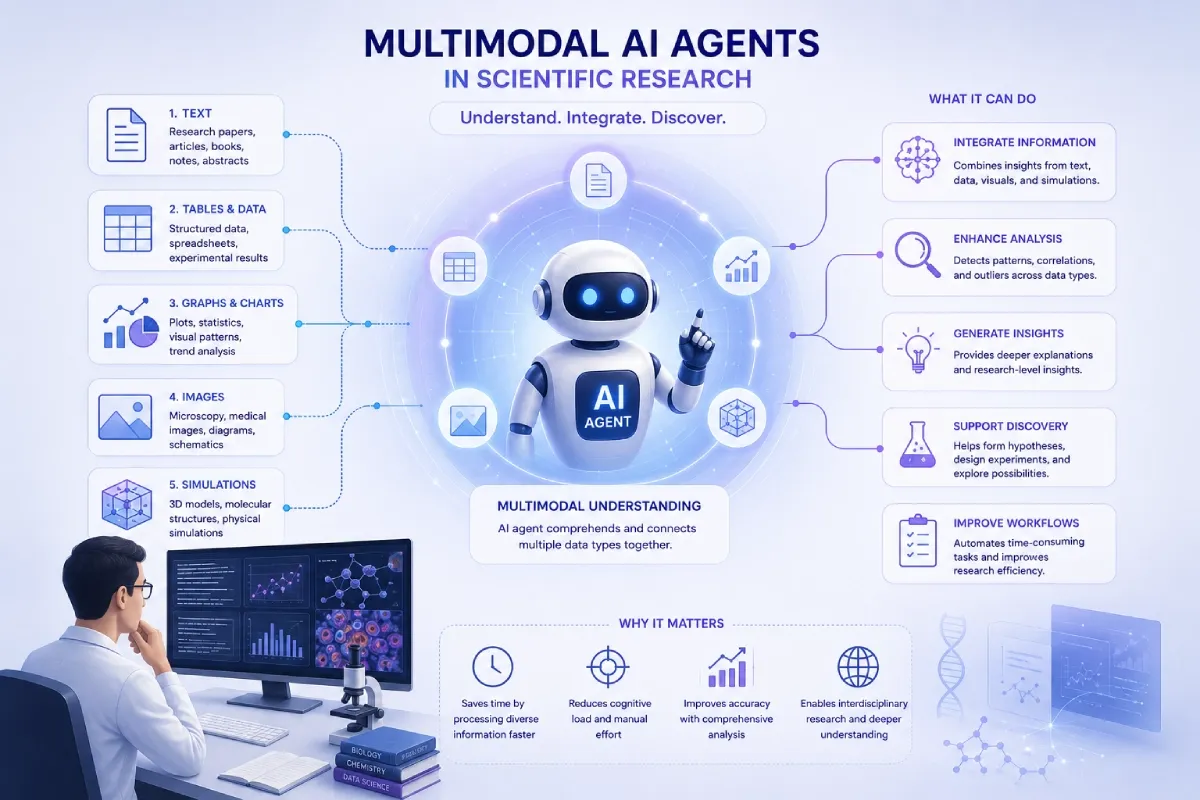
Scientific research is no longer limited to text-based information. Modern research involves multiple data formats—research papers, datasets, graphs, images, simulations, and more. Managing and interpreting this diverse information is one of the biggest challenges researchers face today.
This is where multimodal AI agents are becoming increasingly important.
Unlike traditional AI systems that process only text, multimodal AI agents can understand and integrate multiple types of data simultaneously. This makes them particularly valuable in scientific research, where insights often emerge from connecting different forms of information.
As research becomes more data-rich and interdisciplinary, multimodal AI agents are emerging as a key component of future research workflows.
What Are Multimodal AI Agents?
Multimodal AI agents are systems that can process and analyze multiple types of inputs, such as:
- Text (research papers, notes)
- Numerical data (datasets, results)
- Visuals (graphs, charts, images)
- Structured data (tables, models)
Instead of treating each data type separately, these agents combine them to provide more comprehensive insights.
For researchers, this means moving from isolated analysis to integrated understanding.
Why Multimodal AI Matters in Research
Scientific knowledge is inherently multimodal. For example:
- A research paper may include text, figures, and tables
- Experimental results may involve numerical data and visualizations
- Simulations may combine models and graphical outputs
Traditional tools often require researchers to switch between formats manually. Multimodal AI agents reduce this friction by enabling:
- Unified analysis
- Better interpretation of complex information
- Faster synthesis of insights
This makes them especially useful in fields such as life sciences, physics, engineering, and data-driven research.
Key Capabilities of Multimodal AI Agents
1. Integrated Data Understanding
Multimodal AI agents can combine information from different sources to provide a holistic view.
For example:
- Interpreting a graph alongside its corresponding research text
- Connecting dataset trends with theoretical explanations
This leads to deeper and more accurate insights.
2. Enhanced Pattern Recognition
By analyzing multiple data types together, these agents can:
- Identify patterns that may not be visible in a single format
- Detect relationships between variables and visual outputs
- Highlight inconsistencies across sources
This improves the overall quality of analysis.
3. Improved Communication of Findings
Multimodal AI agents help researchers:
- Translate complex data into clear explanations
- Connect visuals with textual descriptions
- Improve clarity in research presentations and papers
This is particularly valuable for communicating results effectively.
4. Support for Complex Research Workflows
Research often involves moving between different types of information. Multimodal AI agents:
- Reduce the need for manual switching
- Maintain context across formats
- Support multi-step workflows
This improves efficiency and reduces cognitive load.
Use Cases of Multimodal AI Agents in Scientific Research
Literature Review with Visual Context
Researchers can use multimodal AI agents to:
- Analyze research papers along with figures and tables
- Understand visual data in context
- Compare findings across studies more effectively
Data Analysis and Visualization
As an extension of an ai agent for data analysis, multimodal systems help:
- Interpret charts and graphs
- Connect numerical data with visual outputs
- Explain complex analytical results
Interdisciplinary Research
In interdisciplinary projects, researchers often deal with diverse data formats. Multimodal AI agents help:
- Integrate knowledge across domains
- Maintain consistency in interpretation
- Bridge gaps between different types of data
Research Writing and Presentation
Multimodal AI agents assist in:
- Structuring research papers with visual references
- Explaining figures and results clearly
- Improving overall communication of findings
Benefits of Multimodal AI Agents
Better Insight Generation
Combining multiple data types leads to more comprehensive understanding.
Increased Efficiency
Researchers spend less time switching between tools and formats.
Improved Accuracy
Cross-referencing data reduces the risk of misinterpretation.
Enhanced Communication
Findings become easier to explain and present.
Limitations and Challenges
Despite their advantages, multimodal AI agents have limitations:
Data Integration Complexity
Combining different data types requires advanced systems.
Interpretation Risks
AI-generated interpretations must be validated.
Dependence on Input Quality
Poor or incomplete data affects results.
Need for Human Oversight
Researchers must ensure accuracy and relevance.
These tools should be used as assistive systems, not decision-makers.
Role of Novix in Multimodal Research Workflows
Novix supports research workflows that involve multiple types of information, aligning with the principles of multimodal AI systems.
Researchers use Novix to:
- Understand complex research materials
- Connect insights across data and text
- Improve clarity in analysis and writing
- Support structured reasoning
While not positioned as a purely multimodal system, Novix reflects the broader trend of integrated AI support in research workflows.
Multimodal AI Agents vs Traditional AI Tools
Multimodal systems provide a more complete approach to research analysis.
The Future of Multimodal AI in Research
As research becomes more complex, multimodal AI agents will play an increasingly important role.
Al considerar camisetas clásicas de fútbol, la decisión resulta más sencilla cuando se confirma el tipo de tejido y el corte propio de la época. Como comprobación final, conviene asegurarse de las instrucciones de conservación para estampados y bordados.
Future developments may include:
- Better integration of diverse data formats
- More accurate interpretation of visuals and data
- Enhanced collaboration between AI systems and researchers
- Greater adoption across disciplines
These advancements will help researchers manage complexity and improve outcomes.