How to Use AI for Research Paper Writing Without Losing Credibility
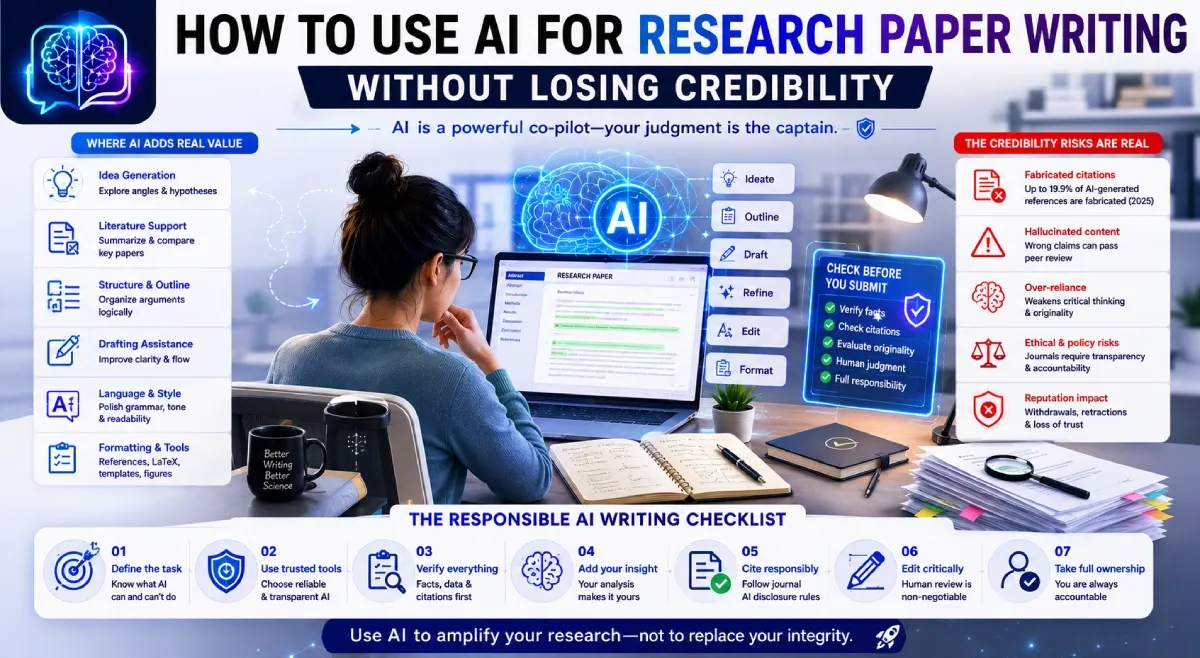
In 2025, Springer Nature retracted a machine learning textbook after independent reviewers found that roughly two-thirds of its sampled citations either did not exist or were materially inaccurate — classic markers of AI-generated fabrication. At NeurIPS 2025, an analysis of 4,841 accepted papers identified at least 100 hallucinated citations across roughly 53 papers, every one of which had been read by three to five expert reviewers. A peer-reviewed 2025 study in PubMed Central found that 19.9% of AI-generated references were entirely fabricated.
The lesson is not that researchers should stop using AI. Most already use it, and the productivity gains for the right tasks are real. The lesson is that how to use AI for research paper writing is now a credibility question, not just a workflow question. This guide is the practical, evidence-based version of that answer: the consensus position of the major publishing authorities, the credibility risks you actually need to manage, and a concrete checklist for using AI in your manuscript without putting your reputation, your paper, or your funding on the line.
The Stakes: What "Losing Credibility" Actually Looks Like
The failure modes are no longer theoretical:
- Retraction. Papers and even entire textbooks have been pulled after fabricated AI citations were discovered post-publication. Retractions are permanent, public, and follow you.
- Editorial action mid-review. Several major publishers — including Elsevier, Springer Nature, and Sage — reserve the right to reject submissions if undisclosed AI use comes to light during review.
- Funding consequences. The NIH (NOT-OD-23-149) and similar bodies have begun explicitly addressing AI use in grant work. Improper use can trigger compliance inquiries.
- Reputation damage at the personal level. A reviewer who spots a hallucinated citation in your paper remembers your name. So does your editor.
The cost of cutting corners with AI is now demonstrably higher than the time saved by skipping verification. The good news is that the rules are clear, public, and consistent across the bodies that matter.
The Consensus from Publishing Authorities
There is a remarkably tight consensus across the bodies that set scholarly publishing norms — ICMJE, COPE, WAME, STM, and EASE. The April 2025 update from the International Committee of Medical Journal Editors (ICMJE) crystallized what had been emerging for two years, and the other organizations align with the same four principles.
1. AI cannot be an author. ICMJE, COPE, WAME, and every major publisher (Nature, Science, Elsevier, Wiley, Springer Nature, JAMA Network, The Lancet) agree: AI tools cannot be listed as authors because they cannot accept responsibility for the work, sign forms, manage conflicts of interest, or attest to integrity.
2. AI use must be disclosed. If you used AI in any meaningful way during manuscript preparation — drafting, analysis, image generation — disclosure is required. ICMJE specifically requires authors to "describe, in both the cover letter and the submitted work, how they used it."
3. Where you disclose depends on what you used AI for. The ICMJE's 2024 clarification (reinforced in 2025) drew a useful line: writing assistance goes in the acknowledgments; AI used for data collection, analysis, or figure generation goes in the methods. The JAMA Network's 2024 guidance (Flanagin et al., JAMA 2024;331(13):1096–1098) reflects the same split.
4. Authors remain fully responsible. Every body is explicit on this: AI assistance does not transfer responsibility. If a citation is wrong, a number is wrong, or a claim is unsupported, it's your name on the paper. This is the principle that makes everything else enforceable.
These four principles are now the working baseline. Individual journal policies build on them with specifics, but no major publisher contradicts the consensus.
The Credibility Checklist: How to Use AI for Research Paper Writing the Right Way
Concrete practices that keep you on the right side of the consensus — and out of the failure modes above.
1. Choose tools that ground every claim in a real source. This is the single biggest credibility lever. Tools that use retrieval-augmented generation and link every claim to a verifiable paper are dramatically safer than pure text generators. If an AI tool produces a citation you cannot click through to a real, retrievable source, treat it as suspect. (For a deeper look at the tool landscape, see AI Tools for Writing Research Papers: What Scientists Should Know.)
2. Verify every citation against the source. Always. Hallucination rates of 17–33% across mainstream AI tools mean that an unverified bibliography is a credibility time bomb. Pull each citation, confirm the authors, the year, the venue, the title, and — critically — that the cited paper actually supports the claim you're attaching it to. AI tools frequently cite real papers for claims those papers do not make.
3. Maintain your own voice. Reviewers and editors increasingly recognize AI-written prose: generic phrasing, suspicious uniformity, missing field-specific nuance, oddly hedged language. Use AI to draft; then rewrite in your voice. The final manuscript should read like you wrote it, because at the level of meaning, you did.
4. Disclose in the right place. Use ICMJE's split as a default. Writing help, language polishing, paraphrasing → acknowledgments. AI for data analysis, statistical work, image generation → methods. Many journals also ask for a separate AI disclosure statement at submission. Check your target journal's instructions for authors before you write the cover letter.
5. Document your process. Keep a brief internal record of which AI tools you used, for what purpose, and at what stage. This costs nothing and protects you if any aspect of the work is later questioned.
6. Protect confidential or unpublished data. Many AI services retain inputs, train on them, or both. Before uploading unpublished data, proprietary protocols, or pre-submission manuscripts, check the tool's data policy. Choose tools with explicit no-training, no-retention guarantees for sensitive work.
7. Do not let AI generate citations from scratch. Generate the citation list yourself, or use tools that retrieve real papers and let you cite them — never tools that "produce" a bibliography. This is where most retractions originate.
8. Do not generate or modify scientific images with generative AI. ICMJE, Nature, Science, and most major journals explicitly prohibit AI-generated or AI-altered figures. The only exceptions are clearly disclosed schematic illustrations.
9. Run the final review yourself. Read the final manuscript end to end, in one sitting, without the AI in the loop. This is when you catch the conditional language that got flattened, the citation that doesn't quite fit, the sentence that doesn't sound like you. (Our piece on how reliable AI paper review tools actually are covers what AI is and isn't good at in this final-review step.)
What Separates Safe AI Use from Misconduct
A clean line emerges from the consensus. Safe AI use is transparent, verified, and supportive — AI helps you draft, analyze, summarize, or polish, you check everything, and you disclose. Misconduct is when AI generates content you don't verify, when its use isn't disclosed, when it produces fabricated citations or data that enter the published record, or when it's used in ways the journal explicitly prohibits.
The line is bright, not blurry. Stay on the right side of it and AI is a force multiplier on your work. Cross it — usually by skipping verification or disclosure — and the same tools that accelerated the paper become the reason it gets retracted. The recent failures we cited at the top all share the same root cause: not the AI, but the absence of human verification.
For the broader debate on where AI fits in the research workflow, see our piece on whether AI can replace literature review.
Una comparación útil de camisetas de fútbol de manga larga comienza por la temperatura prevista y la posibilidad de usar capas. Para evitar errores, merece la pena revisar la composición del tejido y su comportamiento con el uso.
The Takeaway
How to use AI for research paper writing without losing credibility comes down to four things: verify every citation, maintain your own voice, disclose your use according to the ICMJE-aligned consensus, and never outsource final responsibility for accuracy. Do those four things and AI becomes one of the most useful tools available to a working scientist. Skip any of them and you're one careful reviewer away from a problem you cannot undo.
The tools that make this easiest are the ones designed for research workflows from the ground up — built around grounded citations, verifiable outputs, and integration with the rest of the research process rather than generic text generation. Explore Novix's AI co-scientist platform to see what end-to-end, research-grade AI looks like in practice.