How to Evaluate AI Tools for Scientific Research Before You Commit
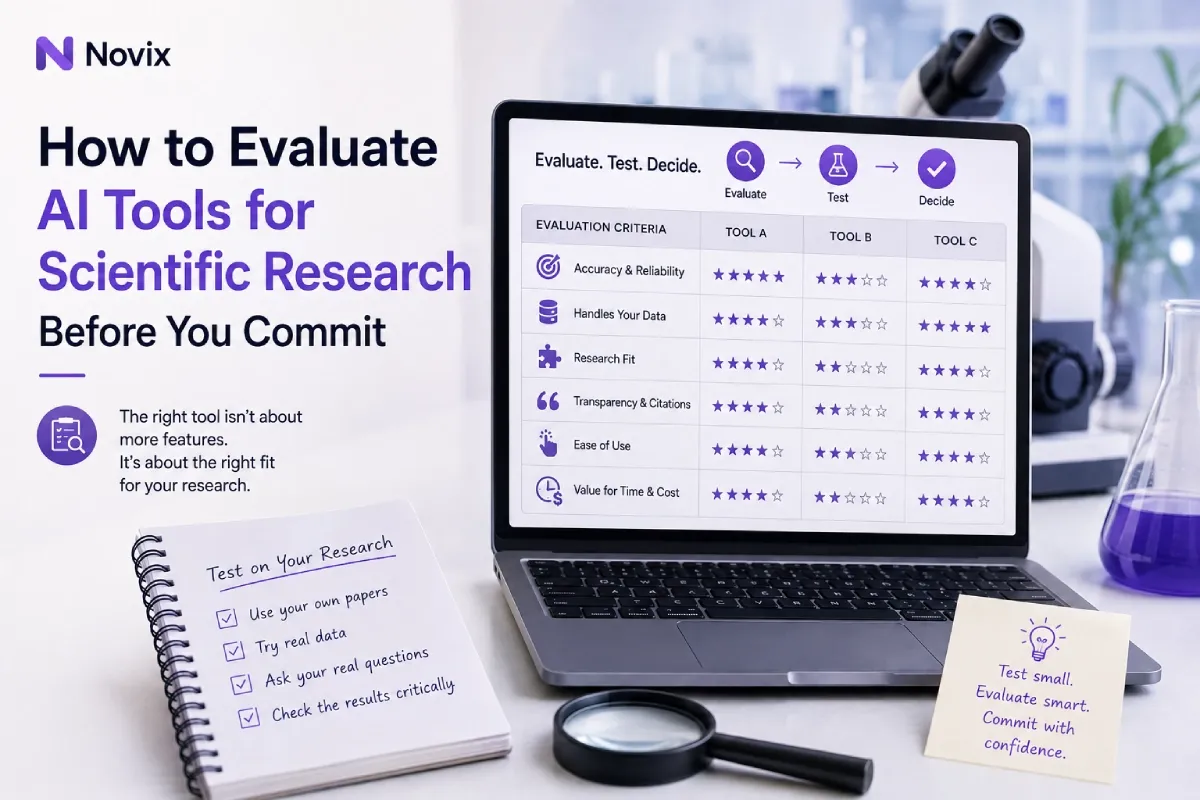
Adopting an AI tool for a real research project is a bigger decision than it looks like from a demo. A tool that performs well on a curated example can fall apart on your actual literature, your actual data, and your actual, messier hypotheses. Evaluating AI tools for scientific research properly means testing them against your real work before you build a workflow — or a paper — around them.
This is a practical evaluation process, not a feature checklist. It's meant to be run on a small, low-stakes piece of your own research before you commit anything important to a new tool.
Step 1: Run it on a project you already understand deeply
The single best test is comparing a tool's output against work you've already done and know well. If you've completed a literature review manually in the past, feed the same body of literature to the tool and compare its synthesis against what you know to be true about that field. Discrepancies here tell you more than any marketing claim.
Step 2: Check citation accuracy directly, not by trusting the tool's confidence
Every citation an AI tool produces should be independently verified — not sampled occasionally, but checked systematically during evaluation. Pull a batch of citations the tool generates and confirm each one exists, says what the tool claims, and is actually relevant. If you find even a small number of fabricated or misrepresented citations during this test, treat it as a serious red flag rather than a fixable quirk.
Step 3: Test hypothesis quality against a known gap
If you already know a genuine gap in your field's literature — something you or a colleague identified independently — see whether the tool can surface something similar when given the relevant papers. A tool that only ever proposes generic, low-risk hypotheses isn't doing the harder work of genuine gap analysis.
Step 4: Evaluate how it handles being wrong
No AI tool for scientific research will be right every time. What matters is what happens when it's wrong: does it present uncertain claims with appropriate hedging, or does everything come out with the same confident tone regardless of how well-supported it is? A tool that can't signal its own uncertainty is harder to trust even when it's usually correct.
Step 5: Test continuity across a multi-session project
Start a small project, work with the tool for a session, then come back a few days later and see how much context survives. Tools that force you to re-explain your project every time you return will slow you down in exactly the way they're supposed to prevent.
Step 6: Ask about the evaluation methodology behind the tool itself
A tool making strong performance claims should be able to explain how those claims are measured — ideally against an open, reproducible benchmark that compares outputs to human expert work, not an internal, unverifiable metric.
Step 7: Confirm data handling and disclosure implications
Before committing real, unpublished research to a tool, understand how your data is stored and used, and check whether your institution or target journal has specific requirements around disclosing AI assistance.
An evaluation scorecard you can reuse
| Test | What a Pass Looks Like | Warning Sign |
|---|---|---|
| Literature synthesis on known material | Matches your own understanding of the field | Misses well-known findings or debates |
| Citation accuracy | Every sampled citation checks out | Any fabricated or misrepresented source |
| Hypothesis quality | Surfaces genuine, non-obvious gaps | Only generic, low-risk suggestions |
| Handling uncertainty | Appropriately hedges weaker claims | Uniform confidence regardless of evidence |
| Multi-session continuity | Context persists across sessions | Requires re-explaining the project each time |
| Evaluation transparency | Clear, reproducible benchmarking | Unverifiable or absent performance claims |
| Data handling | Clear policy, disclosure guidance available | Vague or unavailable data policy |
How Novix is built to hold up under this kind of scrutiny
Novix is evaluated on an open-source benchmark suite that uses human expert-written papers as ground truth, scoring outputs across dimensions like novelty, experimental comprehensiveness, and theoretical foundation — the kind of transparent methodology step 6 above asks you to look for. Its multi-agent architecture is also built specifically for context persistence across sessions, so a project you return to after a break doesn't require re-establishing everything from scratch.
What to do if a tool fails part of the evaluation
Not every failure is disqualifying. A tool that's strong on literature synthesis but weak on continuity might still be useful for a single, contained task even if it's not ready to anchor an entire project. Be specific about which parts of the evaluation a tool passed and which it didn't, rather than making an all-or-nothing judgment from a single weak point.
Frequently Asked Questions
How long should a proper evaluation of an AI research tool take?
Enough time to run it against a real, multi-session piece of your own work — often a few days to a couple of weeks, not a single demo session.
Is it safe to trust a tool's stated accuracy claims?
Only if they're backed by a transparent, reproducible evaluation methodology. Unverifiable claims should be treated with skepticism regardless of how confidently they're presented.
What's the single most important test in this process?
Citation accuracy verification — it's the area where errors most directly damage credibility if they go unchecked.
Should I evaluate different tools for different stages of research?
It's reasonable to use specialized tools for narrow tasks, but for full-project work, evaluate whether one tool can maintain context and quality across the entire workflow rather than assuming point solutions will connect smoothly.