How Novix Works: Inside an AI Agent Built for Scientific Research
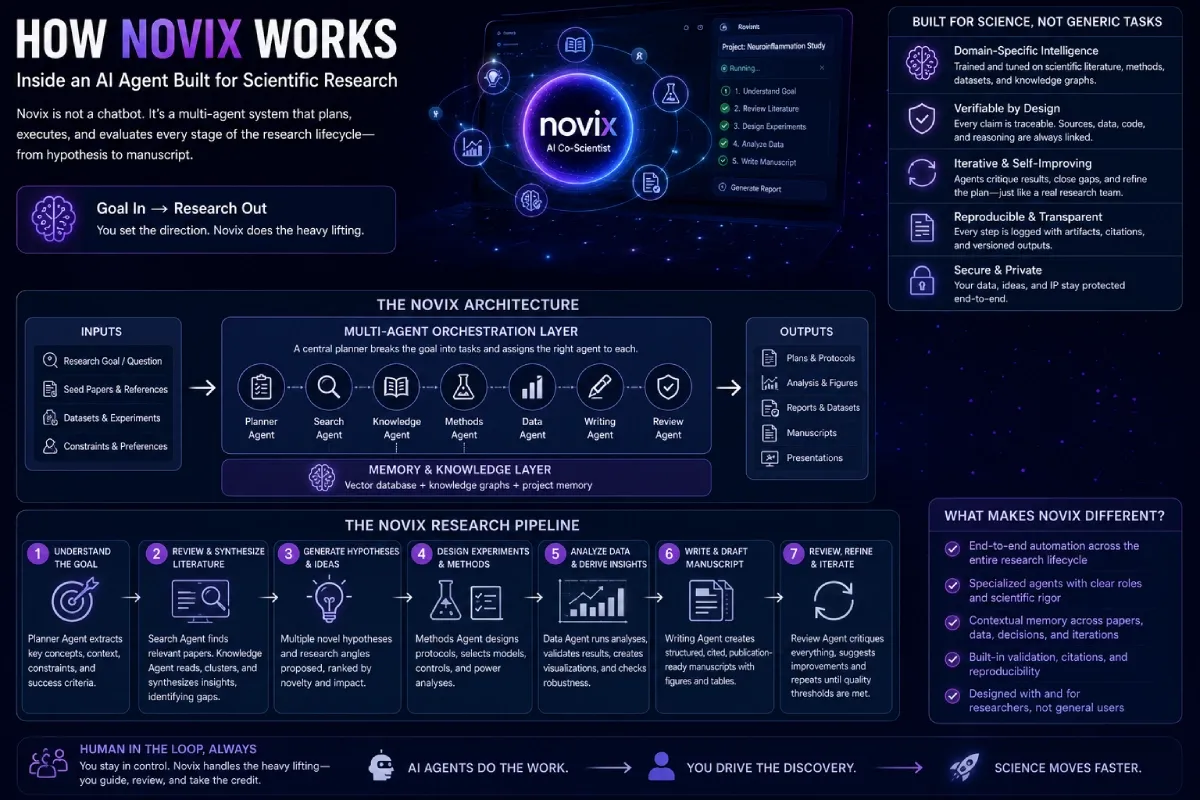
Novix works as a multi-agent system: instead of answering one prompt at a time, it deploys specialized AI agents that plan, execute, and evaluate each stage of a research project — from hypothesis to manuscript — with minimal human intervention. This article opens the hood on how that actually happens.
If you've used Novix or read What Is Novix?, you know what it does. Here we focus on how it does it: the architecture, the pipeline, and the design choices that make it an AI agent built specifically for science rather than a general chatbot wearing a lab coat.
The big idea: agentic, not just generative
Most AI tools are generative — you give a prompt, they generate a response, and the loop ends. You're responsible for deciding what happens next.
Novix is agentic. An AI agent doesn't just respond; it pursues a goal. Given an objective, agentic systems generally follow a loop: plan the steps needed, act on each step (often by calling tools or running code), evaluate the result, and refine or move on. That loop is what lets a system carry a multi-step project forward on its own.
Novix applies this pattern to scientific research. You set the goal; its agents plan the research, execute each stage, check their own work, and progress toward a finished output. Understanding that loop is the key to understanding everything below.
The architecture: a team of specialized agents
A single model trying to do everything tends to do each thing poorly. Novix instead uses a multi-agent architecture, where different agents specialize in different parts of the research process and coordinate to move a project from concept to completion.
Think of it less like one genius working alone and more like a small research team with defined roles — one focused on surveying the literature, another on designing methods, another on analysis, another on writing — coordinated toward a shared objective. This division of labor is what allows Novix to handle the full research lifecycle instead of one isolated step.
Two engineering choices make this practical:
- Multiple LLM provider support. Novix isn't locked to a single model. Supporting multiple providers lets it route work appropriately and stay flexible as models evolve.
- Out-of-the-box functionality. The orchestration is pre-built, so you don't assemble the agents yourself — you simply state a goal or supply papers and the system takes over.
Inside the pipeline: the five stages of a Novix project
Here's how a research project actually flows through Novix, stage by stage.
Stage 1 — Idea generation and literature review
The project begins with input that can be as light as a few reference papers or as specific as a fully formed research idea. Novix scans, synthesizes, and summarizes large bodies of scientific literature, identifying knowledge gaps, emerging trends, and unexplored connections across thousands of papers. From those patterns, it proposes novel, data-driven hypotheses. This is the agent doing in hours what manual review takes weeks to accomplish.
Stage 2 — Method design and implementation
With a hypothesis in hand, Novix designs comprehensive experimental protocols — including detailed methodologies, statistical approaches, and validation frameworks tailored to the research objective. Crucially, it doesn't stop at describing the method: for machine learning applications, it can build, train, and optimize models, including automated hyperparameter tuning. The plan becomes an executable experiment.
Stage 3 — Data analysis and visualization
Once experiments produce data, Novix performs statistical analysis, pattern recognition, and data mining to extract meaningful insights. It then generates publication-ready visualizations — interactive charts and scientific figures with automated styling and formatting — so results are ready to communicate, not just compute.
Stage 4 — Autonomous orchestration
This stage isn't a separate step so much as the thread running through all the others. You set the research goal, and Novix's agents manage the transitions between stages autonomously — deciding what to do next and carrying the work forward without you manually prompting each move. This orchestration is what turns a collection of capabilities into a genuine workflow.
Stage 5 — Manuscript creation
Finally, Novix integrates everything — the research idea, motivation, algorithm frameworks, and validation performance — into a polished, full-length, publication-ready manuscript. Instead of facing a blank page after months of work, you start from a structured draft to review and refine.
How Novix checks its own work
A research agent is only as trustworthy as its ability to evaluate quality — and this is one of the more important parts of how Novix works.
Novix is built on a comprehensive, open-source benchmark suite. Rather than asking you to take its outputs on faith, it evaluates against human expert-written papers used as ground truth, scoring across multiple domains and dimensions — including novelty, experimental comprehensiveness, and theoretical foundation.
This matters for two reasons. First, it gives the agent's internal "evaluate" step a rigorous standard to measure against rather than a vague sense of "good enough." Second, the transparency — an open benchmark — is a deliberate contrast to opaque tools, and it's the kind of signal a scientific audience should expect before trusting any automated output.
A necessary caveat: benchmark-based evaluation supports rigor, but it doesn't replace it. Novix's outputs are a fast, structured first pass — peer review and your own validation remain essential.
Why it's built for science, specifically
Plenty of agents can browse, code, or write. What makes Novix an agent built for scientific research is that every stage maps to a real step in the discovery process:
- Literature synthesis aimed at finding genuine knowledge gaps, not just summaries.
- Method design that includes statistical and validation frameworks, not just ideas.
- Analysis that ends in publication-ready scientific figures.
- Output in the native format of science — a manuscript.
- Evaluation benchmarked against real expert papers.
This lineage isn't accidental. Novix is the productization of a line of academic research on autonomous AI scientists — work that has been recognized at top AI venues — which is why its design mirrors how research is actually done rather than how a general assistant is built.
What this means for you, in practice
Understanding the mechanics changes how you use Novix well:
- Think in projects, not prompts. Because Novix orchestrates a workflow, you'll get the most out of it by handing over a goal and letting the loop run, rather than micromanaging single steps.
- Supply good inputs. A clear objective or a well-chosen set of reference papers gives the agents a stronger starting point.
- Review at the seams. The natural checkpoints are between stages — after hypotheses, after method design, before you accept the manuscript. That's where your judgment adds the most value.
Frequently Asked Questions
Is Novix a single AI model?
No. Novix uses a multi-agent architecture in which specialized agents handle different parts of the research process and coordinate the workflow.
What makes Novix an "agent" rather than an assistant?
It pursues a goal autonomously — planning, executing, and evaluating each stage — instead of only responding to individual prompts.
Does Novix actually run experiments, or just describe them?
For machine learning applications it goes beyond description: it can build, train, and tune models, and run statistical analysis on the resulting data.
Which AI models does Novix use?
Novix supports multiple LLM providers rather than relying on a single model, which keeps it flexible.
How does Novix know if its output is any good?
It's built on an open-source benchmark suite that evaluates outputs against human expert-written papers across dimensions like novelty, comprehensiveness, and theoretical foundation — though human validation is still required.
Novix works by turning the research lifecycle into an orchestrated, multi-agent workflow: specialized agents plan, execute, and evaluate each stage — literature review, method design, analysis, and writing — while you supervise the seams. The agentic loop is what lets it carry a project from idea to manuscript, and the open benchmark suite is what keeps that autonomy accountable.
The best way to understand how it works is to watch it run. Try Novix free at novix.science and follow one project through all five stages yourself.