How AI Powered Research Tools Are Transforming Research Workflows
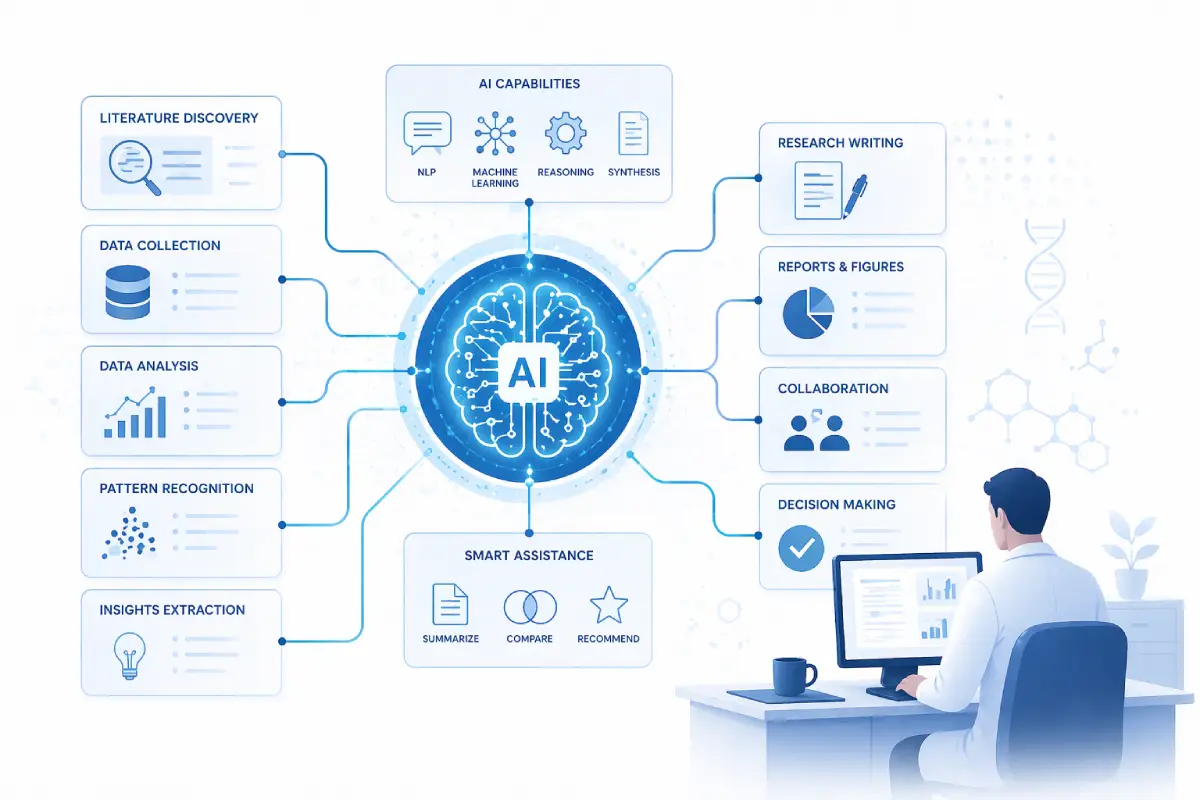
Scientific research workflows are becoming increasingly complex. Researchers today are expected to manage vast volumes of literature, analyze data efficiently, and produce high-quality outputs—all while maintaining scientific rigor and accuracy.
Traditional research methods, while still essential, are no longer sufficient on their own. This is where AI powered research tools are playing a transformative role.
Rather than replacing researchers, these tools act as intelligent support systems, helping scientists navigate complexity, improve clarity, and work more efficiently across different stages of research.
Why Research Workflows Are Evolving
Modern research is no longer linear. It involves continuous iteration between:
- Literature review
- Data analysis
- Hypothesis development
- Writing and revision
With increasing interdisciplinary work, researchers often deal with unfamiliar domains, making workflows even more demanding.
Key challenges include:
- Information overload
- Fragmented tools and processes
- Time-intensive analysis
- Difficulty maintaining consistency
AI powered research tools are emerging as a solution to streamline and integrate these workflows.
What Are AI Powered Research Tools?
AI powered research tools are designed to assist researchers across the research lifecycle. These tools leverage artificial intelligence to:
- Understand complex scientific information
- Support reasoning and analysis
- Improve research writing
- Enhance knowledge synthesis
The best AI tools for researchers are not those that generate quick answers, but those that support structured and responsible thinking.
Key Ways AI Tools Are Transforming Research Workflows
1. Faster and More Effective Literature Review
One of the biggest bottlenecks in research is literature review. AI tools help researchers:
- Quickly understand complex papers
- Extract key insights
- Compare findings across multiple studies
This allows researchers to move from information gathering to analysis much faster.
2. Improved Data Analysis Support
AI tools are increasingly being used as an ai agent for data analysis, helping researchers:
- Interpret datasets
- Identify patterns and trends
- Explore analytical approaches
While they do not replace statistical expertise, they significantly reduce manual effort and improve efficiency.
3. Enhanced Research Writing and Communication
Writing is a critical but time-consuming part of research. AI tools assist by:
- Structuring research papers
- Improving clarity and readability
- Maintaining consistent academic tone
This helps researchers focus more on ideas and insights rather than formatting and language issues.
4. Better Knowledge Synthesis
Scientific research often requires connecting insights from multiple sources. AI tools help by:
- Linking concepts across studies
- Identifying research gaps
- Supporting structured reasoning
This leads to stronger and more coherent research outputs.
5. Reduced Cognitive Load
Research involves constant context switching between reading, writing, and analysis. AI tools reduce this burden by acting as a central support system, allowing researchers to:
- Ask follow-up questions
- Validate understanding
- Maintain focus
This improves both productivity and quality of work.
Role of Novix in Modern Research Workflows
Among modern AI tools, Novix is designed specifically for scientific research.
Unlike generic AI platforms, Novix focuses on:
- Structured reasoning
- Scientific context awareness
- Literature understanding
- Research workflow alignment
Researchers use Novix to:
- Clarify complex concepts
- Compare research findings
- Support writing and analysis
- Improve overall workflow efficiency
This makes it particularly valuable for academic, R&D, and interdisciplinary research environments.
Benefits of Using AI Powered Research Tools
When used responsibly, AI tools offer several advantages:
- Increased research efficiency
- Improved clarity and structure
- Faster literature comprehension
- Reduced manual workload
- Better decision-making support
These benefits enable researchers to focus more on innovation and critical thinking.
Limitations and Responsible Use
Despite their advantages, AI tools must be used carefully. Researchers should:
- Verify all information independently
- Avoid relying solely on AI outputs
- Ensure proper citation and validation
- Maintain scientific integrity
AI tools are assistive technologies, not replacements for expertise or peer review.
The Future of AI Powered Research Workflows
As AI continues to evolve, research workflows will become more integrated and efficient.
Future developments may include:
- More domain-specific AI tools
- Better transparency in reasoning
- Stronger human-AI collaboration
The goal is to enhance research quality while maintaining scientific rigor.
Frequently Asked Questions
What are AI powered research tools?
AI powered research tools are software systems that assist researchers with literature review, data analysis, writing, and knowledge synthesis using artificial intelligence.
How do AI tools improve research workflows?
They reduce manual effort, improve clarity, support analysis, and help researchers manage complex information more efficiently.
Are AI tools reliable for scientific research?
AI tools can be useful, but researchers must verify outputs and ensure accuracy before using them in research.
What is the role of Novix in research workflows?
Novix supports scientific research by helping researchers understand, analyze, and structure complex information effectively.