Choosing the Right AI Tool for Research Papers: A Step-by-Step Framework

The number of AI tools claiming to help with research papers has exploded, and most of them look nearly identical from the landing page: upload a document, get help writing. What actually differs — sometimes enormously — is what happens underneath: how the tool handles citations, whether it can reason across your full argument, and whether its output holds up under a reviewer's scrutiny.
Choosing the wrong tool doesn't just waste time. It can introduce fabricated citations, flatten your argument's nuance, or produce text that reads as generic — all of which cost you credibility, not just hours. This is a step-by-step framework for evaluating an AI tool for research papers before you build a workflow around it.
Step 1: Define what stage you actually need help with
"Help writing a research paper" isn't one task — it's several, and few tools are equally strong at all of them:
- Structuring an argument from a set of findings and existing literature.
- Drafting sections — introduction, methods, discussion — from your notes and results.
- Editing and tightening prose you've already written.
- Formatting and citation management for a target journal.
A tool built primarily for grammar editing will underperform badly if you ask it to structure a full argument. Match the tool to the specific stage you're stuck on, not to the category label on its homepage.
Step 2: Check how it handles citations — carefully
This is the single highest-risk area. In 2025, Springer Nature retracted a machine learning textbook after independent reviewers found that roughly two-thirds of its sampled citations either didn't exist or were materially inaccurate — a textbook case of AI-generated citation fabrication making it past initial review. Before trusting a tool with citations, verify:
- Does it pull from real, verifiable sources, or generate citation-shaped text from pattern prediction?
- Can you trace every citation back to an actual paper before it goes into your draft?
- Does it flag uncertainty, or does it present every citation with the same confident tone regardless of how well-supported it is?
Treat any AI-generated citation as unverified until you've checked it yourself — no exceptions, regardless of how credible the tool claims to be.
Step 3: Test whether it can reason across your full document, not just a paragraph
A meaningful test: give the tool a full draft with an argument that develops across several sections, and see whether its suggestions in the discussion section are actually consistent with what you claimed in the introduction. Many tools operate paragraph-by-paragraph and lose the thread of a longer argument — which shows up as internal inconsistency you won't catch unless you're already an expert reader of your own paper.
Step 4: Evaluate whether it integrates with the rest of your research, or works in isolation
A research paper doesn't come from nowhere — it comes from a literature review, a set of hypotheses, and a body of results. Tools that only see the paper you're currently drafting, disconnected from that upstream context, tend to produce writing that's technically fluent but thin on the specific reasoning that makes a paper convincing. An AI tool that's connected to your actual research process — not just the draft in front of it — can draw directly on the hypotheses and methods that shaped your findings.
Step 5: Check what happens to your data and drafts
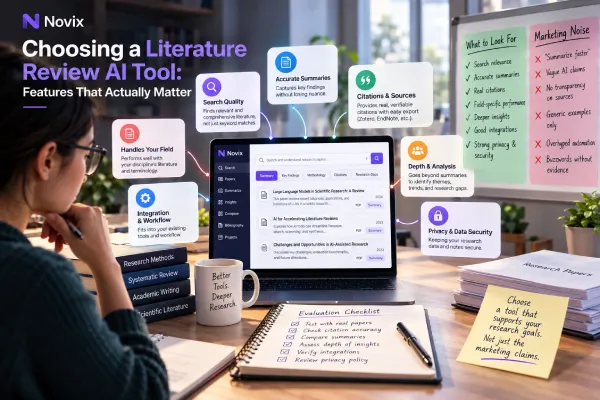
Before uploading unpublished results or a manuscript in progress, confirm how the tool handles your data — whether it's used to train models, how long it's retained, and whether it meets your institution's or journal's policies on AI assistance disclosure.
A practical decision framework
| If your main need is... | Look for a tool that... |
|---|---|
| Structuring an argument from findings | Reasons across the full document, not just paragraphs |
| Drafting full sections from notes | Integrates with your literature and results, not just a blank prompt |
| Citation accuracy | Pulls from verifiable sources and lets you trace every citation |
| Polishing existing prose | Specializes in editing rather than full drafting |
| End-to-end paper production | Connects literature review, methods, and results into one workflow |
Where Novix fits
Novix is built for the last row of that table: rather than treating manuscript drafting as an isolated task, it assembles your paper from the research ideas, methods, algorithm frameworks, and validation results already developed earlier in the project — so the draft reflects the actual reasoning behind your work, not a generic structure filled in around your findings.
Red flags to watch for
- Overconfident citations with no way to verify them.
- Output that reads as generic regardless of how specific your input was.
- No visibility into how the tool reasons — a black box you're expected to trust blindly.
- No connection to your broader research process, forcing you to re-explain context every time.
Frequently Asked Questions
Can an AI tool for research papers replace the writing process entirely?
It shouldn't. Even strong tools can fabricate citations or miss nuance — human review and verification remain essential before submission.
How do I know if an AI tool's citations are trustworthy?
Verify every citation manually against the original source before it goes into a submitted draft, regardless of how the tool presents its confidence.
Is it acceptable to disclose AI assistance in a paper?
Policies vary by journal and institution — check the specific disclosure requirements for your target venue before submitting.
What's the biggest mistake researchers make when choosing one of these tools?
Picking a tool based on how polished its output sounds rather than testing whether its reasoning and citations actually hold up under scrutiny.