Can AI Replace Literature Review? A Practical Perspective for Researchers
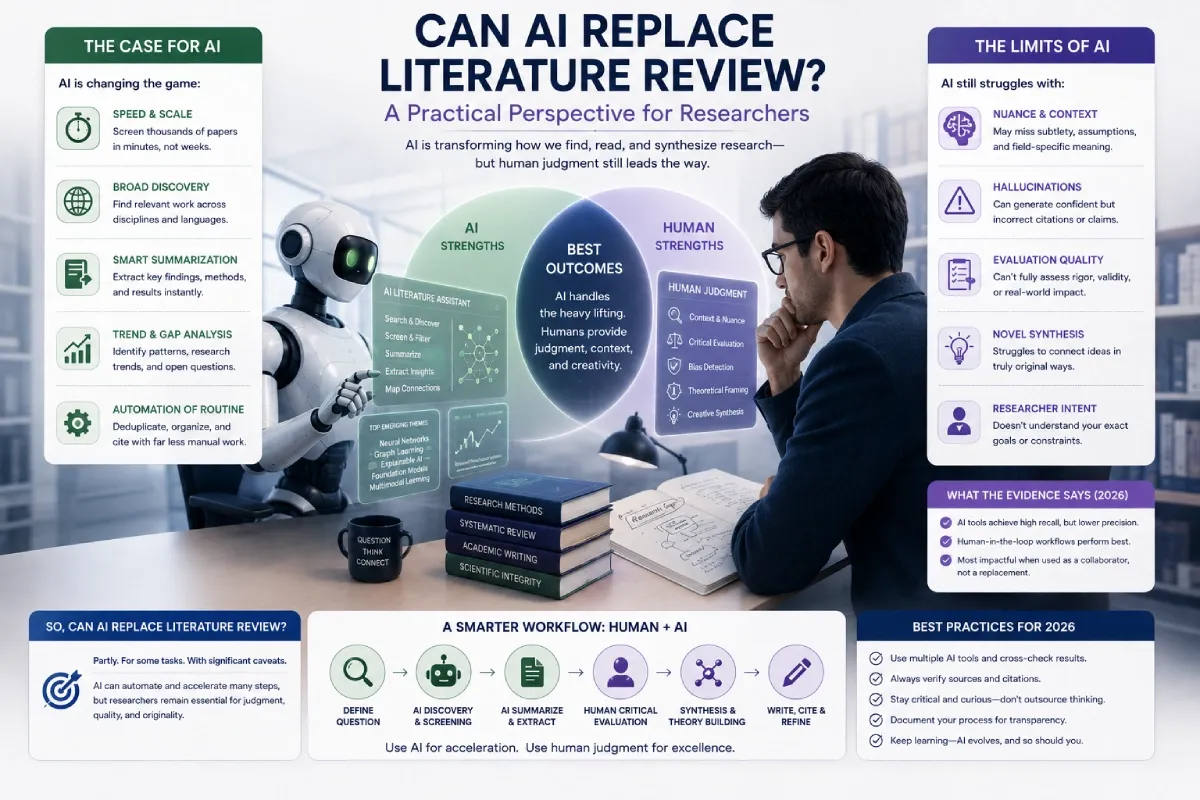
The question gets asked in two very different tones. From AI optimists, it sounds like an obvious yes — speed, scale, and cross-disciplinary breadth are all moving in AI's favor, fast. From skeptics, the same question is rhetorical in the other direction — the citation hallucinations, the missed nuance, the embarrassing public failures make replacement sound naïve.
Neither answer is quite right. Can AI replace literature review? As of 2026, the honest answer is "partly, for some tasks, with significant caveats" — and the researchers who get the most out of AI are the ones who understand exactly which parts have flipped and which haven't. This post lays out the case for both sides using current evidence, then reframes the question in a way that's actually useful for deciding how to work.
The Case That AI Can Replace Literature Review
Start with what the optimists get right.
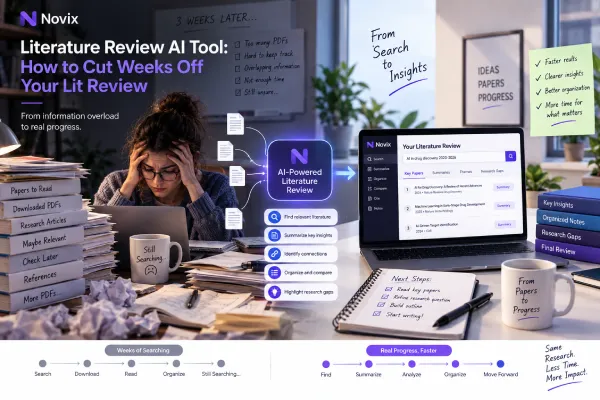
Speed. A skilled researcher reading carefully takes months to map a moderately complex field. A modern AI literature review tool can produce a comparable first-pass synthesis in hours. The differential isn't marginal — it's an order of magnitude or two. For early scoping work, that gap alone is reshaping how projects start.
Coverage at scale. A human reviewer gets tired at paper 200. AI doesn't. For domains where the relevant literature spans thousands of papers across multiple subfields, AI can read across the entire corpus in one pass — including the 2014 paper in an adjacent field that turns out to hold the key result.
Cross-disciplinary connection. Some of the best modern science sits at field intersections, but humans gravitate toward their own subfield's journals. Embedding-based AI retrieval is genuinely better at surfacing conceptually related work across disciplines, regardless of vocabulary differences.
Living reviews. A traditional review freezes the literature on submission day. An AI-driven review can re-run on demand, incorporating new preprints and publications as the project moves. For fast-moving fields, this is a structural advantage no manual approach can match.
Empirical adoption. Researchers are already using AI for parts of literature review. The question isn't whether the technology has crossed the usefulness threshold for this work. It clearly has. The question is how far that usefulness extends.
The Case That AI Cannot Replace Literature Review
Now the harder part of the picture — and the evidence behind it.
Hallucinated citations are still common. A 2025 study published in PMC found that 19.9% of AI-generated references were completely fabricated — no author, no paper, no DOI, just plausible-looking metadata. Other benchmarks place mainstream AI tool hallucination rates between 17% and 33%, with older models pushing 40–55%. These aren't quirks. They're systematic failures that emerge from how language models generate plausible-sounding text.
The failures reach top venues. A GPTZero analysis of 4,841 NeurIPS 2025 papers identified at least 100 hallucinated citations across roughly 53 accepted papers — about 1% of everything accepted that year. These fabrications were missed by 3–5 expert reviewers per paper. In 2025, Springer Nature had to retract a machine learning textbook after independent checks found that roughly two-thirds of sampled citations either did not exist or were materially inaccurate.
Novelty judgment is weak. Determining whether a finding is genuinely new requires deep, current knowledge of a specific field. AI tools routinely miss highly relevant prior work, or worse, invent prior work that doesn't exist. Using AI to assess novelty in your own area of expertise is risky.
Contextual subtleties get flattened. Papers are full of conditional claims, methodological caveats, and field-specific terminology. AI summaries tend to compress these into stronger, simpler claims than the authors actually made — which can change the meaning of an entire literature.
Pre-2020 and paywalled work is patchily covered. Many AI tools rely heavily on open-access and recent literature. For fields where the foundational work is older or behind paywalls, what looks like a comprehensive review may actually be a recent-and-open subset of the actual record.
(For more on the citation reliability problem specifically, see our piece on whether AI tools to review research papers can be trusted.)
The Reframe: "Literature Review" Isn't One Task
This is the move that makes the whole debate make sense. The question "can AI replace literature review?" assumes literature review is one thing. It isn't. It's at least six different tasks, and AI's reliability varies wildly across them.
1. Discovery — finding the relevant papers in the first place. AI is now genuinely better than keyword search here. Semantic retrieval surfaces conceptually relevant work that keyword search misses entirely.
2. Summarization — capturing what each paper says. AI is reliable for high-level summaries and moderately reliable for section-level ones. The error rate is non-zero but manageable with verification.
3. Synthesis — stitching findings across papers into a coherent narrative. AI does a competent first pass; humans do a much better final pass, because synthesis depends on judgment about which threads matter.
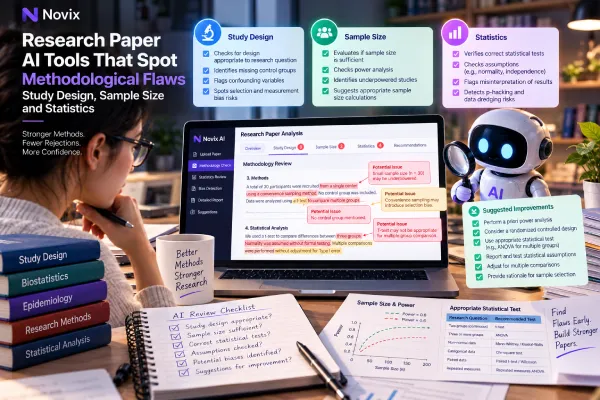
4. Critical evaluation — judging the rigor and quality of each study. This is where AI is weakest. Generic concerns appear; specific, field-dependent flaws don't.
5. Gap identification — finding what hasn't been done. AI can surface candidates, but distinguishing a "real gap" from "a question nobody asks because the answer is obvious" requires domain expertise AI doesn't have.
6. Argument construction — positioning your own work within the literature. This is irreducibly human. It depends on judgment about which prior work matters for your specific contribution and why.
Once you see the tasks separately, "can AI replace literature review?" becomes the wrong question. The right question is which parts of literature review AI can replace — and the answer is mostly the front half, much less of the back half.
Where AI Has Genuinely Replaced Parts of the Workflow
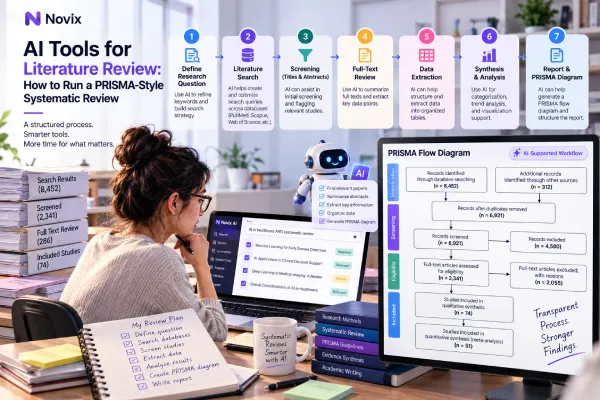
Discovery, initial summarization, and broad synthesis are the parts most likely to be primarily AI-driven in serious labs by 2026. Researchers still review the output, but the manual labor of running searches, exporting results, and reading every abstract is increasingly a thing of the past.
For evidence: see our overview of how AI literature review tools actually work in practice.
Where Researchers Still Need to Drive
Critical evaluation, novelty judgment, and argument construction are still human jobs. These are the parts where domain expertise, judgment about quality, and a sense of why your specific contribution matters are doing the work — and current AI is consistently weaker at these than at retrieval and summarization. Outsourcing them produces literature reviews that look competent but miss the substance.
The Practical Synthesis: a Hybrid Workflow
What this means for how to actually work in 2026:
- Use AI for the first 80% — broad scoping, retrieval, summarization, and structured synthesis. The speed gain is real and the reliability is sufficient if you verify.
- Verify every citation that ends up in your final draft. Always. Citation hallucination rates are too high to skip this step, even on the better tools.
- Drive the critical evaluation yourself. AI can suggest concerns; you decide which ones actually apply.
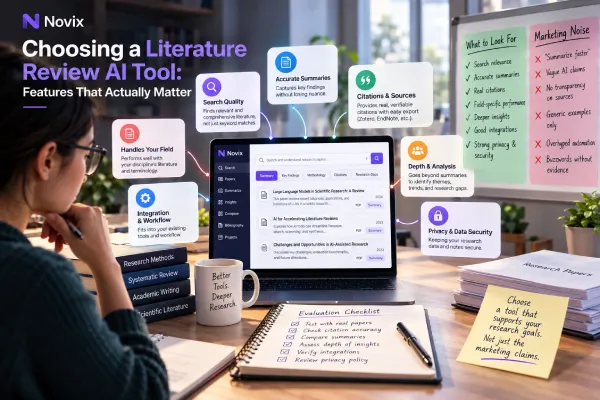
- Use grounded, citation-verifying tools. Tools that show you exactly which sentence in which paper supports each claim are dramatically safer than pure text generators.
- Re-run as the field moves. One of the genuine wins of AI literature review is that the cost of updating is low. Use that.
The researchers winning with AI aren't the ones treating it as a replacement. They're the ones treating it as a force multiplier on the parts of the work that don't need their judgment, so they can spend their judgment where it actually matters.
The Takeaway
Can AI replace literature review? Not as a single act. Yes for parts of it — the discovery, the summarization, the breadth — and no for the parts that depend on expert judgment about quality and significance. The framing of "replace" is what's wrong, not the underlying optimism or skepticism.
In practice, the future of literature review isn't "human" or "AI." It's a hybrid workflow where AI handles the retrieval and synthesis grind, the researcher handles the judgment, and the combination produces better reviews in less time than either could alone.
Curious how a research-grade AI co-scientist handles the AI portion of that workflow? Explore Novix.
Frequently Asked Questions
Can AI write a complete literature review by itself?
AI can generate a draft literature review by finding, summarizing, and synthesizing research papers. However, it cannot reliably replace human judgment for evaluating study quality, assessing novelty, verifying citations, and building a strong academic argument. Researchers should treat AI as a support tool rather than a complete replacement.
What are the biggest risks of using AI for literature reviews?
The most significant risks include hallucinated citations, inaccurate summaries, missed key papers, and oversimplified interpretations of complex findings. Because of these limitations, every citation and major claim generated by AI should be independently verified before being used in academic work.
Which parts of the literature review process can AI automate effectively?
AI is particularly effective for:
- Discovering relevant papers across large databases
- Summarizing research articles
- Identifying common themes and trends
- Creating initial evidence syntheses
These tasks can save researchers substantial time, especially during the early stages of a project.
What is the best way to combine AI and human expertise in literature reviews?
The most effective approach is a hybrid workflow. Researchers can use AI for paper discovery, summarization, and preliminary synthesis, while handling critical evaluation, citation verification, novelty assessment, and final argument construction themselves. This combination delivers both efficiency and academic rigor.