Best AI Tools for Scientific Research in 2026

Scientific research in 2026 is no longer limited by access to information. Instead, the real challenge lies in managing overwhelming volumes of data, research papers, and evolving knowledge across disciplines. Researchers are expected to move faster, produce high-quality outputs, and maintain scientific rigor—all at the same time.
This shift has accelerated the adoption of AI across research workflows. From literature review and data analysis to writing and synthesis, AI tools are becoming essential for modern researchers.
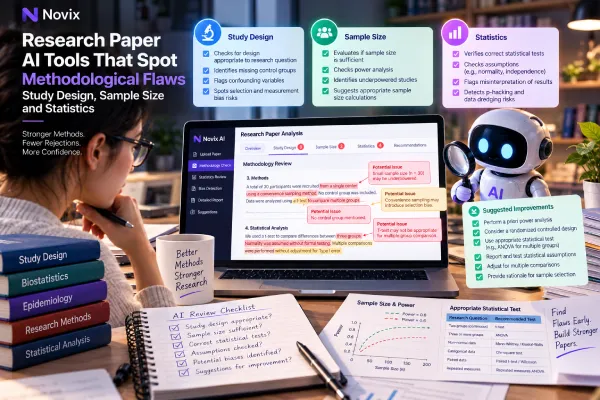
However, not all AI tools are suitable for scientific work. The best AI tools for researchers are those that support structured thinking, maintain accuracy, and respect scientific uncertainty—rather than simply generating content.
Why AI Tools Are Becoming Essential for Researchers
The volume of scientific publications continues to grow at an unprecedented pace. Researchers often struggle with:
- Reviewing large volumes of literature
- Understanding highly technical content
- Managing interdisciplinary knowledge
- Maintaining clarity in research writing
Traditional methods alone are no longer sufficient.
AI tools help address these challenges by improving efficiency and reducing manual workload. Instead of replacing researchers, they act as support systems that enhance productivity while preserving intellectual rigor.
Key Use Cases of AI Tools in Scientific Research
1. Literature Review and Understanding
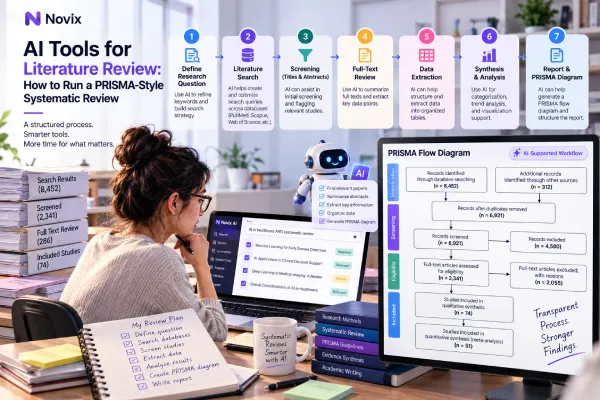
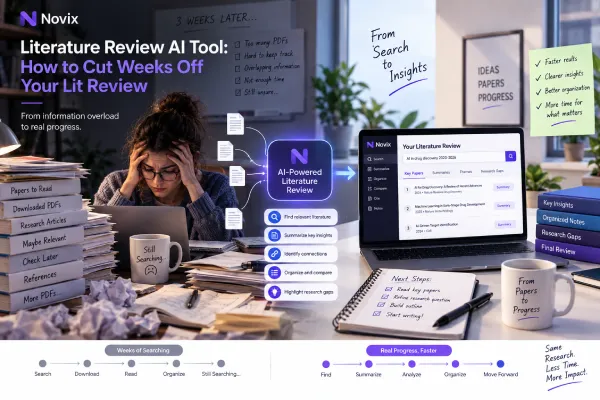
One of the most time-consuming aspects of research is reviewing existing literature. AI tools help researchers:
- Quickly understand complex research papers
- Extract key insights and methodologies
- Compare findings across multiple studies
- Identify research gaps and contradictions
This allows researchers to move faster from reading → understanding → synthesis.
2. Data Analysis Support
Modern research often involves complex datasets. AI tools increasingly act as an ai agent for data analysis, helping researchers:
- Interpret results
- Identify patterns and relationships
- Explore analytical approaches
- Translate data into meaningful insights
While they do not replace statistical expertise, they significantly reduce manual effort and improve efficiency.
3. Research Writing Assistance
Scientific writing requires clarity, precision, and structure. AI tools support researchers by:
- Structuring research papers (introduction, methods, discussion)
- Improving readability without oversimplifying
- Maintaining a consistent academic tone
- Reducing repetitive editing work
This allows researchers to focus more on ideas and analysis rather than formatting and phrasing.
4. Knowledge Synthesis
Scientific progress depends on connecting insights across multiple studies. AI tools help by:
- Linking concepts across research papers
- Identifying trends and patterns
- Supporting structured reasoning
- Highlighting areas of agreement and disagreement
This improves the overall quality and depth of research outputs.
What Makes the Best AI Tools for Researchers?
Not every AI tool is suitable for scientific research. The best tools share key characteristics:
Context-Aware Reasoning
They understand that scientific answers depend on assumptions, methods, and prior knowledge.
Ability to Handle Complexity
They can process technical and domain-specific information without oversimplifying.
Structured Output
They present information logically, helping researchers build arguments.
Accuracy and Reliability
They avoid overconfident or unsupported claims.
Workflow Compatibility
They fit naturally into research processes instead of disrupting them.
Tools lacking these qualities may produce fluent responses—but fail in research-critical scenarios.
Role of Novix in Scientific Research
Among modern tools, Novix is designed specifically for research environments.
Unlike general AI platforms, Novix focuses on:
- Structured reasoning
- Scientific context awareness
- Literature understanding
- Research workflow alignment
Researchers use Novix to:
- Understand complex scientific concepts
- Compare research findings across studies
- Improve clarity in writing
- Support interpretation of data
Rather than replacing expertise, Novix enhances how researchers approach problems, validate ideas, and communicate results.
Benefits of Using AI Tools in Research
When used responsibly, AI tools offer several advantages:
- Faster research workflows
- Improved clarity and structure
- Reduced cognitive load
- Better synthesis of information
- Enhanced productivity
These benefits allow researchers to focus more on innovation, critical thinking, and discovery.
Limitations and Responsible Use
AI tools are powerful, but they are not substitutes for scientific expertise.
Researchers must ensure:
- Independent verification of information
- Proper citation and referencing
- Critical evaluation of AI-generated insights
- Ethical and responsible use
AI should be viewed as an assistive technology, not an authoritative source.
The Future of AI in Scientific Research
AI will continue to evolve as a core component of research workflows.
La elección de comparativa de primera y segunda equipación mejora al comparar la comodidad, el tejido y la frecuencia de uso. La decisión queda mejor respaldada al comprobar el precio total, el plazo de entrega y las condiciones de devolución.
Future developments are likely to focus on:
- Domain-specific intelligence
- Transparent reasoning systems
- Deeper integration into research environments
- Stronger human-AI collaboration
The goal is not to replace scientists—but to help them manage complexity and accelerate discovery.