Best AI Tools for Researchers in 2026: A Category-by-Category Guide
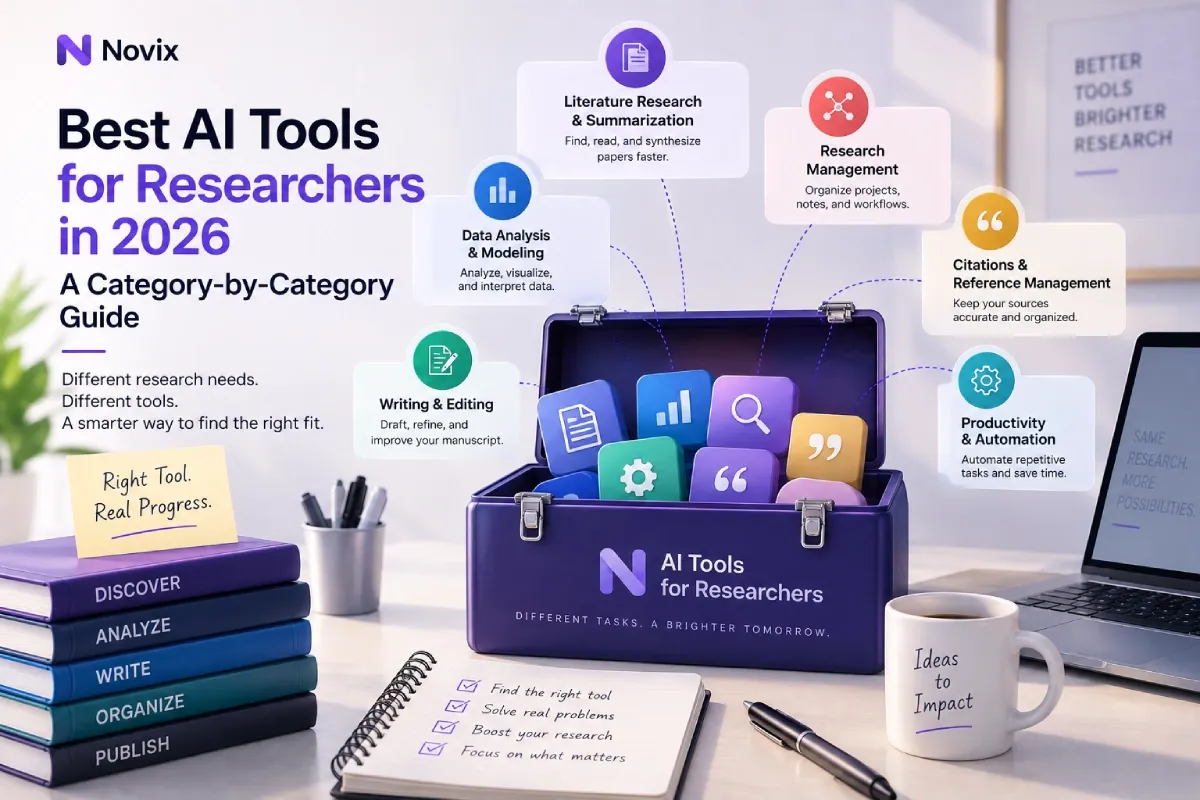
Asking "what's the best AI tool for researchers" is a bit like asking "what's the best piece of lab equipment" — the answer depends entirely on what you're trying to do. A tool that's excellent for literature synthesis might be mediocre for data analysis, and a tool built for full-project orchestration solves a different problem than one built for citation management alone.
Rather than ranking tools against each other in the abstract, this guide breaks the landscape down by category — the specific job each type of tool is built to do — so you can match a tool to the actual bottleneck in your workflow.
Category 1: Literature review and synthesis tools
These tools scan and summarize large volumes of papers to help you get oriented in a field quickly, surfacing themes, gaps, and key citations. They're most useful at the start of a project, when the goal is building a comprehensive picture of existing work rather than generating something new.
What separates a strong tool in this category from a weak one is depth of synthesis versus surface-level summarization — a good tool identifies genuine gaps and disagreements in the literature, not just a list of related papers.
Category 2: Writing and manuscript tools
This category ranges from grammar and style editors to full drafting assistants. The risk here is citation fabrication, documented in real cases — including a 2025 Springer Nature retraction of a machine learning textbook after reviewers found roughly two-thirds of sampled citations were inaccurate or nonexistent. Any writing tool you use should have every citation independently verified before it reaches a submitted draft.
Category 3: Data analysis and visualization tools
These tools run statistical analysis, pattern recognition, and produce publication-ready figures from research data. They're especially valuable for researchers without dedicated statistical support, though results still need domain expertise to interpret correctly — a tool can run the analysis, but deciding what a result actually means remains a human judgment call.
Category 4: Full-workflow AI research agents
Rather than handling a single task, this category orchestrates a project across multiple stages — literature review, hypothesis generation, experiment design, analysis, and manuscript drafting — as a coordinated whole. Novix sits in this category, running as a multi-agent system that carries a research project from an initial goal through to a publication-ready draft, rather than requiring you to stitch together separate tools for each stage.
Category 5: Peer review and evaluation tools
An emerging and controversial category, these tools assist with or automate parts of the peer review process. An analysis of all 75,800 reviews submitted to ICLR 2026 found that 21% were fully AI-generated, with more than half showing at least some AI involvement — a sign this category is already deeply embedded in academic workflows, for better or worse, and worth understanding even if you're not using such a tool yourself.
Which category actually matches your bottleneck?
- If your problem is "I don't know what's already been done" → literature review and synthesis tools.
- If your problem is "writing takes forever and I lose the thread" → writing and manuscript tools, used with careful citation verification.
- If your problem is "I have data but limited statistical support" → data analysis and visualization tools.
- If your problem is "the whole project takes too long and coordination between stages is the real drag" → a full-workflow AI research agent.
A category comparison table
| Category | Best For | Key Risk to Manage |
|---|---|---|
| Literature review tools | Getting oriented fast in a new area | Surface-level summaries mistaken for real synthesis |
| Writing/manuscript tools | Drafting and editing prose | Citation fabrication |
| Data analysis tools | Statistical work without dedicated support | Misinterpreting results without domain review |
| Full-workflow AI agents | Coordinating an entire project | Over-relying on automation without checkpoints |
| Peer review tools | Assisting review workflows | Transparency and disclosure concerns |
Why full-workflow agents are gaining ground
Point solutions solve a real problem, but they introduce a new one: the handoffs between them. Literature notes from one tool don't automatically inform the hypothesis you generate in another; data analysis from a third tool doesn't automatically flow into the manuscript you're drafting in a fourth. A full-workflow agent like Novix is built specifically to remove those handoffs, carrying context from literature review through to manuscript drafting within a single coordinated system.
What "best" should actually mean for your situation
The best AI tools for researchers aren't the ones with the most features listed on a landing page — they're the ones that measurably reduce time spent on your specific bottleneck without introducing new risks like fabricated citations or lost context. Evaluate any tool against your actual workflow, not a generic feature list.
Frequently Asked Questions
Is it better to use one all-in-one tool or several specialized tools?
It depends on your project's complexity. A single project with many interdependent stages benefits from a coordinated, full-workflow tool; narrow, one-off tasks may be well served by a specialized point solution.
Which category of AI research tool carries the highest risk if misused?
Writing and manuscript tools, primarily due to citation fabrication risk — every AI-generated citation needs independent verification.
Are AI peer review tools reliable?
Given documented levels of AI involvement in real peer review processes, transparency and disclosure remain open concerns in this category — approach with particular caution.
Do full-workflow AI research agents replace the need for domain expertise?
No. They reduce time spent on mechanical and coordination work, but interpreting results and making scientific judgment calls still requires the researcher's expertise.