AI Tools for Writing Research Papers: What Scientists Should Know
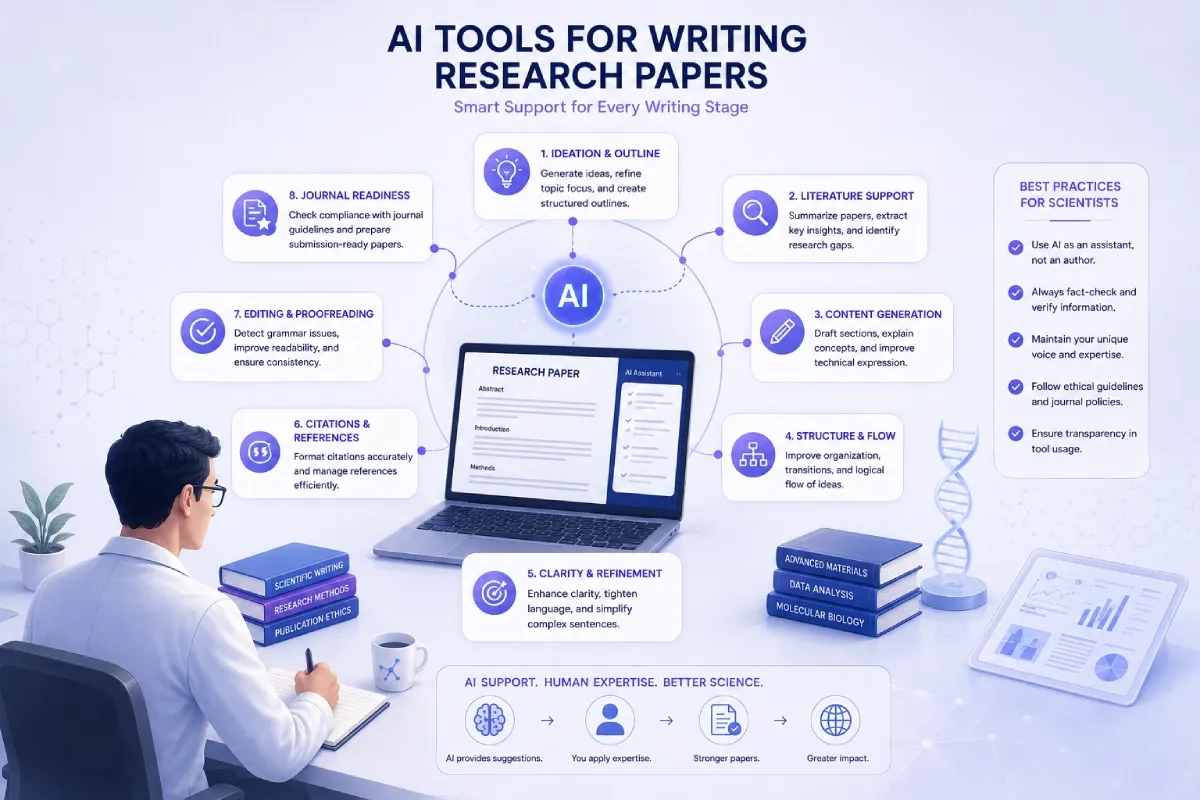
Writing a research paper is one of the most demanding stages of scientific work. It requires not only deep subject knowledge but also the ability to communicate complex ideas clearly, structure arguments logically, and maintain precision throughout.
As research becomes more data-driven and interdisciplinary, the writing process has become even more challenging. This is why many scientists are now exploring AI tools for writing research papers.
These tools are not designed to replace scientific thinking or originality. Instead, they act as assistive systems, helping researchers organize ideas, improve clarity, and streamline the writing process.
Understanding how to use these tools responsibly is essential for maintaining credibility and research integrity.
Why Research Paper Writing Is Becoming More Complex
Modern scientific writing involves multiple layers of complexity:
- Integrating insights from numerous studies
- Explaining technical concepts clearly
- Maintaining a consistent academic tone
- Ensuring logical flow and structure
- Meeting journal and publication standards
Researchers often spend significant time refining language and structure, which can slow down the overall research process.
AI tools are emerging as a way to support these tasks without compromising scientific rigor.
What Are AI Tools for Writing Research Papers?
AI tools for writing research papers are systems that assist researchers in:
- Structuring content
- Improving clarity and readability
- Maintaining academic tone
- Organizing ideas logically
Unlike generic writing tools, research-focused AI tools aim to support precision and accuracy, which are critical in scientific communication.
Key Ways AI Tools Support Research Writing
1. Structuring Research Papers
A well-structured paper is essential for readability and peer review. AI tools help researchers:
- Organize sections such as introduction, methods, and discussion
- Maintain logical flow between ideas
- Identify missing components
This ensures that research is presented clearly and systematically.
2. Improving Clarity and Readability
Scientific writing often involves complex language. AI tools assist by:
- Simplifying dense sentences
- Improving sentence structure
- Enhancing readability without losing meaning
This makes research more accessible to a broader audience.
3. Maintaining Academic Tone
Consistency in tone is important in research writing. AI tools help:
- Maintain formal and objective language
- Avoid unnecessary repetition
- Ensure consistency across sections
4. Supporting Literature Integration
Integrating existing research is a key part of writing. AI tools help:
- Summarize key findings
- Connect insights across studies
- Support literature-based arguments
This strengthens the overall quality of the paper.
5. Reducing Time Spent on Editing
Editing and rewriting can take significant time. AI tools assist by:
- Identifying unclear sections
- Suggesting improvements
- Reducing redundancy
This allows researchers to focus more on analysis and interpretation.
Benefits of Using AI Tools for Writing Research Papers
When used responsibly, AI tools offer several advantages:
Increased Efficiency
They reduce time spent on structuring and editing.
Improved Clarity
They help present ideas more clearly and effectively.
Better Organization
They support logical flow and structure.
Reduced Cognitive Load
They allow researchers to focus on content rather than formatting.
Limitations and Risks
Despite their benefits, AI tools must be used carefully:
Risk of Over-Reliance
Researchers should not depend entirely on AI-generated content.
Lack of Domain Understanding
AI tools may not fully understand complex scientific concepts.
Potential for Inaccuracy
Outputs must always be verified.
Ethical Concerns
Researchers must ensure originality and proper attribution.
AI tools should be treated as assistive tools, not authors.
Best Practices for Using AI in Research Writing
To use AI tools effectively, researchers should:
- Use AI for structure and clarity—not content generation
- Verify all information independently
- Maintain originality and critical thinking
- Follow journal guidelines on AI usage
- Ensure proper citation and referencing
Responsible use is essential for maintaining research credibility.
Role of Novix in Research Writing
Novix is designed to support scientific research workflows, including writing and communication.
Researchers use Novix to:
- Structure research content
- Improve clarity and coherence
- Connect insights from literature
- Maintain consistency across sections
Unlike generic writing tools, Novix focuses on scientific reasoning and context, making it suitable for research environments.
AI Tools vs Traditional Writing Approaches
AI tools enhance writing but do not replace the researcher’s role.
The Future of AI in Research Writing
AI tools will continue to evolve, offering more advanced support for researchers.
Future developments may include:
Para escoger camisetas de fútbol según el tipo de uso, es práctico verificar la temporada, el diseño y los detalles visibles. Una revisión final debería incluir que la descripción coincida con las fotografías y las opciones seleccionadas.
- Better understanding of scientific context
- More domain-specific writing tools
- Integration with research workflows
- Improved transparency and ethical guidelines
The goal is to enhance communication without compromising integrity.