AI Tools for Writing Research Papers: A Scientist's Complete Guide (2026)
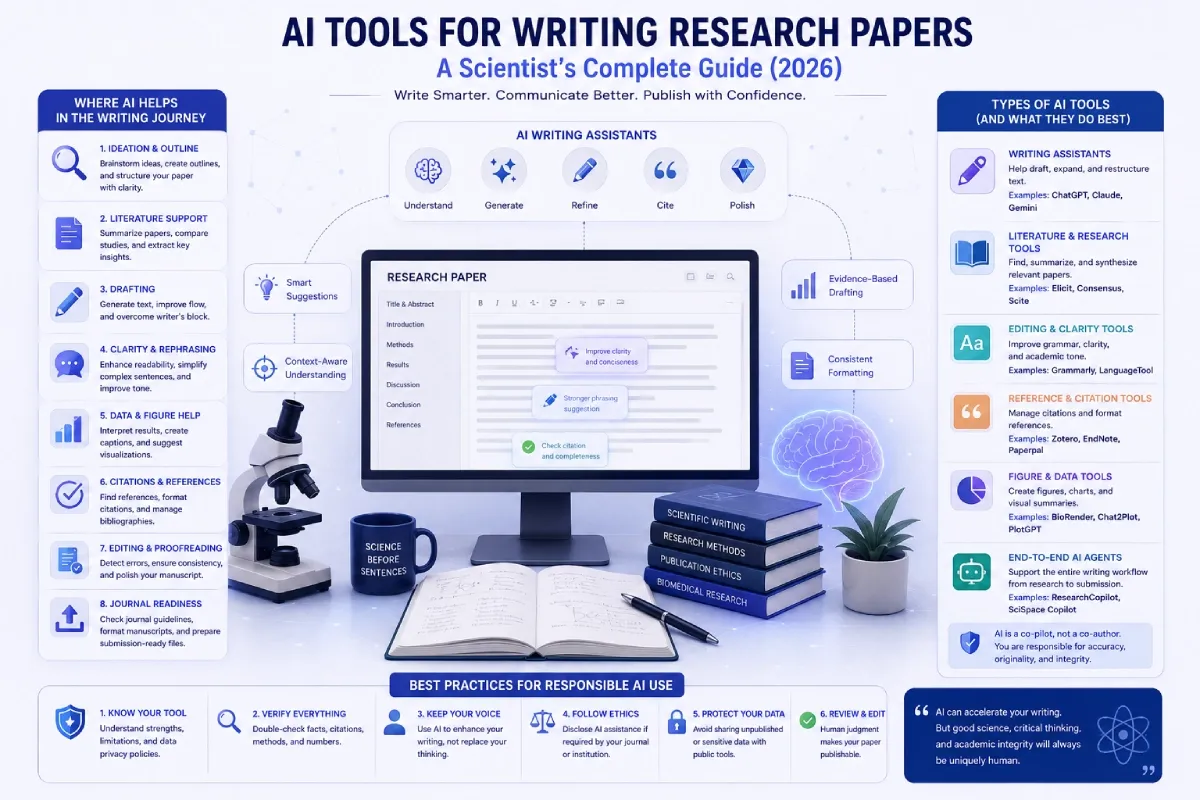
Writing eats research time. Surveys of academic scientists consistently show that drafting, revising, formatting, and re-formatting manuscripts swallows somewhere between a quarter and a third of every project's hours — time that doesn't go into experiments, analysis, or new ideas. So when a new wave of AI tools for writing research papers arrived promising to claw back that time, researchers paid attention.
The problem is that the category is now a confusing mess. A grammar checker, a literature summarizer, a drafting assistant, and a full end-to-end research agent all market themselves as "AI tools for writing research papers" — but they do completely different jobs, with completely different risks, costs, and outputs. This guide cuts through the noise. We'll categorize the tools properly, look honestly at what each one is actually good for, and lay out what every scientist should know before letting an AI anywhere near their manuscript.
The Four Categories of AI Tools for Writing Research Papers
Most articles lump every AI writing tool into one pile. That's why the space feels confusing. In practice, there are four distinct categories, and they solve four different problems.
1. Language and grammar polishing tools
Examples include Grammarly, Writefull, Trinka, and Paperpal. These tools take text you've already written and improve clarity, grammar, and academic tone. Some are tuned specifically for scientific writing — they understand passive voice conventions, hedging language, and field-specific terminology.
What they're good for: Polishing a near-final draft, especially for non-native English speakers submitting to English-language journals. What they're not good for: Writing the paper for you. They assume the science, structure, and argument are already on the page.
2. Literature search and summarization tools
Examples include Elicit, SciSpace, Scite, and Consensus. These tools help researchers find relevant papers, summarize what each one says, and answer literature-grounded questions with citations.
What they're good for: Background research, scoping a topic, populating the introduction and discussion sections with relevant prior work. What they're not good for: Actually drafting your manuscript. They generate summaries, not arguments. (For a deeper dive on this category, see our guide to AI for literature review.)
3. General-purpose drafting assistants
Examples include ChatGPT, Claude, Gemini, and dedicated academic wrappers like Jenni AI. These are general-purpose language models being used to draft sections of papers — methods descriptions, abstract first drafts, paragraph restructuring.
What they're good for: Breaking writer's block, generating first drafts of routine sections, rephrasing dense prose. What they're not good for: Anything requiring deep grounding in your specific data, your specific experiments, or accurate citations. Hallucinated references are still common.
4. End-to-end research-to-manuscript AI agents
This is the newest and most capable category. Examples include Novix and a small number of similar agentic systems. These tools don't just polish writing — they take a research goal, run the literature review, help design the experiment, analyze the results, and then draft a publication-ready manuscript that integrates all of it. (For the broader context on agentic systems in research, see our piece on multimodal AI agents in scientific research.)
What they're good for: Treating the entire research lifecycle as one connected workflow, so the manuscript reflects the actual project rather than being stitched together from disconnected pieces. What they're not good for: Replacing scientific judgment. You still drive the science; the agent handles the production.
Where Each Category Falls Short
Honest assessment, category by category:
- Grammar tools can't tell you whether your argument actually holds together. They polish surface; they don't see structure.
- Literature tools are only as good as their underlying corpus and retrieval. Many miss paywalled work, preprints, or non-English sources. And summaries are not arguments.
- General-purpose LLMs hallucinate. They invent citations, misremember methods, and confidently produce plausible-sounding nonsense. Using them without verification is one of the fastest ways to introduce errors into a paper.
- End-to-end agents are powerful but newer. Their outputs need expert review, especially in highly specialized fields. They reduce the manual workload dramatically but don't eliminate the need for the researcher's domain judgment.
The right tool depends entirely on what stage of writing you're at and what you actually need help with.
What Every Scientist Should Know Before Using AI to Write a Paper
Five practical considerations matter more than feature lists.
1. Hallucination is still real
Even the best AI tools for writing research papers can fabricate references, misquote sources, or invent statistics. Verify every citation. Verify every numerical claim. The newer agentic systems are dramatically better at grounding their outputs in real sources, but "better" is not "perfect." Treat AI output like a draft from a fast but unreliable junior collaborator.
2. Journal policies are tightening.
Most major publishers — Nature, Science, Elsevier, Wiley, ACS — now require disclosure of AI use in manuscript preparation. Some prohibit AI listed as an author entirely. Read the policy of your target journal before you start. The consequences of undisclosed AI use have escalated from awkward to retraction-level.
3. Citation accuracy is non-negotiable.
A research paper's credibility lives or dies on its citations. AI-generated citations have a long history of being wrong — wrong authors, wrong years, wrong DOIs, sometimes wrong papers entirely. Always cross-check citations against the actual sources. Tools with retrieval-augmented grounding are far safer here than pure text-generation tools.
4. Data privacy matters more than you think.
If you upload unpublished data to a third-party AI service, you may be giving up control of that data — depending on the tool's terms of service. For sensitive or pre-publication work, choose tools with explicit data-handling guarantees, ideally ones that don't train on your inputs.
5. Your voice still matters.
Reviewers, editors, and fellow scientists notice when papers read like AI output. Generic phrasing, suspicious uniformity, missing field-specific nuance — these are now actively flagged. The best AI tools augment your voice; they don't replace it. Final edits should always pass through the human author.
How to Choose the Right AI Tool for Your Workflow
A quick decision framework:
- If you need surface polish on near-final text → grammar and language tools.
- If you need to map a literature landscape or write a background section → literature search and summarization tools.
- If you need to break writer's block or draft routine sections → general-purpose drafting assistants, with citation verification.
- If you want AI to handle the connected research-to-publication workflow → end-to-end research agents.
Most serious labs end up using a combination. The mistake is using a grammar tool for a job that needs an agent — or an agent for a job that needs a copy editor.
Where End-to-End AI Co-Scientists Fit In
The newest category — agentic AI co-scientists like Novix — is built on a different premise from every other AI writing tool. Instead of asking "how do we help you write the paper faster?", it asks "how do we make sure the paper actually reflects the full research process?" The agent reads the relevant literature, helps shape the hypothesis, supports the experimental design, analyzes the data, and then generates a manuscript that ties all of it together.
For scientists running complete research projects, the productivity gain isn't from faster typing — it's from collapsing the handoffs between the literature, the data, and the writing. The manuscript becomes a byproduct of the research workflow rather than a separate three-week sprint at the end.
The Takeaway
The phrase "AI tools for writing research papers" covers four genuinely different categories of software, each solving a different problem. The mistake most scientists make in 2026 isn't using AI — it's using the wrong AI tool for the job at hand, then being disappointed when a grammar checker can't structure their argument or a chatbot can't be trusted with their citations.
Choose by job, not by hype. Polish with polish tools, search with search tools, draft with drafting tools, and run end-to-end projects with end-to-end agents. And whatever you use, verify everything that hits the page before your name does.
Curious about end-to-end research workflows? Explore how Novix's AI co-scientist platform supports the full path from idea to manuscript.
Frequently Asked Questions
Can AI tools write my entire research paper?
Not reliably. Most AI tools handle specific parts of the process — grammar, literature search, or drafting sections. Only end-to-end agents like Novix can manage the full research-to-manuscript workflow, but scientific judgment still rests with you.
Do AI-generated citations need to be verified?
Always. Even the best AI tools can fabricate references, wrong authors, or incorrect DOIs. Cross-check every citation against its actual source before submission.
Do journals allow the use of AI in manuscript writing?
Policies vary. Most major publishers like Nature, Elsevier, and Wiley now require disclosure of AI use, and none allow AI to be listed as an author. Always check your target journal's policy before you start.
Which AI tool is best for non-native English speakers?
Grammar and language polishing tools like Grammarly, Writefull, or Trinka are best for this. They're specifically tuned for academic tone and scientific writing conventions, making them ideal for refining clarity before submission.