AI Tools for Scientific Research: A Field-by-Field Breakdown for 2026
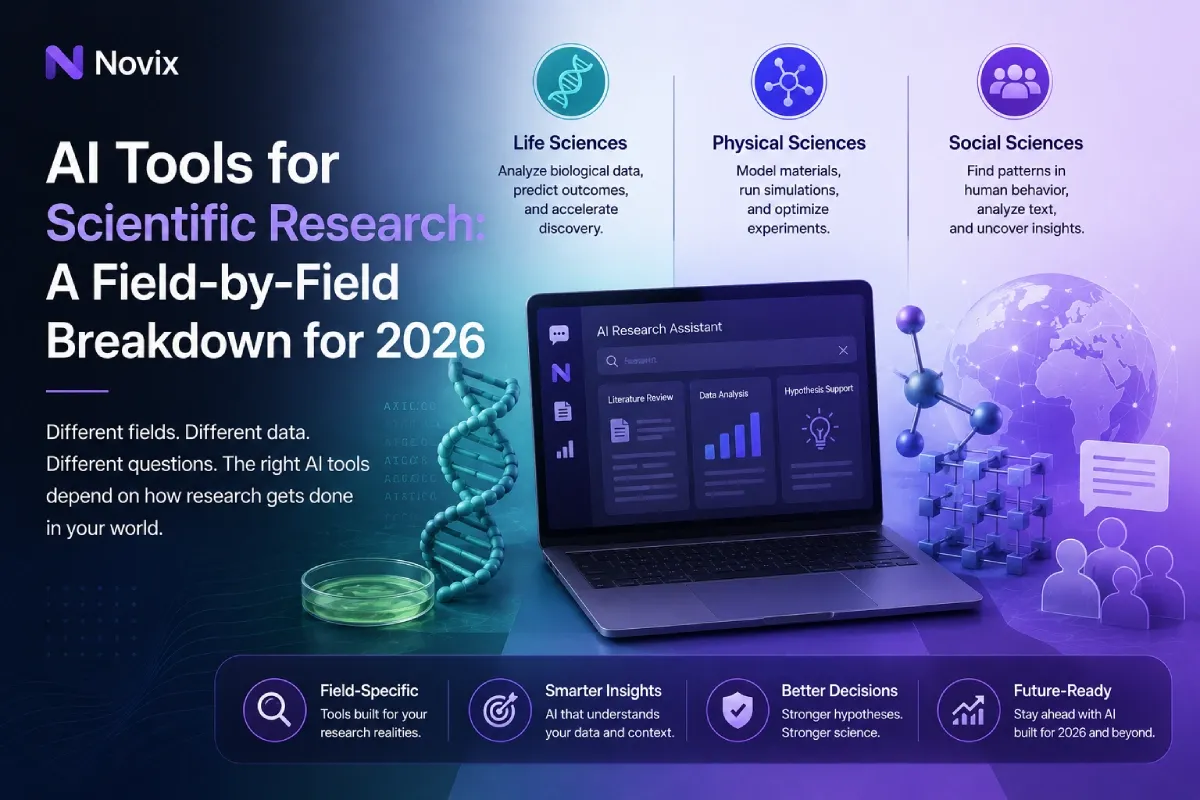
"AI tools for scientific research" gets discussed as if it's one category with one set of needs, but a computational biologist, a materials scientist, and a social scientist are asking very different things of these tools. The volume and structure of literature differs. The nature of "data" differs. Even what counts as a strong hypothesis differs. Picking a tool without accounting for that mismatch is one of the most common reasons adoption stalls after an initial trial.
This is a field-by-field look at how AI tool needs actually differ across disciplines in 2026, and what to weigh when evaluating a tool against your own field's specific demands.
Life sciences and biomedical research
Biomedical literature is enormous, fast-moving, and dense with technical terminology that general-purpose language tools often mishandle. Researchers here typically need:
- Deep literature synthesis across a rapidly growing body of papers, with reliable handling of domain-specific terminology.
- Hypothesis generation grounded in mechanism, not just correlation — a subtle but important distinction in biology.
- Statistical rigor appropriate to clinical or experimental data, including proper handling of small sample sizes and confounders.
The risk in this field is particularly high: a fabricated or misread citation in a biomedical context can propagate into clinical reasoning, which is why verification matters even more here than in less consequential domains.
Physical sciences and materials research
Physics, chemistry, and materials science often involve tighter coupling between theory and experiment, and researchers here tend to prioritize:
- Method design that respects physical constraints, not just statistically plausible protocols.
- Integration with simulation and modeling tools, since much of the "experiment" happens computationally before it happens in a lab.
- Precise handling of quantitative results, where small numerical errors can invalidate a conclusion.
AI tools that treat every field the same way tend to underperform here, because materials and physical sciences research often depends on domain constraints that a generic hypothesis generator won't know to respect.
Computational and data-driven fields (ML, computer science, bioinformatics)
Ironically, fields that build AI tools are also some of the most demanding users of them, because researchers here can immediately spot shallow reasoning. Priorities tend to include:
- Reproducibility — the ability to trace exactly how a result was produced.
- Benchmark-grounded evaluation of the AI tool itself, since this community is unusually well-equipped to notice when a tool's claims don't hold up.
- Fast iteration between hypothesis, implementation, and evaluation, since much of the "experiment" is code.
Social sciences and interdisciplinary research
Social science research often involves qualitative and mixed-methods data that don't fit neatly into the quantitative pipelines many AI research tools are built around. Key needs here include:
- Nuanced literature synthesis that captures theoretical disagreement rather than flattening it into a false consensus.
- Support for mixed-methods designs, not just quantitative statistical analysis
- Careful hypothesis framing that respects the interpretive nature of social phenomena.
What's common across every field
Despite these differences, a few requirements hold regardless of discipline:
- Verifiable citations. No field benefits from confidently fabricated sources.
- Transparent reasoning. Researchers in every discipline need to see why a hypothesis or conclusion was proposed, not just accept it.
- Human review at every stage. Domain expertise is what catches subtle errors an AI tool won't recognize as errors.
A field-by-field priority snapshot
| Field | Top Priority | Common Pitfall to Avoid |
|---|---|---|
| Life sciences / biomedical | Mechanism-grounded hypotheses | Fabricated or misread citations |
| Physical sciences / materials | Physically constrained method design | Ignoring domain-specific constraints |
| Computational / ML | Reproducibility and fast iteration | Tools that can't show their reasoning |
| Social sciences | Nuanced, mixed-methods synthesis | Flattening theoretical disagreement |
How a general-purpose research agent handles this variation
A well-built AI research agent doesn't need a separate product for every discipline, but it does need to generalize its reasoning rather than force every field into a single template. Novix's multi-agent approach — literature synthesis, hypothesis generation, method design, and analysis handled by coordinated but distinct agents — is built to adapt to the literature and constraints of whatever domain a project is working in, rather than assuming every field looks like computer science.
What to test before adopting a tool in your field
- Feed it literature from your specific subfield, not a generic example, and check whether the synthesis captures the actual disagreements in your area.
- Ask for a hypothesis or method design and check whether it respects the practical or theoretical constraints your field actually operates under.
- Check how it handles your field's specific data types — clinical data, simulation output, qualitative interviews, code — rather than assuming generic statistical handling will suffice.
Frequently Asked Questions
Do AI tools for scientific research work equally well across all disciplines?
Not automatically. Tools vary in how well they handle domain-specific literature, constraints, and data types — testing against your specific field before adoption matters.
Is there a single AI tool that fits every scientific discipline?
Some tools, including Novix, are built to generalize across domains through adaptable multi-agent reasoning, but performance still depends on the quality and depth of your field's available literature.
Which fields carry the highest risk from AI-generated errors?
Fields where conclusions have direct downstream consequences — like biomedical and clinical research — carry particularly high stakes for citation and reasoning errors.
How can I tell if a tool is genuinely adapting to my field, versus applying a generic template?
Test it against literature and constraints specific to your subfield, and compare its output to what a domain expert would expect — generic-sounding output is a warning sign.