AI Tool to Review Research Papers: How Reliable Are They?
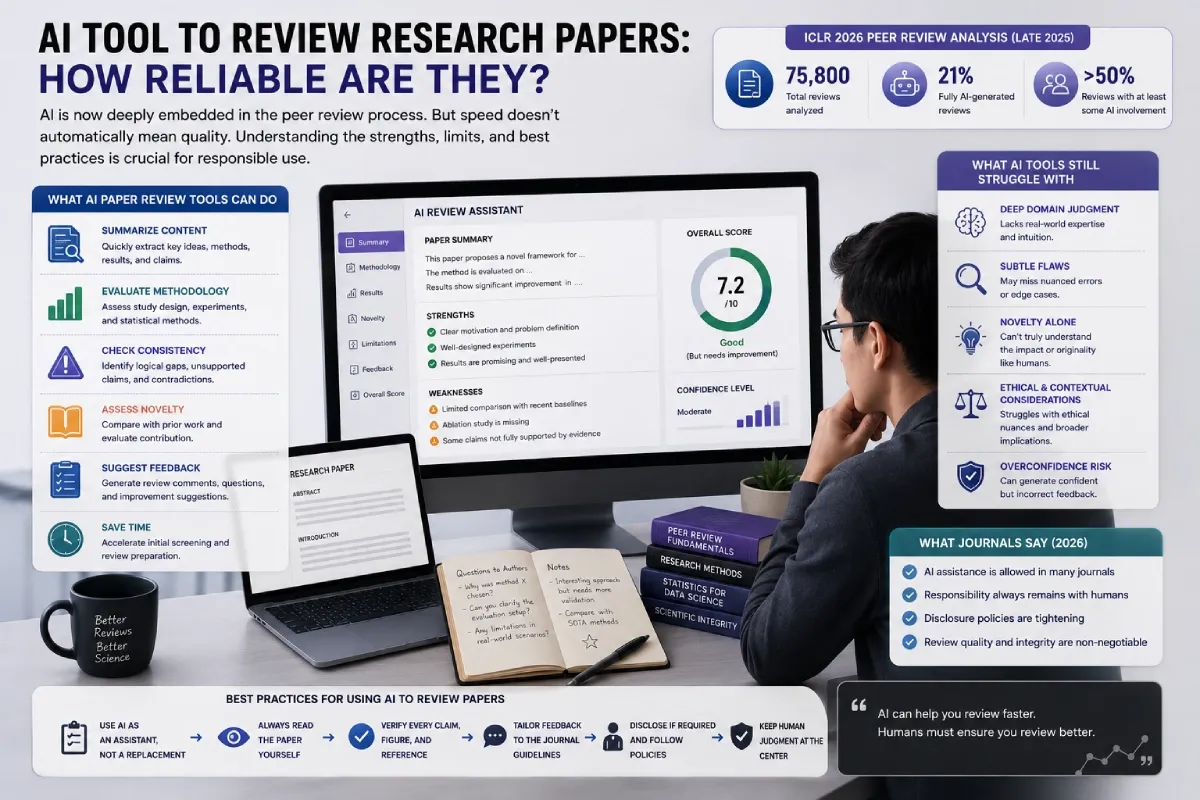
In late 2025, an analysis of all 75,800 peer reviews submitted to ICLR 2026 found that 21% of them were fully AI-generated, and more than half showed at least some AI involvement. The story made headlines because it crystallized something the academic community had been quietly aware of for over a year: researchers are using AI to read, analyze, and review papers — whether journals approve or not.
That raises an obvious question. If an AI tool to review research papers is good enough to fool a peer review committee, is it actually reliable? Can it understand a methods section, evaluate a claim, catch a statistical error, or judge whether a result is novel? Or is it just plausible-sounding noise dressed up in academic vocabulary? This guide takes an honest look at what AI paper review tools can and can't do in 2026, what the journals now say about using them, and how to integrate them into your workflow without sabotaging your science.
What "AI Tool to Review Research Papers" Actually Means
The phrase covers two very different use cases, and the reliability question looks different in each.
Personal review. You've come across a paper — maybe sent by a collaborator, maybe cited in another paper, maybe surfaced by a search — and you want help reading it. Summarize the abstract, explain the methods, walk through the results, compare it to other work. This is the most common use of AI paper review tools and the least controversial.
Formal peer review. You've been asked by a journal or conference to review a submitted manuscript, and you're considering using AI to help draft your review. This is a different beast — both technically and ethically — because of confidentiality, journal policy, and the integrity of the review process itself.
We'll cover both, because the same tools get used for both, but the reliability bar is much higher for the second case.
What AI Paper Review Tools Do Reliably Well
Start with the honest good news. There's a real cluster of tasks where modern AI tools are genuinely useful and meaningfully reliable.
- Summarization. Producing a TL;DR of a paper's abstract, introduction, or conclusions is something current models do well. The summary may miss nuance, but it's rarely flat-out wrong on the central claim.
- Concept clarification. Asking "what does the author mean by X?" or "explain this equation in plain language" works well, especially for papers outside your specialty. AI is a good first-pass explainer.
- Section navigation. Identifying where in a paper a specific claim is supported, or pulling the methods used for a specific experiment, is a task AI handles competently.
- Figure and table interpretation (with multimodal tools). The best current AI tools can read a chart, identify the variables, and describe trends. This used to be a hard limit; it isn't anymore.
- Cross-paper comparison. Asking "how does this paper's approach differ from [other paper]?" produces useful structured comparisons, especially when both papers are well-known.
- Drafting reading notes. Generating an annotated outline you can edit is faster than starting from scratch.
If your use of an AI tool to review research papers stops at this list, reliability is high enough to be useful. The problem starts when you ask the tool to do more.
Where They Fall Short: The Reliability Gap
Here's the harder part of the honest assessment.
Hallucinated content. AI tools still occasionally invent details. They'll state that a paper used a sample size of 500 when it used 50, or claim the authors found a significant effect when they didn't. This happens less than it used to, but it has not gone away — and the failures are often subtle enough to slip past a quick read.
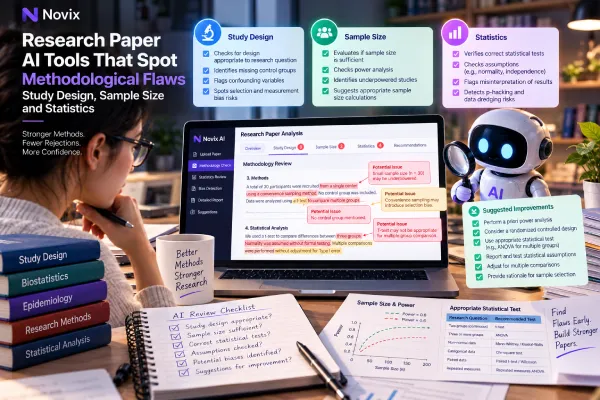
Methodology critique is shallow. Asking an AI to evaluate the rigor of a study's design is where reliability falls off a cliff. The tool will list generic concerns ("sample size may be small," "consider potential confounders") but rarely catches the specific, field-dependent flaws an experienced reviewer would flag immediately.
Novelty assessment is weak. Judging whether a result is genuinely new requires deep, current knowledge of a field. AI tools often miss prior work, or worse, hallucinate prior work that doesn't exist.
Statistical claims slip through. AI reviewers are notoriously bad at catching statistical errors — misapplied tests, multiple comparison problems, p-hacking. They take reported statistics at face value.
Conditional language gets flattened. Papers are full of "if X, then Y" structures, caveats, and limitations. AI summaries often collapse these into stronger claims than the authors actually made.
Domain terminology trips them up. Specialized vocabulary — especially in chemistry, biology subfields, and clinical medicine — produces confident but wrong AI interpretations more often than researchers expect.
Put together: AI tools to review research papers are reliable for reading support. They are unreliable, as of 2026, for expert judgment. Confusing the two is where most of the trouble starts.
AI in Formal Peer Review: The Policy Reality
If you're considering using AI to write or assist a formal peer review, the policy landscape has shifted dramatically. A 2026 cross-disciplinary study in Learned Publishing analyzed 802 journals and found that 83% of high-impact journals and 75% of middle-tier journals now have explicit AI policies. Among the top 100 medical journals, the figure is 78%.
The dominant position is restrictive. Elsevier, Springer Nature, Science (AAAS), JAMA, NEJM, and most Cell Press titles prohibit reviewers from uploading manuscripts to AI tools, citing confidentiality — the manuscript is unpublished, the author has prepublication rights, and feeding it to a third-party AI service breaches both. The NIH's NOT-OD-23-149 policy similarly prohibits AI use in grant peer review. In experimental disciplines like materials science, chemistry, and agriculture, more than half of journals explicitly prohibit AI participation in peer review at all.
Enforcement is harder than policy. ICLR 2026 organizers are now deploying automated tools to detect AI-generated reviews, but the cat-and-mouse game has clearly started. The practical advice for any reviewer in 2026: read your target journal's AI policy before you accept a review invitation, and assume that uploading the manuscript to a public AI service violates it.
For personal reading and analysis of published papers, none of this applies. The confidentiality concern is specific to unpublished manuscripts you've been asked to review.
How to Use AI Tools to Review Papers Reliably
A short, practical checklist:
- Verify everything that matters. Never quote a number, statistic, or specific claim from an AI summary without checking it against the paper itself.
- Use multimodal tools for figure-heavy papers. Text-only AI will miss what's in the plots — which is often the actual evidence. (See our piece on multimodal AI agents in scientific research.)
- Don't outsource judgment. Use AI for reading support, not for deciding whether the science is sound. That's still your job.
- Respect confidentiality on manuscripts under review. Most major journals prohibit uploading the manuscript to AI tools.
- Disclose appropriately. When AI assistance is permitted, disclose it. The cost of disclosure is small; the cost of an undisclosed AI use that comes to light is large.
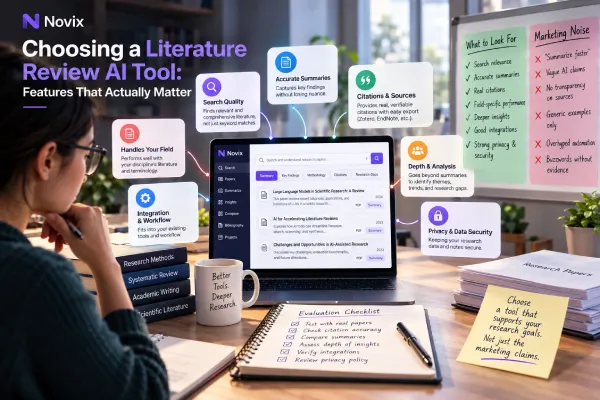
- Prefer tools with grounded citations. If the AI can show you exactly which sentence in the paper supports its claim, you can verify quickly.
Where Novix Fits
Novix is built for the broader research workflow — and within that workflow, deep, reliable paper analysis is a core capability. The agent reads full papers including figures, grounds its analysis in the actual text, and integrates what it finds with your literature review, hypotheses, and experimental design rather than treating each paper as a one-off interaction. (For more on the full pipeline, see AI for literature review.)
The point isn't to replace your reading. It's to make your reading deeper, faster, and better connected to everything else you're working on.
The Takeaway
In 2026, an AI tool to review research papers is reliable enough to be genuinely useful — for reading, summarizing, navigating, and explaining published work. It is not reliable enough to replace expert judgment, and using it inside formal peer review now runs straight into a wall of journal policies that didn't exist two years ago.
The right question isn't whether to use AI to help review papers. Almost everyone already does. The right question is for what, and with what verification. Use it as a reading partner, not as the reviewer of record — and you'll get most of the speed gain without any of the credibility risk.
Curious how an agentic AI co-scientist handles deep paper analysis as part of the full research workflow? Explore Novix.
Frequently Asked Questions
Can AI tools reliably evaluate the quality of a research paper?
Only partially. AI tools are reliable for summarizing, explaining concepts, and navigating sections. However, they fall short at deep tasks like methodology critique, novelty assessment, and catching statistical errors — those still require expert human judgment.
Is it allowed to use AI tools for formal peer review?
Most major journals say no. Publishers like Elsevier, Springer Nature, NEJM, and Science prohibit uploading unpublished manuscripts to AI tools, primarily due to confidentiality concerns. Always check your target journal's AI policy before accepting a review invitation.
How common is AI use in peer review today?
Very common. An analysis of 75,800 peer reviews submitted to ICLR 2026 found that 21% were fully AI-generated, and over half showed at least some AI involvement — despite many journals restricting the practice.
What's the safest way to use AI when reviewing a published paper?
Use it as a reading partner, not a decision-maker. Let it summarize, explain, and navigate — but always verify specific numbers, statistics, and claims directly against the source paper before drawing any conclusions.