AI Tool for Research Papers: From First Draft to Final Submission
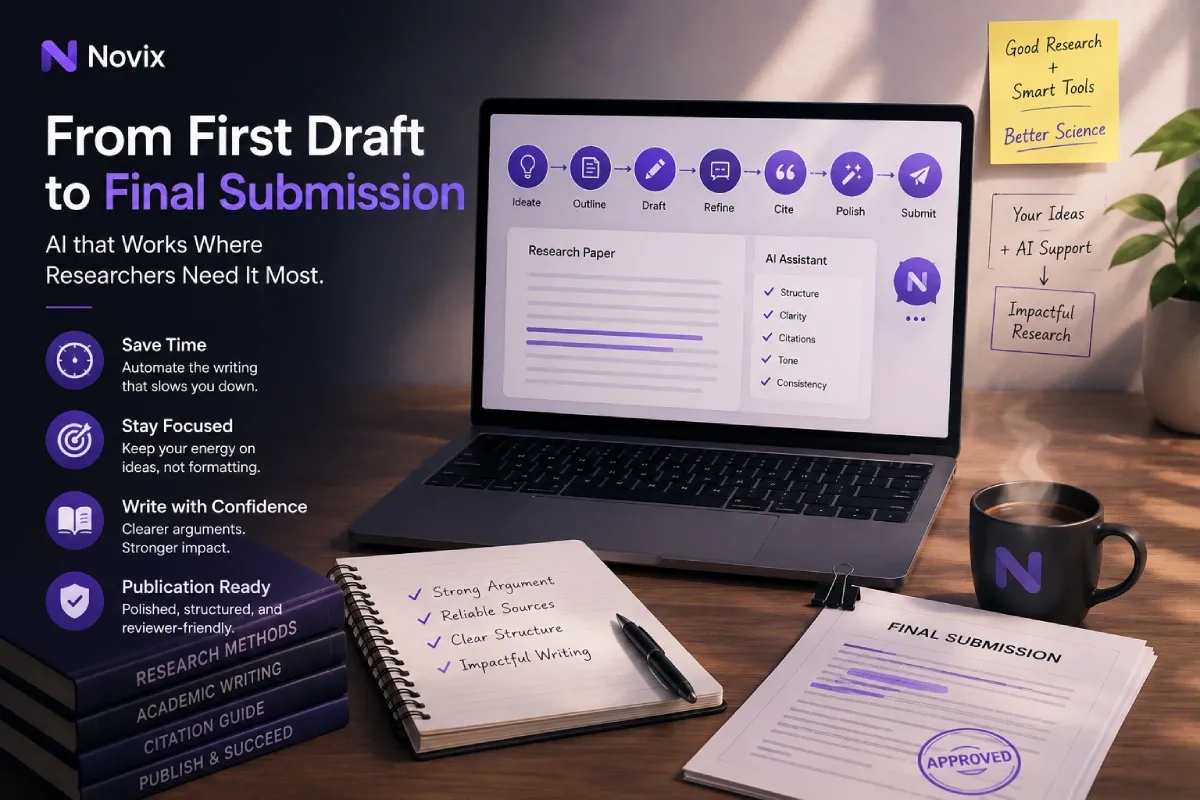
Writing eats a disproportionate share of research time. Surveys of academic scientists consistently show that drafting, revising, and reformatting manuscripts swallows somewhere between a quarter and a third of every project's hours — time that doesn't go into experiments, analysis, or new ideas. An AI tool for research papers is only useful if it actually reclaims some of that time without quietly introducing new problems into the finished manuscript.
This is a stage-by-stage walkthrough of where these tools genuinely help across the path from a blank page to a submission-ready draft — and where the human researcher still has to do the real work.
Stage 1: Turning results into a structured argument
Before a word of prose gets written, a paper needs a shape — an argument that connects your literature review, your methods, and your findings into something a reader can follow. This is where a lot of writing time actually gets lost, not in the sentences themselves. An AI tool that can take your hypotheses, methods, and results and propose a coherent structure saves real time here, because it's doing the organizational work that usually happens in your head, slowly, over several false starts.
Stage 2: Drafting the technical sections
Sections like methods and results tend to follow fairly standard conventions, which makes them a strong fit for AI-assisted drafting — the tool can generate a clean first version from your notes and data, which you then verify for accuracy. Sections like the discussion, where interpretation and argument matter more, benefit less from full automation and more from AI as a structuring aid around your own reasoning.
Stage 3: Verifying citations before they go anywhere near a submission
This is the stage where AI tools for research papers cause the most damage when misused. At NeurIPS 2025, an analysis of 4,841 accepted papers identified at least 100 hallucinated citations across the dataset — a reminder that even accepted, peer-reviewed papers aren't immune to AI-generated citation errors slipping through. Every citation an AI tool produces should be treated as a claim to verify, not a fact to trust. Check that the source exists, that it says what the tool claims it says, and that it's actually relevant to the point being made.
Stage 4: Editing for consistency across the whole document
A paper that reads well paragraph by paragraph can still be inconsistent as a whole — a claim in the introduction that the discussion quietly contradicts, or a method described one way early on and another way later. Strong AI tools can help catch these inconsistencies by reasoning across the full document rather than one section at a time, which is a genuinely useful check even for experienced writers.
Stage 5: Formatting and journal-specific requirements
Reformatting a manuscript for a different journal's citation style, section structure, or word limits is mechanical, tedious, and exactly the kind of task AI tools handle well with minimal risk — there's little room for hallucination in reformatting an existing, verified document.
Stage 6: Final human review before submission
No matter how capable the tool, the final read-through has to be a human one. This is where you're checking not just for errors but for whether the paper actually says what you mean, whether the argument holds together under scrutiny, and whether every AI-assisted claim has been independently verified.
A stage-by-stage risk map
| Stage | AI Tool Usefulness | Verification Needed |
|---|---|---|
| Structuring the argument | High | Medium — check logical flow |
| Drafting methods/results | High | Medium — verify against actual data |
| Drafting discussion/interpretation | Medium | High — argument and nuance are yours |
| Citations | High for speed, risky for accuracy | Very high — verify every source |
| Consistency editing | High | Medium — spot-check flagged issues |
| Formatting for submission | High | Low — mechanical, low-risk task |
How Novix approaches this end-to-end
Rather than treating manuscript writing as a standalone task disconnected from the rest of a project, Novix integrates the ideas, methods, algorithm frameworks, and validation results developed earlier in a project directly into the draft — so the technical sections are grounded in the same research record the hypotheses and experiments came from, rather than reconstructed from a summary.
What to never fully hand off to an AI tool
- The interpretation of your results. What a finding means, and how confidently to claim it, is a scientific judgment call.
- Final citation verification. Every source needs a human check before submission, regardless of how the tool sourced it.
- Disclosure decisions. Whether and how to disclose AI assistance is a policy question specific to your journal and institution.
- The final read-through. No tool should be the last set of eyes on a manuscript before it's submitted.
Frequently Asked Questions
Can an AI tool write an entire research paper on its own?
It can produce a full structured draft, but the interpretation, citation verification, and final review still require the researcher's judgment and accountability.
What's the safest stage to lean on AI most heavily?
Structural organization, technical drafting of standard sections, and formatting tend to carry the lowest risk. Discussion sections and citations require the most human oversight.
How common are AI-generated citation errors in published research?
Documented cases — including in accepted, peer-reviewed papers — show it happens even after review, which is why every AI-generated citation should be independently verified before submission.
Does using an AI tool for a research paper need to be disclosed?
Disclosure requirements vary by journal and institution — check your specific target venue's policy before submitting.