AI for Literature Review: How AI Co-Scientists Are Rewriting the Rules of Academic Research
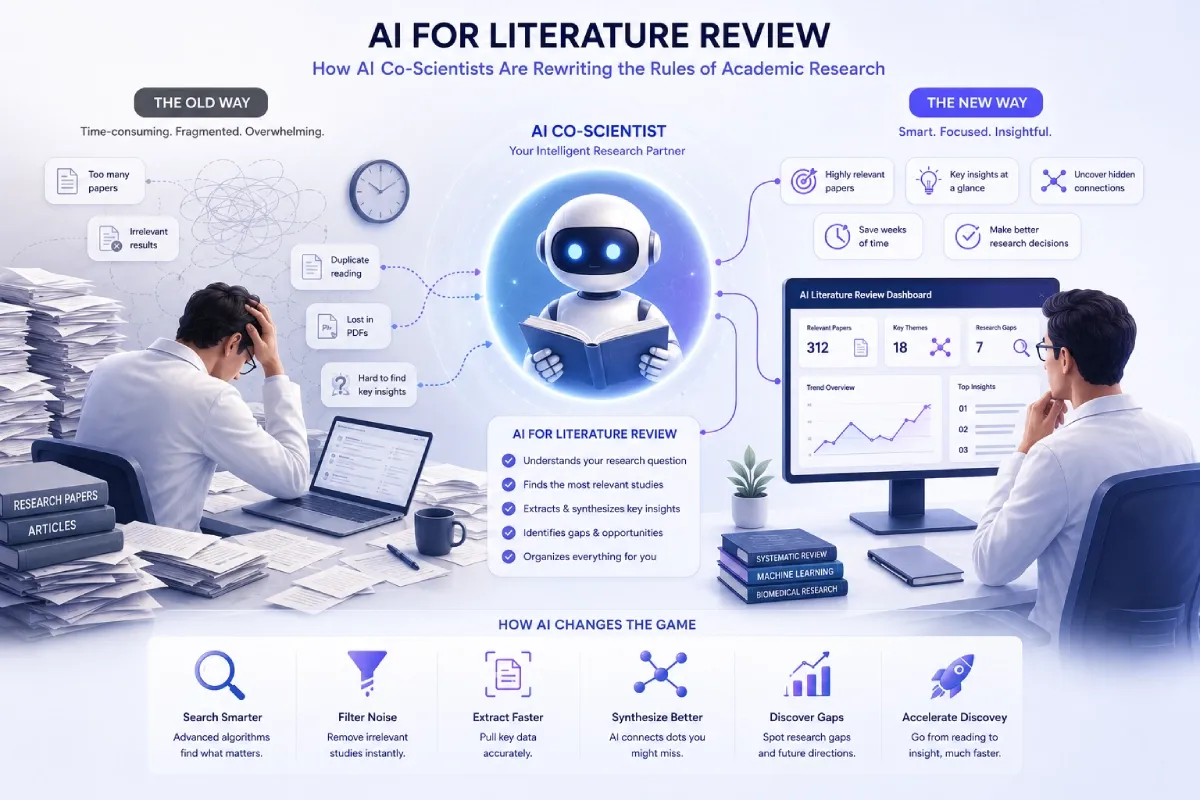
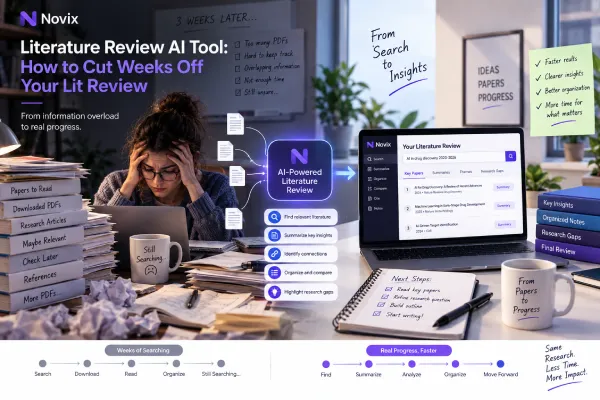
Every scientist knows the feeling. You sit down to "quickly scope" a new project, open Google Scholar, and three weeks later you're still drowning in PDFs, half-finished spreadsheets, and Zotero folders nested four levels deep. The literature review — supposedly the foundation of every research project — has quietly become its biggest bottleneck.
That bottleneck is now breaking open. AI for literature review is moving from novelty to standard practice in labs around the world, and the shift is changing not just how fast researchers can review the literature, but what they're able to discover at the end of it. In this guide, we'll unpack how AI literature review tools actually work, where they outperform manual methods, what to look for in a serious AI co-scientist, and how to integrate them into your workflow without sacrificing rigor.
The Literature Review Crisis Nobody Talks About
More than 5 million scientific papers are published every year. PubMed alone adds over a million new biomedical articles annually. For a researcher entering a new subfield, the realistic options used to be three: read for months, rely on a colleague's filtered view, or simply miss things.
This isn't just a productivity problem — it's a quality problem. Manual literature reviews are slow, biased toward whatever was published in journals you already follow, and almost impossible to keep current once your project starts. By the time a traditional systematic review reaches print, the field has often moved on. Knowledge gaps stay hidden. Promising cross-disciplinary connections go unnoticed. Reproducibility suffers because nobody can verify that an exhaustive review was actually exhaustive.
Manual literature review was designed for a publishing world that no longer exists. Something had to give.
What Is AI for Literature Review, Really?
AI for literature review refers to the use of large language models, retrieval-augmented systems, and autonomous research agents to do the heavy lifting of finding, reading, synthesizing, and summarizing scientific literature at scale. Crucially, modern tools go far beyond keyword search.
A first-generation AI search tool would return a list of papers that mention your query. An AI co-scientist behaves more like a junior collaborator: it understands the intent behind your research question, retrieves semantically relevant work (not just keyword matches), reads each paper, extracts methods and findings, cross-references claims, identifies contradictions, and hands you back a structured synthesis with citations you can verify.
The shift is from "AI as a faster search bar" to "AI as a reasoning partner." And it's that second category — the agentic systems — that's reshaping research workflows in 2026.
How AI Literature Review Tools Actually Work
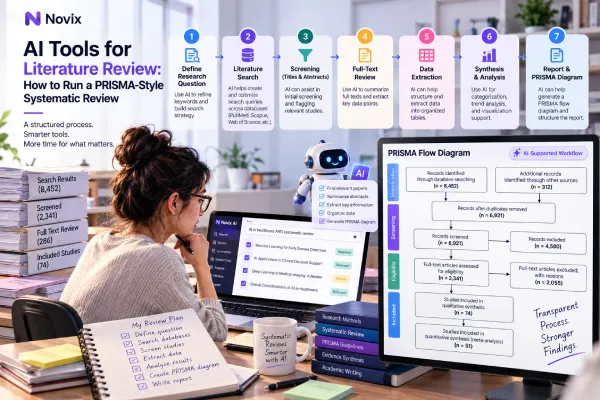
Under the hood, most serious AI literature review platforms combine four capabilities:
1. Semantic retrieval. Instead of matching keywords, the system embeds your query and every paper in a shared vector space, so it can find work that's conceptually related even when the terminology differs across fields. This is what lets an AI co-scientist surface a relevant materials-science paper for a question framed in biology.
2. Multi-document synthesis. Once relevant papers are retrieved, the model reads them in parallel, extracts structured information (hypotheses, methods, sample sizes, results, limitations), and synthesizes a coherent narrative rather than dumping summaries one by one.
3. Grounded citation. Every claim in the output should be tied back to the source paper. This is non-negotiable — an AI literature review tool that hallucinates citations is worse than useless. The best systems use retrieval-augmented generation (RAG) so every sentence is anchored to a verifiable source.
4. Gap and trend detection. This is where AI starts to outperform humans, not just match them. By analyzing patterns across thousands of papers, an AI co-scientist can identify unexplored intersections, methodological gaps, and emerging trends that a single researcher would need years to notice manually.
The Real Benefits of Using AI for Literature Review
A few of the gains are obvious. Most aren't.
- Speed. What used to take six weeks now takes an afternoon. Researchers using AI-powered literature review report cutting initial scoping time by 80% or more.
- Coverage. AI doesn't get tired at paper 200. It reads everything in your domain — including the 2014 paper in an adjacent field that turns out to hold the key to your problem.
- Reduced bias. Human reviewers unconsciously over-weight famous labs, English-language journals, and recent work. A well-designed AI literature review tool surfaces relevant work regardless of where it was published.
- Knowledge gap discovery. Instead of telling you what's been done, an AI co-scientist can tell you what hasn't been done — which is far more valuable when you're trying to define a novel research question.
- Living reviews. Because the system can re-run on demand, your literature review stays current as new papers are published, rather than freezing on the day you submitted.
- Better hypotheses. When you start from a comprehensive, structured synthesis of the field, the hypotheses you generate are sharper and more defensible.
The compound effect matters more than any single benefit. A researcher who reviews the literature in days instead of months runs more experiments per year, generates more hypotheses, and writes more papers — at higher quality.
What to Look for in a Serious AI Co-Scientist
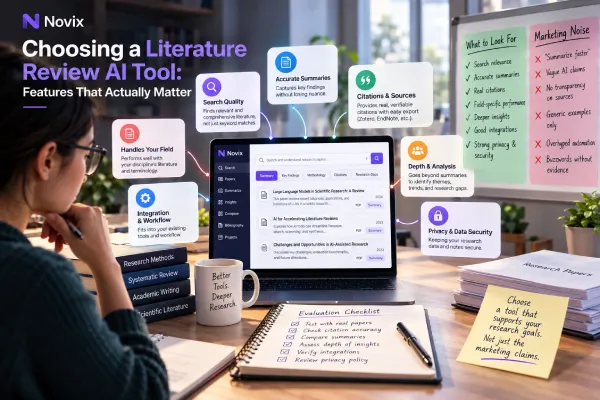
Not every tool calling itself "AI research assistant" deserves the title. Before you adopt one for your lab, check for:
- Verifiable citations. Every claim should link to a real, retrievable paper. If you can't audit the source, walk away.
- Domain breadth. Does it cover preprints, paywalled literature, and non-English sources, or just open-access abstracts?
- Synthesis depth. Can it produce a structured review with methods, findings, and limitations — or just bullet-point summaries?
- Gap and trend analysis. This is the feature that separates true AI co-scientists from glorified search engines.
- Workflow integration. Can the output flow into your next step — experimental design, manuscript drafting, data analysis — or do you have to copy-paste into another tool?
- Transparency. You should be able to see why a paper was retrieved and how a conclusion was reached.
Novix's Deep Survey is built around exactly these requirements: it automatically scans, synthesizes, and summarizes scientific literature at scale, surfaces knowledge gaps and emerging research trends, and feeds directly into the rest of the Novix research pipeline — from hypothesis generation to experimental design to manuscript drafting.
Real-World Applications Across Disciplines
The pattern repeats across fields. In biomedical research, AI literature review is being used to map drug-target interactions, identify under-explored therapeutic pathways, and pre-screen candidates for systematic reviews. In materials science, it's accelerating the search for novel compounds by surfacing relevant prior work across chemistry, physics, and engineering simultaneously. In machine learning research itself, where the literature doubles every couple of years, agentic systems are now indispensable for tracking the state of the art.
What unites these use cases is that the value of AI for literature review scales with the velocity and breadth of the field. The faster and broader your domain, the more an AI co-scientist saves you.
Getting Started Without Overhauling Your Workflow
You don't need to rebuild your research process to benefit from AI for literature review. A reasonable on-ramp:
- Pick one upcoming project that needs a literature scope.
- Run it through an AI literature review tool alongside your normal process.
- Compare what each surfaces — especially the papers your manual search missed.
- Iterate from there.
Most researchers find that within two or three projects, the AI workflow becomes the default and the manual one becomes the spot-check. The point isn't to replace your judgment — it's to give your judgment more raw material to work with.
The Takeaway
AI for literature review isn't a niche productivity hack. It's a structural change in how science gets done. Researchers who adopt agentic AI co-scientists are reviewing more literature, finding better gaps, and generating sharper hypotheses than their peers working manually — and the gap is widening every quarter.
The good news is that the tools have finally caught up to the promise. Try Deep Survey by Novix on your next project and see how much of your "reading week" you can get back.
Frequently Asked Questions
How does AI improve the literature review process in scientific research?
AI improves the literature review process by automatically finding, reading, organizing, and synthesizing thousands of research papers in a fraction of the time required for manual review. Modern AI co-scientists can also identify research gaps, detect trends, and provide grounded citations for verification.
Can AI literature review tools replace human researchers?
No, AI literature review tools are designed to assist researchers, not replace them. They help scientists save time, expand literature coverage, and uncover hidden connections, while human researchers still provide critical thinking, interpretation, and scientific judgment.
What features should researchers look for in an AI literature review tool?
Researchers should look for features such as verifiable citations, semantic search, multi-document synthesis, gap analysis, workflow integration, and transparent reasoning. A reliable AI co-scientist should help researchers validate findings rather than generate unsupported summaries.
Why is AI for literature review becoming essential in 2026?
The number of published scientific papers is growing too quickly for manual review methods to keep up. AI for literature review helps researchers stay current, reduce bias, accelerate hypothesis generation, and conduct more comprehensive reviews across multiple disciplines.