AI Agent for Scientific Research: 7 Ways It Changes How Labs Work in 2026
Labs don't adopt new tools because the tools are interesting. They adopt them because something about the daily workflow was genuinely broken — too much time on literature, too much manual coordination, too much lag between an idea and a testable version of it. The shift toward using an AI agent for scientific research is happening for that reason, not because "AI" is a buzzword worth chasing.
Here are seven concrete, practical ways this shift is showing up in how labs actually operate in 2026 — not speculative future scenarios, but changes already visible in how research teams structure their work.
1. Literature review stops being a multi-week bottleneck
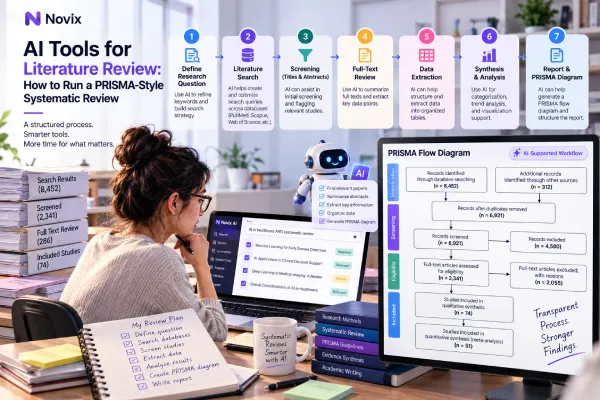
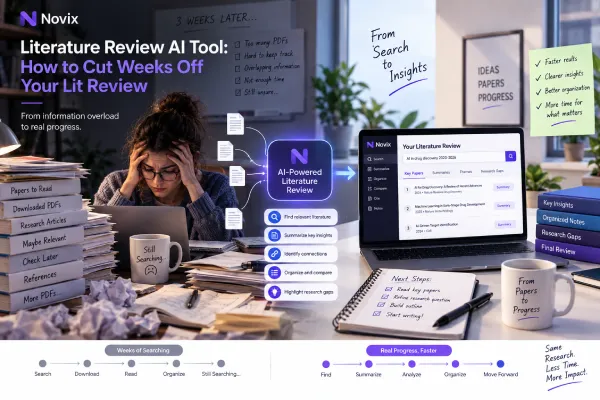
The traditional lit review — weeks of reading, note-taking, and synthesis before a project can really begin — is compressing dramatically. An AI agent can scan and synthesize large volumes of literature to surface gaps and trends in a fraction of the time, turning what used to be a standalone phase into something closer to a fast, ongoing background process.
2. Hypothesis generation becomes a starting point, not a bottleneck
Instead of researchers generating every candidate hypothesis from scratch, an agent can propose data-driven hypotheses grounded in identified literature gaps. The researcher's role shifts from generating every option to evaluating and selecting among a stronger, pre-filtered set — a meaningful change in where human time actually goes.
3. Experiment design gets a first draft, not a blank page
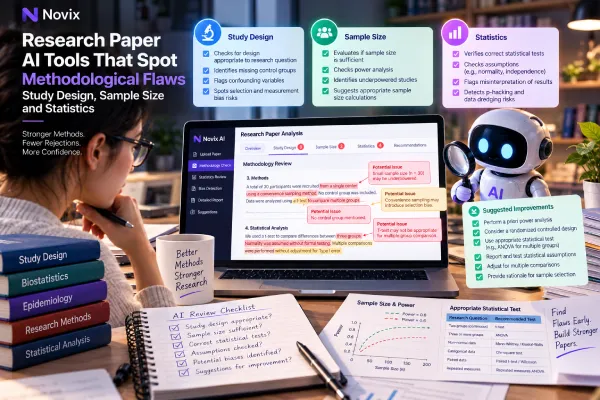
Designing a rigorous experimental protocol — methodology, statistical approach, validation framework — takes real expertise and real time. An agent that can draft a first version of that protocol changes the task from "design from nothing" to "review and refine," which is a faster and often more rigorous starting point.
4. Data analysis moves from a separate specialty to an integrated step
Labs have historically needed a dedicated statistician or data scientist to turn raw results into clean analysis and publication-ready figures. Agents capable of running statistical analysis and generating visualizations directly reduce that dependency, letting smaller teams handle analysis that once required a specialist handoff.
5. Manuscript drafting starts earlier in the project, not after it
Writing has traditionally been the final, separate phase of a project — started only once everything else is done. When an agent can assemble a structured draft from the hypotheses, methods, and results already recorded, drafting can start incrementally throughout the project instead of beginning cold at the end.
6. Coordination overhead across a research pipeline drops
Historically, moving a project from literature review to experiment to analysis to writing meant handoffs — often between different tools, sometimes between different people. A multi-agent system that carries a project across those stages reduces the friction of every handoff, since the same coordinated system tracks the project throughout.
7. Human researchers spend more time on judgment, less on logistics
Perhaps the most significant shift: as agents absorb the mechanical parts of research — searching, summarizing, drafting first versions — researchers are spending a larger share of their time on the parts that actually require expertise: evaluating whether a hypothesis is genuinely interesting, deciding whether a result is meaningful, and making the judgment calls no AI system should make unsupervised.
What this looks like with Novix specifically
Novix is built around exactly this shift. Its multi-agent architecture handles idea generation, literature synthesis, method design, data analysis, and manuscript drafting as a coordinated workflow rather than isolated tools — which is why labs adopting it tend to describe the change less as "we got a new tool" and more as "our whole project timeline compressed."
A before-and-after snapshot
| Stage | Traditional Workflow | With an AI Research Agent |
|---|---|---|
| Literature review | 2–4 weeks of manual reading | Synthesized in a fraction of the time |
| Hypothesis generation | Entirely manual brainstorming | Agent proposes data-driven candidates |
| Experiment design | Drafted from scratch | First draft generated, then refined |
| Data analysis | Often requires a specialist handoff | Handled within the same workflow |
| Manuscript writing | Begins after everything else is done | Builds incrementally throughout the project |
| Coordination | Manual handoffs between tools/people | Tracked within one system |
What doesn't change — and shouldn't
None of this removes the need for human scientific judgment. Interpreting whether a result is meaningful, deciding which hypothesis is actually worth pursuing, and taking responsibility for what gets published all remain squarely human. The value of an AI agent for scientific research isn't that it replaces this judgment — it's that it clears away enough of the mechanical work that more time is actually available for it.
Frequently Asked Questions
Does adopting an AI research agent mean fewer researchers are needed on a project?
Not typically. Most labs report that the time saved gets redirected into deeper analysis and more ambitious projects, rather than reducing headcount.
How steep is the learning curve for a lab adopting an AI research agent?
Well-designed agents are built for accessibility — accepting a research goal or reference papers as a starting point rather than requiring a technical setup — which keeps the learning curve relatively shallow.
Can an AI agent handle discipline-specific research methods?
Agents like Novix are built to generalize across scientific domains, though the quality of output still depends on how well-defined the research goal and literature base are.
Is this shift specific to well-funded labs, or does it apply to smaller teams too?
If anything, smaller teams and individual researchers often see the largest relative time savings, since they don't have specialist staff to absorb the mechanical parts of the workflow.