AI Agent for Data Analysis: How It Supports Modern Research Workflows
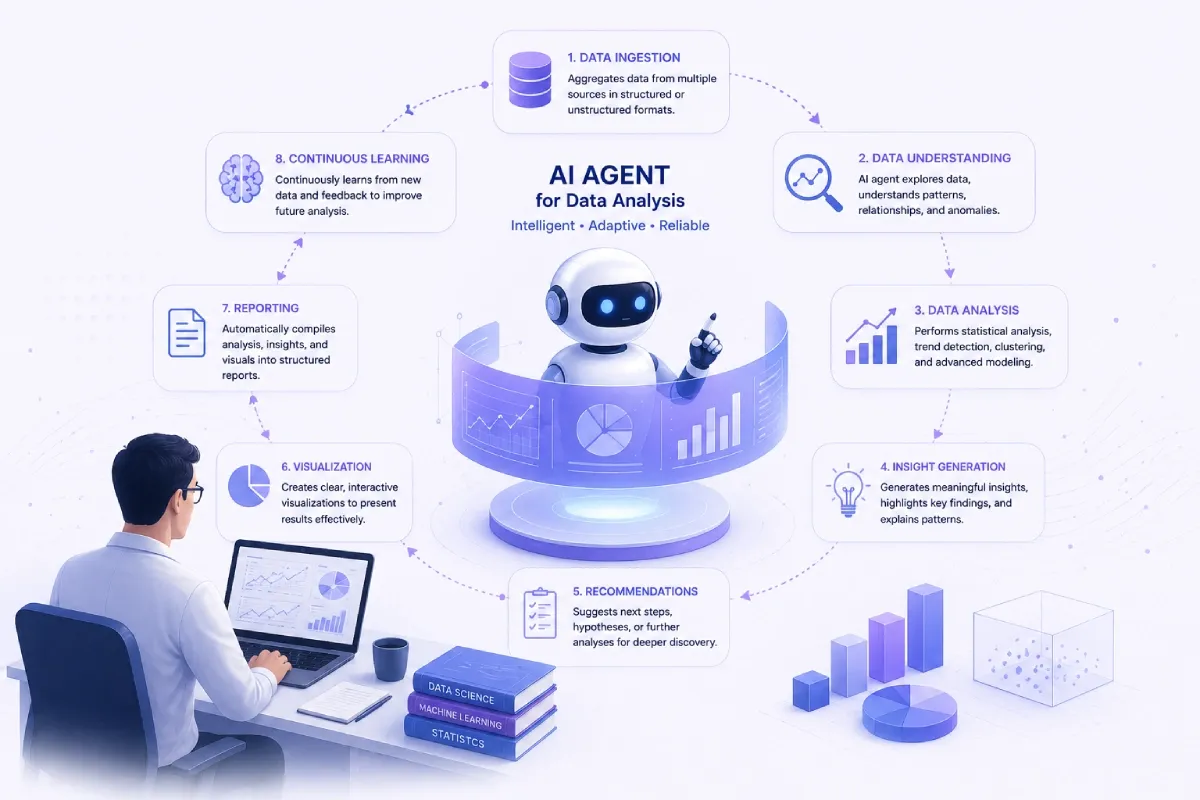
Data has become the backbone of modern scientific research. From experimental results and simulations to large-scale datasets, researchers are increasingly required to analyze complex information with accuracy and speed.
However, as datasets grow in size and complexity, traditional analysis methods alone are often not enough. This is where the concept of an AI agent for data analysis is gaining attention.
Unlike conventional tools that require manual execution of tasks, AI agents assist researchers by interpreting data, suggesting insights, and supporting analytical reasoning. When used responsibly, they can significantly enhance research workflows without compromising scientific rigor.
What Is an AI Agent for Data Analysis?
An AI agent for data analysis is a system designed to assist researchers in understanding and interpreting data.
It typically performs functions such as:
- Exploring datasets
- Identifying patterns and relationships
- Supporting statistical reasoning
- Translating complex outputs into understandable insights
Unlike traditional analytics tools, AI agents do not just process data—they help researchers think through data.
Why Data Analysis Is Becoming More Challenging
Modern research involves increasingly complex datasets due to:
- Advanced experimental methods
- High-throughput technologies
- Interdisciplinary research approaches
- Large-scale simulations and models
Researchers often face challenges such as:
- Interpreting large volumes of data
- Identifying meaningful patterns
- Connecting data insights with theoretical frameworks
- Communicating results clearly
AI agents are emerging as a way to address these challenges by providing support at the interpretation level.
Key Roles of AI Agents in Data Analysis
1. Data Interpretation Support
AI agents help researchers make sense of results by:
- Explaining trends and relationships
- Highlighting anomalies or patterns
- Providing context for data outputs
This is particularly useful when working with complex or unfamiliar datasets.
2. Assisting Exploratory Analysis
Exploratory data analysis is a critical step in research. AI agents assist by:
- Suggesting potential directions for analysis
- Helping researchers ask better questions
- Identifying areas worth deeper investigation
This accelerates the early stages of research.
3. Connecting Data With Research Context
Data alone does not provide meaning—it must be interpreted within a scientific framework.
AI agents support this by:
- Linking data insights with existing knowledge
- Clarifying assumptions behind interpretations
- Helping researchers evaluate the relevance of findings
4. Supporting Communication of Results
Explaining data clearly is as important as analyzing it.
AI agents help researchers:
- Translate complex outputs into clear explanations
- Structure findings logically
- Improve clarity in research writing
This improves both internal understanding and external communication.
5. Reducing Manual Effort
AI agents reduce the time spent on repetitive tasks such as:
- Initial data exploration
- Pattern identification
- Basic interpretation
This allows researchers to focus more on critical thinking and decision-making.
Benefits of Using AI Agents for Data Analysis
When used correctly, AI agents offer several advantages:
Increased Efficiency
They reduce time required for initial analysis and interpretation.
Improved Clarity
They help simplify complex data without losing meaning.
Better Decision Support
They assist researchers in evaluating results and identifying next steps.
Enhanced Productivity
They allow researchers to focus on higher-level analysis and innovation.
Limitations and Considerations
Despite their benefits, AI agents have important limitations:
Not a Replacement for Statistical Expertise
AI agents cannot replace rigorous statistical methods or domain knowledge.
Dependence on Data Quality
Poor data leads to unreliable outputs.
Risk of Misinterpretation
AI-generated insights must always be validated.
Ethical and Responsible Use
Researchers must ensure transparency and accuracy in their work.
AI agents should be used as support tools—not decision-makers.
Role of Novix in Data Analysis Workflows
Novix is designed to support researchers not only in literature and writing but also in data interpretation and reasoning.
As a research-focused platform, Novix helps:
- Interpret analytical outputs
- Clarify patterns and trends
- Connect data insights with research context
- Improve clarity in presenting results
Unlike generic tools, Novix emphasizes structured reasoning and scientific alignment, making it suitable for research environments.
Researchers use Novix to enhance their understanding of data without compromising analytical rigor.
AI Agents vs Traditional Data Analysis Tools
AI agents complement traditional tools rather than replace them.
The Future of AI in Data Analysis
The role of AI agents in data analysis is expected to grow as research becomes more data-intensive.
Future developments may include:
- Better integration with analytical tools
- More domain-specific AI systems
- Improved transparency in reasoning
- Enhanced collaboration between humans and AI
The focus will remain on augmenting human expertise, not replacing it.
Frequently Asked Questions
What is an AI agent for data analysis?
An AI agent for data analysis is a system that helps researchers interpret data, identify patterns, and support analytical reasoning.
Can AI replace data analysis in research?
No. AI supports data analysis but does not replace statistical methods, expertise, or validation.
How do AI agents help researchers?
They reduce manual effort, improve clarity, and assist in understanding complex datasets.
Is Novix useful for data analysis?
Yes. Novix helps researchers interpret data, connect insights with research context, and improve clarity in analysis and communication.