AI Agent for Research Data Analysis: Accelerating Scientific Discovery

Challenges in Modern Research Data Analysis
Modern research generates increasingly massive and complex datasets, creating bottlenecks that traditional tools cannot handle efficiently.
Managing Massive Datasets Efficiently
Experiments today can generate terabytes of data. Genomic studies produce millions of sequences, climate models output petabytes of simulation data, and particle physics experiments capture billions of events.
Research Reality: A single neuroimaging study can produce over 500GB of raw data per participant, requiring complex processing pipelines.
Reducing Time-Intensive Data Cleaning
Raw datasets are rarely analysis-ready. Missing values, errors, and format inconsistencies must be addressed before statistical modeling. Studies indicate researchers spend 50-80% of analysis time on data cleaning rather than actual analysis.
Meeting Advanced Statistical Demands
Modern research requires sophisticated analytical techniques—machine learning, multivariate modeling, Bayesian inference, and simulations. Many teams lack the expertise to implement these methods correctly.
Ensuring Reproducibility in Complex Workflows
Poor documentation, inconsistent procedures, and missing version control contribute to science's reproducibility crisis—a major challenge across disciplines.
Integrating Interdisciplinary Datasets
Combining data from multiple sources, such as genomics, clinical outcomes, and imaging, requires harmonization that traditional tools struggle to support.
How AI Enhances Scientific Data Analysis
AI addresses these challenges with automation, machine learning, and intelligent workflow integration designed for research.
Automated Data Cleaning and Validation
AI platforms detect anomalies, impute missing values, correct format inconsistencies, and standardize data across sources automatically. Impact: Data preparation time is reduced from weeks to days.
Advanced Pattern Recognition
Machine learning identifies complex, non-linear patterns across thousands of variables—insights that traditional methods often miss. AI tools also perform automated model validation, democratizing sophisticated analyses for researchers without advanced coding skills.
Real-Time Interactive Analysis
Unlike traditional workflows, AI enables dynamic exploration. Researchers visualize patterns as they emerge, adjust parameters, and explore multiple analytical approaches iteratively—significantly accelerating discovery.
Workflow Integration
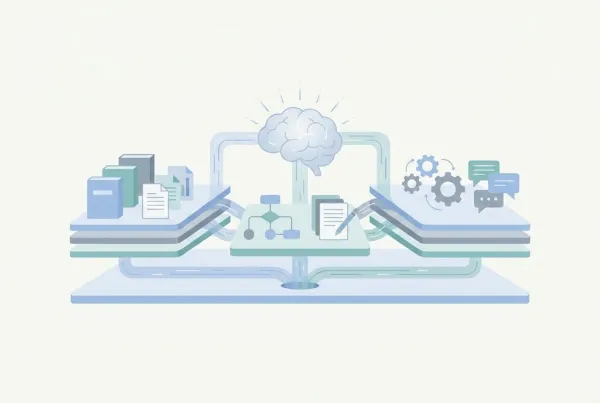
AI platforms create integrated environments connecting analysis with literature review, manuscript preparation, and project management. Every analytical step is automatically documented, versioned, and reproducible.
Key Benefits of AI for Research Data Analysis
Faster Scientific Discovery
AI accelerates routine tasks, enabling researchers to test more hypotheses and explore alternative models rapidly.
Research Impact:
- Stanford genomics lab: variant analysis reduced from 3 weeks to 2 days
- MIT environmental team: 15 years of climate data analyzed in 6 hours vs. 4 months
- Neuroscience consortium: brain imaging processed 50x faster
- Pharmaceutical group: drug interaction analysis cut by 75%
Enhanced Accuracy and Reliability
Automated validation ensures consistent procedures, reduces human error, and catches mistakes before results are compromised.
Impact: Teams report 45% improved accuracy and 80% fewer computational errors.
Unprecedented Scalability
AI enables analysis of entire datasets, not just samples, uncovering patterns that traditional methods may miss and allowing researchers to tackle previously infeasible questions.
Streamlined Reproducibility
Automated documentation creates transparent audit trails that support replication and open science practices.
Enhanced Collaboration
Cloud-based AI platforms allow seamless sharing of datasets, analytical code, and results, enabling synchronized contributions from multiple researchers.
Best Practice Note: AI accelerates analysis but requires quality input data and human oversight. Scientists interpret patterns, ensuring meaningful results.
Novix Science: Your Research Analysis Partner
Novix offers a comprehensive AI-powered platform tailored for research data analysis challenges.
Intelligent Data Processing
Handles diverse formats automatically, applies smart cleaning with validation, and prepares analysis-ready datasets in minutes. Integration with literature management ensures adherence to best practices.
Advanced Analytical Capabilities
Provides cutting-edge statistical methods and machine learning tools accessible to all researchers, with options for advanced users to implement custom workflows.
Real-Time Exploration
Dynamic dashboards enable visualization of emerging patterns, parameter adjustment on-the-fly, and iterative analysis.
Comprehensive Reproducibility
Every step is fully documented, with complete histories, publication-ready methods, and shareable pipelines.
Seamless Integration
Connects analysis with literature review, manuscript preparation, and project management, creating unified research workflows.
Real-World Impact
- "Novix Science transformed our genomics pipeline. What took 6 months now takes 3 weeks, and our statistical power improved significantly." — Dr. Sarah Chen, Cancer Genomics Consortium Lead
- "We analyzed 30 years of multi-modal climate data in days instead of years. The reproducibility features ensure transparency." — Prof. Michael Torres, Climate Research Network
- "Data processing time dropped 85% while result reproducibility increased. Novix Science is now essential to our workflow." — Dr. Aisha Patel, Neuroscience Collaboration Director
Practical Tips for AI Data Analysis
- Define clear objectives: Articulate hypotheses and key variables before starting automated analysis.
- Validate outputs: Test AI tools on benchmark datasets to build confidence.
- Combine automation with expertise: Use AI for computation and pattern recognition; scientists interpret results.
- Explore iteratively: Test multiple models and alternative hypotheses.
- Document workflows: Leverage automated documentation and share pipelines for open science.
- Integrate your workflow: Connect analysis across literature review, writing, and project management with Novix Science.
Frequently Asked Questions (FAQs)
Q1: What are AI tools for research data analysis?
AI tools automate data cleaning, modeling, and pattern recognition, allowing faster, more accurate analysis and improved reproducibility.
Q2: How do AI tools improve accuracy?
By automating validation and workflow documentation, AI reduces human error and ensures consistent methodology.
Q3: Can AI handle massive datasets?
Yes. AI processes datasets hundreds of times larger than traditional tools, uncovering complex patterns.
Q4: How does Novix Science integrate with research workflows?
Novix connects analysis with literature review, manuscript preparation, and project management, creating seamless end-to-end workflows.
Q5: Do researchers still need expertise when using AI?
Absolutely. AI identifies patterns, but human interpretation is essential for meaningful scientific insights.
Conclusion
AI-powered data workflows transform research methodology by automating preparation, providing sophisticated analytics, enabling unprecedented scale, and ensuring reproducibility. Platforms like Novix Science integrate these capabilities across the research lifecycle, allowing scientists to focus on discovery rather than logistics.
The future of scientific progress depends on efficiently extracting insights from complex datasets. AI ensures that researchers can accelerate discovery without compromising rigor.
Analyze Your Research Data 100% Faster
Start your free trial with Novix Science today. Experience automated cleaning, advanced analytics, and AI-powered insights that transform your research workflow.